
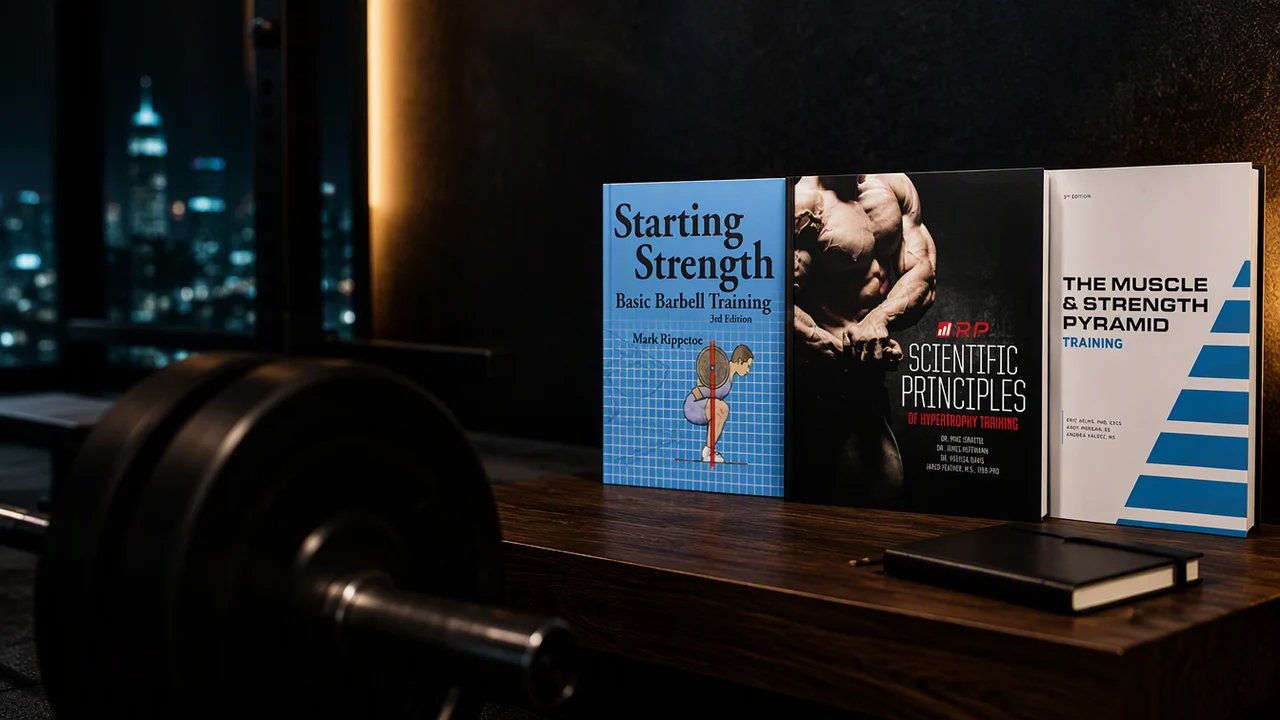
Top 8 Best Strength Training Books: Programs That Actually Work for Muscle Gain (2026)
The best strength training books ranked by program quality and progression logic - the evidence-based programming manuals and canonical programs that actually get you stronger, with theory and reference classics scored honestly.
8 picks — ranked by our 50/50 methodology
Compare all 8 picks side by sidefull score breakdown · strength & weakness · price
| Product | Score | Program quality & progression35% | Evidence & author authority30% | Actionability25% | Value & readability10% | Price & buy |
|---|---|---|---|---|---|---|
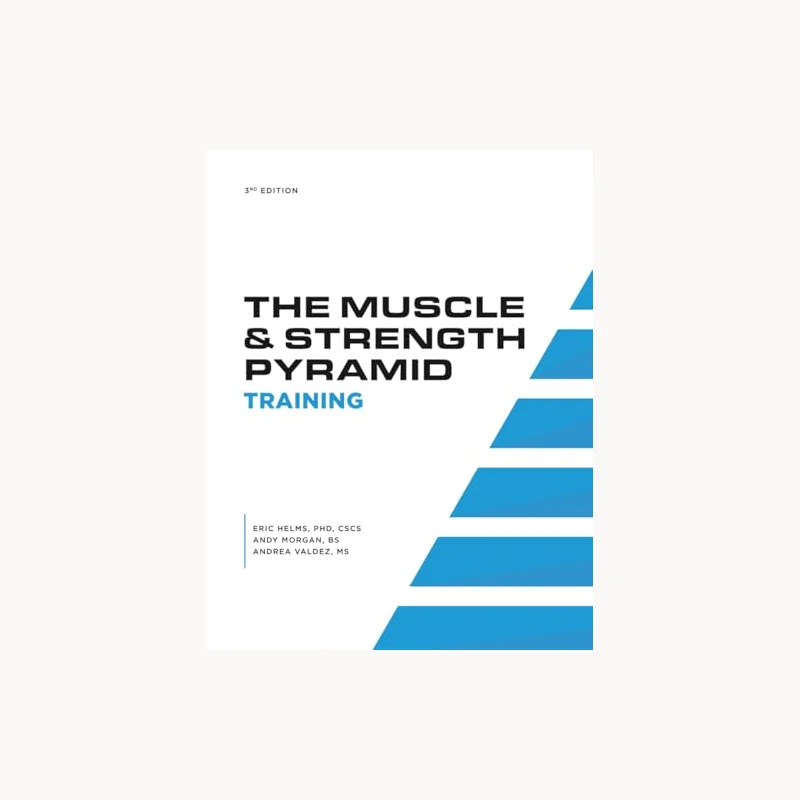 #1 The Muscle and Strength Pyramid: Training — Eric Helms, PhDBest overall #1 The Muscle and Strength Pyramid: Training — Eric Helms, PhDBest overall | 9.4 | 9.61 | 9.71 | 9.03 | 8.6 | Paperback ~$41On Amazon |
+Puts the variables in the researched priority order — adherence, volume, intensity, frequency — before any detail work−Priciest of the program books (~$41) — the value is real, but the entry cost is the highest in the top five | ||||||
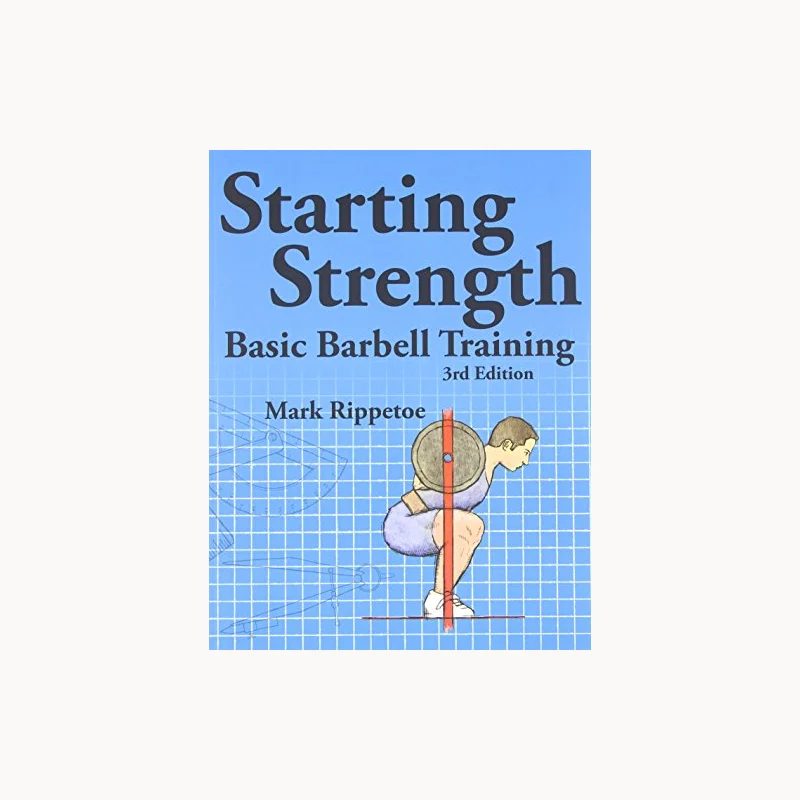 #2 Starting Strength: Basic Barbell Training — Mark RippetoeBest for beginners #2 Starting Strength: Basic Barbell Training — Mark RippetoeBest for beginners | 9.2 | 9.32 | 9.0 | 9.51 | 9.02 | Paperback ~$23On Amazon |
+The definitive technique instruction for the five big barbell lifts — hundreds of pages of mechanics and cues−Deliberately narrow: five lifts, one progression — hypertrophy-focused lifters will outgrow the program (not the technique chapters) | ||||||
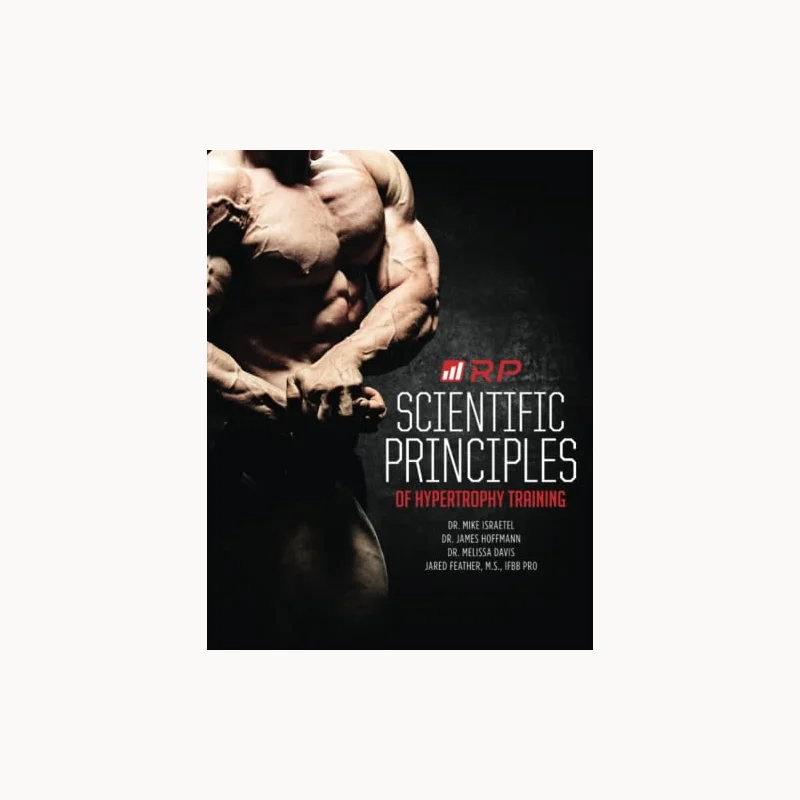 #3 Scientific Principles of Hypertrophy Training — Israetel, Hoffmann, Davis et al.Best deep-dive #3 Scientific Principles of Hypertrophy Training — Israetel, Hoffmann, Davis et al.Best deep-dive | 9.0 | 9.23 | 9.53 | 8.3 | 8.4 | Paperback ~$38On Amazon |
+The clearest treatment of volume landmarks (MV, MEV, MAV, MRV) — the practical layer on top of the dose-response research−A framework more than a follow-along plan — you assemble the final program, which novices shouldn't be doing yet | ||||||
 #4 Bigger Leaner Stronger — Michael MatthewsBest mainstream start #4 Bigger Leaner Stronger — Michael MatthewsBest mainstream start | 8.8 | 8.7 | 8.2 | 9.42 | 9.21 | Paperback ~$20On Amazon |
+Complete package: a sound heavy-compound program AND the energy-balance/protein math in one accessible read−Author authority is practitioner-tier, not researcher/coach-legend tier — solid synthesis, less pedigree than Helms or Rippetoe | ||||||
 #5 5/3/1: The Simplest and Most Effective Training System — Jim WendlerBest long-term system #5 5/3/1: The Simplest and Most Effective Training System — Jim WendlerBest long-term system | 8.6 | 8.9 | 8.0 | 9.03 | 8.83 | Paperback ~$27On Amazon |
+The most sustainable progression model in print: conservative training maxes + monthly cycles that survive bad weeks−Deliberately slow: an actual novice leaves gains on the table versus per-session progression (run Starting Strength first) | ||||||
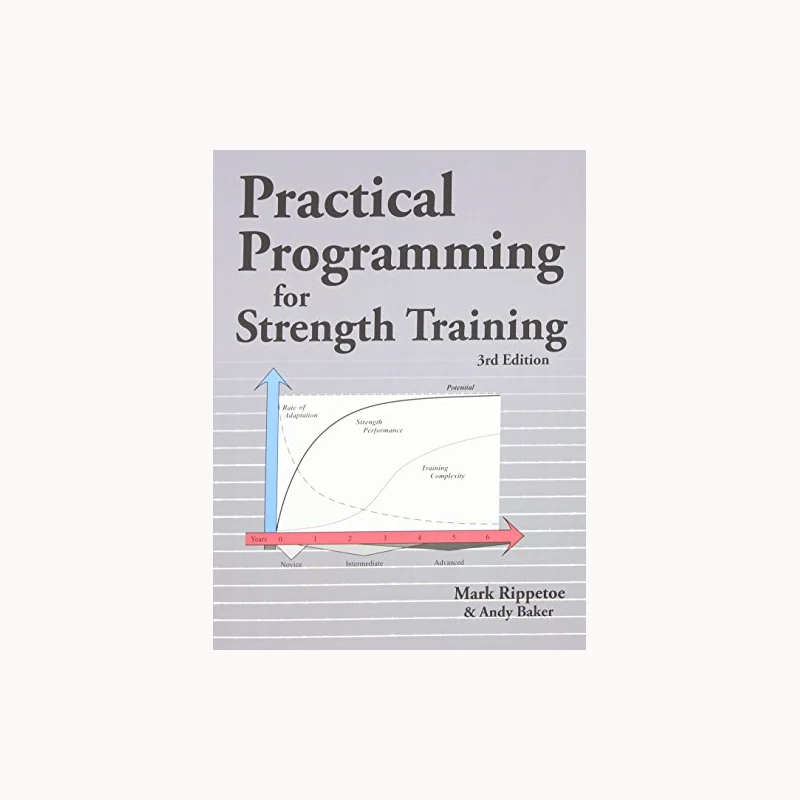 #6 Practical Programming for Strength Training — Rippetoe & BakerBest programming theory #6 Practical Programming for Strength Training — Rippetoe & BakerBest programming theory | 8.5 | 8.8 | 8.9 | 7.8 | 8.2 | Paperback ~$24On Amazon |
+The definitive treatment of training ages: why per-session progress ends and what weekly/monthly progression looks like−Strength-centric: hypertrophy programming gets far less attention than in the Pyramid (#1) or Scientific Principles (#3) | ||||||
 #7 Science and Practice of Strength Training — Zatsiorsky & KraemerBest academic reference #7 Science and Practice of Strength Training — Zatsiorsky & KraemerBest academic reference | 8.0 | 8.0 | 9.62 | 6.8 | 6.5 | Hardcover ~$89On Amazon |
+The deepest author pedigree on the list — Soviet sports science meets decades of Western research−A textbook in structure and price (~$89) — you study it, you don't 'read' it | ||||||
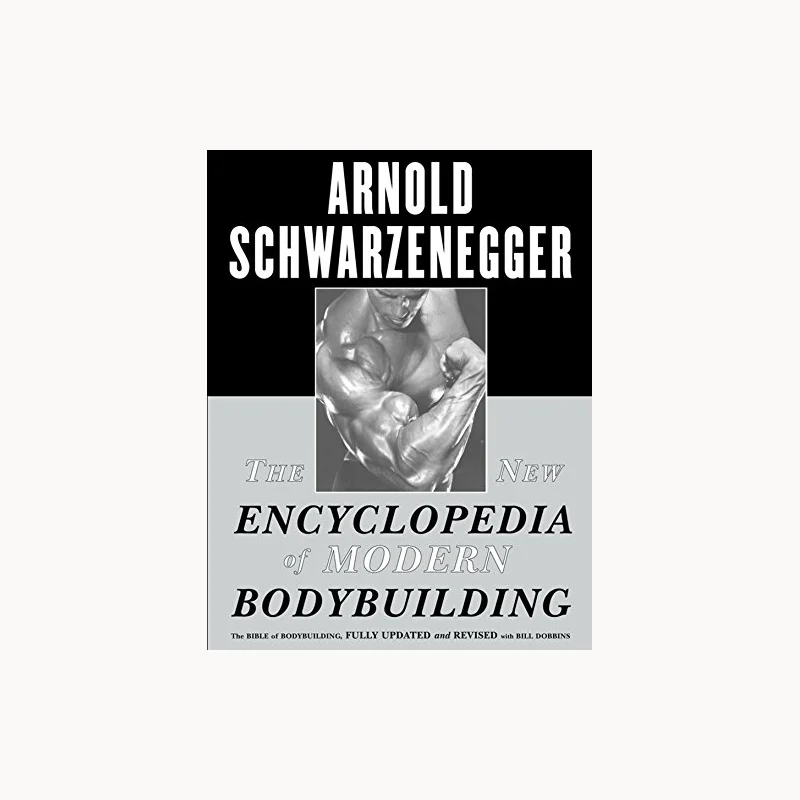 #8 The New Encyclopedia of Modern Bodybuilding — Arnold SchwarzeneggerBest classic #8 The New Encyclopedia of Modern Bodybuilding — Arnold SchwarzeneggerBest classic | 7.6 | 7.4 | 7.2 | 8.0 | 8.5 | Paperback ~$23On Amazon |
+The most comprehensive exercise reference in print — hundreds of movements with Arnold's own execution notes−The high-volume splits reflect a different era and a pharmacological context most readers don't share — run a modern program instead | ||||||
- #1Best overall
The Muscle and Strength Pyramid: Training — Eric Helms, PhD
3rd edition · Eric Helms, Andy Morgan, Andrea Valdez9.4/10SAC Product Score™SAC Product Score™ — how it breaks down- Program quality & progression35%9.6
- Evidence & author authority30%9.7
- Actionability25%9.0
- Value & readability10%8.6
The evidence-based programming manual: training variables in the researched order of importance, turned into templates from novice to advanced.
- Authors
- Eric Helms, PhD, CSCS · Andy Morgan · Andrea Valdez, MS
- Format
- Programming manual + complete templates
- Level
- Novice to advanced — grows with you
- Best for
- Muscle-focused lifters who want research-grade programming
Pros- Puts the variables in the researched priority order — adherence, volume, intensity, frequency — before any detail work
- Programming model tracks the volume dose-response evidence (Schoenfeld 2017) directly
- Concrete templates for every training age, plus RPE-based autoregulation you can grow into
- Helms is the rare author who is an active researcher AND a working natural-bodybuilding coach
Cons- Priciest of the program books (~$41) — the value is real, but the entry cost is the highest in the top five
- Light on barbell technique teaching — a true novice should learn the lifts from Starting Strength (#2) alongside it
Our take — If you buy one training book, make it this one. The Pyramid's core insight — that the variables have a researched order of importance, and most lifters obsess over the bottom of the pyramid while neglecting the top — reorganises how you think about training, and the book backs it with concrete templates you can run from your first intermediate program to advanced work. Eric Helms writes as both active researcher and working coach, which is exactly the combination this list exists to reward. Honest caveats: it's the most expensive program book here, and it won't teach you to squat — pair it with Starting Strength's technique chapters if you're new to the barbell. As a programming reference, nothing in print currently beats it.
- #2Best for beginners
Starting Strength: Basic Barbell Training — Mark Rippetoe
3rd edition · Mark Rippetoe, illustrated by Jason Kelly9.2/10SAC Product Score™SAC Product Score™ — how it breaks down- Program quality & progression35%9.3
- Evidence & author authority30%9.0
- Actionability25%9.5
- Value & readability10%9.0
The canonical novice barbell program wrapped in the best technique teaching ever put in print — the fastest route from zero to strong.
- Author
- Mark Rippetoe — 40+ years coaching the barbell lifts
- Format
- Technique manual + the novice linear progression
- Level
- Novice — deliberately and unapologetically
- Best for
- Learning squat, press, deadlift, bench, power clean properly
Pros- The definitive technique instruction for the five big barbell lifts — hundreds of pages of mechanics and cues
- The simplest effective program in existence: add weight every session while your novice recovery allows it
- Actionable from day one — you can read the squat chapter today and train tonight
- At ~$23, the best value-per-strength-gained purchase in print
Cons- Deliberately narrow: five lifts, one progression — hypertrophy-focused lifters will outgrow the program (not the technique chapters)
- The surrounding-era diet advice (GOMAD for skinny trainees) has aged badly; take the barbell teaching, skip the gallon of milk
Our take — Still the canonical beginner book, and it isn't close. Starting Strength does two jobs better than anything else in print: it teaches the barbell lifts with a depth of mechanical reasoning no video can match, and it hands a novice the simplest program that works — add weight every session and ride the fastest progress of your training life. The honest limits: it optimizes the bar rather than the mirror, the program has a definite shelf life (every novice progression ends), and the diet advice of its era earns its memes. Run it for the six-to-twelve months it's built for, film your lifts against its cues, then graduate to the Pyramid (#1) or 5/3/1 (#5) with a base most gym-goers never build.
- #3Best deep-dive
Scientific Principles of Hypertrophy Training — Israetel, Hoffmann, Davis et al.
Renaissance Periodization · Dr Mike Israetel and teamSAC Product Score™ — how it breaks down- Program quality & progression35%9.2
- Evidence & author authority30%9.5
- Actionability25%8.3
- Value & readability10%8.4
The modern theory of muscle-growth programming — stimulus, fatigue, and the volume landmarks that turn 'do more sets' into a managed dose.
- Authors
- Dr Mike Israetel, Dr James Hoffmann, et al. (Renaissance Periodization)
- Format
- Theory framework + sample programming
- Level
- Intermediate+ — assumes you already train
- Best for
- Understanding and designing hypertrophy programs
Pros- The clearest treatment of volume landmarks (MV, MEV, MAV, MRV) — the practical layer on top of the dose-response research
- Teaches program auditing: after this book you can see WHY a plan is or isn't working
- Stimulus-fatigue framework that explains deloads, mesocycles, and exercise rotation without hand-waving
Cons- A framework more than a follow-along plan — you assemble the final program, which novices shouldn't be doing yet
- Dense, textbook-adjacent reading; the payoff is real but you'll work for it
Our take — The best modern deep-dive on how muscle-growth programming actually works. Where the Pyramid (#1) hands you the priorities and templates, Scientific Principles teaches the machinery underneath — how stimulus and fatigue interact, how weekly volume behaves as a managed dose between a minimum effective amount and a maximum recoverable one, and why programs need phases at all. Read it and you stop being a program-consumer and start being someone who can audit any plan, including your own. The honest trade: it's a framework, not a follow-along program, and it reads dense. Intermediates and coaches get the most from it; a novice should run Starting Strength first and file this for year two.
- #4Best mainstream start
Bigger Leaner Stronger — Michael Matthews
Legion · Michael Matthews — training, diet, and mindset in one package8.8/10SAC Product Score™SAC Product Score™ — how it breaks down- Program quality & progression35%8.7
- Evidence & author authority30%8.2
- Actionability25%9.4
- Value & readability10%9.2
The friendliest complete on-ramp: a sound heavy-compound program plus the diet math, written for the ordinary gym-goer who wants one book that covers everything.
- Author
- Michael Matthews (Legion Athletics)
- Format
- All-in-one: training program + diet + mindset
- Level
- Novice to early intermediate
- Best for
- The mainstream gym-goer who wants everything in one book
Pros- Complete package: a sound heavy-compound program AND the energy-balance/protein math in one accessible read
- The most actionable book here for a normal gym-goer — you can start the program and the diet the same week
- Builds protein and progressive overload in explicitly, in line with the evidence (Morton 2018)
Cons- Author authority is practitioner-tier, not researcher/coach-legend tier — solid synthesis, less pedigree than Helms or Rippetoe
- Program is good rather than exceptional; a dedicated barbell novice progresses faster on Starting Strength (#2)
Our take — The book to hand the friend who keeps asking where to start. Bigger Leaner Stronger's real achievement is packaging — a legitimate heavy-compound training program, honest energy-balance and protein math, and enough mindset framing to keep a beginner consistent, all in one genuinely readable book at the lowest price in the top five. It's scored honestly: Matthews is a skilled practitioner-synthesiser rather than a researcher or coaching legend, and the program is very good rather than field-defining. But actionability is where this book wins — more people have gone from sedentary to consistently training on this book than on almost any other on the list, and that counts.
- #5Best long-term system
5/3/1: The Simplest and Most Effective Training System — Jim Wendler
Jim Wendler · four days, one main lift each, progress for years8.6/10SAC Product Score™SAC Product Score™ — how it breaks down- Program quality & progression35%8.9
- Evidence & author authority30%8.0
- Actionability25%9.0
- Value & readability10%8.8
The program people actually stick with: conservative training maxes, slow monthly progression, and a structure that survives real life.
- Author
- Jim Wendler — elite powerlifter turned everyman coach
- Format
- One complete system + assistance options
- Level
- Late novice to advanced
- Best for
- Lifters who want sustainable strength progress for years
Pros- The most sustainable progression model in print: conservative training maxes + monthly cycles that survive bad weeks
- Dead simple to run — four days, one main lift each, percentages you can compute on a napkin
- Scales from late novice to advanced without changing systems — many lifters run 5/3/1 variants for a decade
Cons- Deliberately slow: an actual novice leaves gains on the table versus per-session progression (run Starting Strength first)
- Assistance-work guidance is looser than the Pyramid's — you're expected to bring judgment (later 5/3/1 books tighten this)
Our take — The program-adherence king. Wendler's insight was that the enemy of long-term progress isn't a suboptimal set scheme — it's programs too aggressive to survive real life. 5/3/1's conservative training maxes and slow monthly waves feel almost insultingly easy in week one, and that's precisely why people are still running it in year five, adding weight the whole time. Scored honestly: the evidence grounding is coaching-experience-tier rather than research-tier, a true novice progresses faster on per-session jumps first, and the assistance guidance asks for judgment. As the system you'll still be running when trendier programs are long deleted from your notes app, it has no equal.
- #6Best programming theory
Practical Programming for Strength Training — Rippetoe & Baker
3rd edition · Mark Rippetoe & Andy Baker8.5/10SAC Product Score™SAC Product Score™ — how it breaks down- Program quality & progression35%8.8
- Evidence & author authority30%8.9
- Actionability25%7.8
- Value & readability10%8.2
What to do when the novice program stops working — the clearest explanation of training ages and progression models in print.
- Authors
- Mark Rippetoe & Andy Baker
- Format
- Progression theory + intermediate/advanced templates
- Level
- The book you buy WHEN you stall
- Best for
- Understanding novice → intermediate → advanced progression
Pros- The definitive treatment of training ages: why per-session progress ends and what weekly/monthly progression looks like
- The Texas Method and other intermediate templates, with the reasoning that lets you adjust them
- Pairs perfectly with Starting Strength — the same voice, one level up
Cons- Strength-centric: hypertrophy programming gets far less attention than in the Pyramid (#1) or Scientific Principles (#3)
- Less immediately actionable than a follow-along program — it's the book about programs, best read alongside one
Our take — The book that explains the moment every lifter hits: the day adding weight every session stops working. Practical Programming's stress-recovery-adaptation model and its taxonomy of training ages — novice, intermediate, advanced, defined by how fast you recover — remain the clearest mental model in print for why progression must change shape over a training career, and its intermediate templates (the Texas Method above all) put the theory straight to work. Honestly placed at #6: it's strength-first, and it's the book ABOUT programs more than a program itself. But as the answer to 'my novice program stalled — now what?', it's still the reference.
- #7Best academic reference
Science and Practice of Strength Training — Zatsiorsky & Kraemer
Human Kinetics · Vladimir Zatsiorsky & William KraemerSAC Product Score™ — how it breaks down- Program quality & progression35%8.0
- Evidence & author authority30%9.6
- Actionability25%6.8
- Value & readability10%6.5
The academic classic under everything else on this list — maximal effort, dynamic effort, repeated effort, and the sports-science foundations of programming.
- Authors
- Vladimir Zatsiorsky & William Kraemer
- Format
- Sports-science textbook
- Level
- Coaches, students, serious theory nerds
- Best for
- The scientific foundations beneath every modern program
Pros- The deepest author pedigree on the list — Soviet sports science meets decades of Western research
- The conceptual source of methods every other book applies: maximal/dynamic/repeated effort, delayed transformation, load management
- A career book: coaches return to it for decades
Cons- A textbook in structure and price (~$89) — you study it, you don't 'read' it
- Gives a recreational lifter no follow-along program at all; pure theory tier
Our take — The book underneath the books. Most of the programming language this list trades in — effort methods, load management, phase structure — traces back through Zatsiorsky and Kraemer's academic classic. For a coach, a sports-science student, or a lifter who has already run programs for years and wants the foundations, it's the strongest authority purchase on the page, and its pedigree score reflects that. For everyone else the honest advice is equally clear: at textbook price with zero follow-along programming, it's the wrong FIRST purchase — buy a program book from the top five, and add this when your questions outgrow them.
- #8Best classic
The New Encyclopedia of Modern Bodybuilding — Arnold Schwarzenegger
Simon & Schuster · Arnold Schwarzenegger with Bill Dobbins7.6/10SAC Product Score™SAC Product Score™ — how it breaks down- Program quality & progression35%7.4
- Evidence & author authority30%7.2
- Actionability25%8.0
- Value & readability10%8.5
800 pages of exercise reference, contest history, and the mindset of the most influential bodybuilder ever — the classic you buy for fire, not for a modern program.
- Authors
- Arnold Schwarzenegger with Bill Dobbins
- Format
- Encyclopedia: exercises, routines, history, mindset
- Level
- Everyone — as reference and motivation
- Best for
- The shelf, the exercise library, and the fire
Pros- The most comprehensive exercise reference in print — hundreds of movements with Arnold's own execution notes
- Unmatched motivational value: the mindset chapters and contest history still light people up 50 years on
- At ~$23 for 800 pages, the best cost-per-page on the list
Cons- The high-volume splits reflect a different era and a pharmacological context most readers don't share — run a modern program instead
- No evidence framework: it's experience and iron-culture, honestly scored as such
Our take — Ranked last by the standard this list is built on, and owned by more serious lifters than any other book on it — both facts are true, and neither embarrasses the Encyclopedia. As a modern program it can't compete: the marathon volume splits belong to their era, and we score its programming honestly. As an exercise reference, a history of the sport, and a motivation engine, nothing matches it — Arnold's execution notes on hundreds of movements alone justify the price, and the mindset chapters have started more training careers than any RCT ever will. Buy it as the classic it is, pair it with a program from the top five, and let it do the job it's actually great at.
▸ Affiliate disclosure: every Amazon link uses our Associates tag (superachieverclub-20). We earn a small commission at no cost to you; it funds independent reviews. We never accept payment to change a ranking.
Ask ten lifters what program to run and you'll get eleven answers — which is exactly why the best investment in your training is still a book. The underlying science has stabilised: weekly training volume drives muscle growth in a graded dose-response relationship (Schoenfeld 2017, PMID 27433992), training frequency matters mainly as a tool for distributing that volume (Grgic 2018, PMID 29470825), and protein intake around 1.6 g/kg/day supports the gains training earns (Morton 2018, PMID 28698222). What separates lifters who progress for years from lifters who stall isn't secret information — it's running a coherent program with a progression model, long enough for the trend to work. Here's the lens that makes this list different from a generic 'best fitness books' roundup: we rank by PROGRAM, not fame. A book earns the top spots by handing you a complete, evidence-based plan with clear progression — the research-grade programming manual from a PhD researcher-coach, the canonical novice barbell program, the sustainable long-term system. Famous books that explain training without programming it — Zatsiorsky's academic classic, Arnold's 800-page encyclopedia — are scored honestly for this specific job, and we say so out loud. We scored eight books across four criteria, in order of weight: program quality and progression logic (35%), evidence and author authority (30%), actionability (25%), and value/readability (10%). Every ASIN was verified live on Amazon before publishing — all print editions, prices as checked. One honesty note before the picks: the best book here is the one you'll actually run for 8-12 weeks as written. Program-hopping between all eight is the only guaranteed way to waste this page.
Just tell me what to read: get The Muscle and Strength Pyramid: Training (#1) by Eric Helms — the most complete evidence-based programming manual for normal lifters, with templates from novice to advanced. Complete beginner? Starting Strength (#2) teaches the barbell lifts better than anything in print, and Bigger Leaner Stronger (#4) is the friendlier all-in-one starter at the best price. Want the deep 'why' of muscle growth: Scientific Principles of Hypertrophy Training (#3). Want a system you'll still be running in five years: 5/3/1 (#5). When progress stalls, Practical Programming (#6) explains what changed and what to do about it. Zatsiorsky (#7) is the academic reference for coaches and serious nerds, and Arnold's New Encyclopedia (#8) is the classic you buy for reference and fire, not for a modern program.
How we ranked these eight
Each book was scored 0-10 across four criteria, then weighted to a final composite. Program quality and progression logic carries the most weight (35%) because the entire point of a training book is leaving you with a plan: is there a complete program, does it have a progression model that survives contact with reality, and does it match the reader it claims to serve? This is where the programming manuals and canonical programs pull ahead, and where reference works score low no matter how iconic. Evidence and author authority (30%) rewards research grounding and real coaching pedigree — an active researcher-coach, four decades of barbell coaching, a team that publishes its framework. Actionability (25%) asks whether a reader can start this week from the book alone — templates, worked examples, technique teaching. Value and readability (10%) is the tie-breaker: a book you finish beats a rigorous one you abandon. We do not invent figures: the exercise-science claims on this page rest on three verified sources (Schoenfeld 2017, Morton 2018, Grgic 2018), and every ASIN and price was checked live on Amazon via the Creators API before publishing.
- Program quality & progression35%
The most important factor: does the book hand you a complete program with a progression model you can run long-term? Complete templates with clear progression score highest; frameworks that require you to assemble the final plan score mid; reference works with era-bound routines score low by design.
- Evidence & author authority30%
Research grounding and coaching pedigree. An active researcher who coaches, a legendary technique teacher, a team whose framework tracks the published dose-response literature — that's what scores here. This is the trust axis: who wrote it, and does the method reflect the actual evidence?
- Actionability25%
Can a reader act this week from the book alone? Concrete templates, worked examples, technique instruction, and stall protocols score highest. Books that inform brilliantly but leave you without a next session score lower — understanding is not a plan.
- Value & readability10%
Price against useful lifespan, and how approachable the book is to actually finish. The lightest weight and the tie-breaker: a $20 book you read twice beats a $90 textbook that guards the shelf.
The bottom line — and the one rule that beats every purchase
If you just want to start: The Muscle and Strength Pyramid: Training (#1) is the most complete evidence-based programming manual for normal lifters — buy it, run one of its templates, and it will still be your reference in five years. Complete beginners have a faster route: Starting Strength (#2) for the definitive barbell on-ramp, or Bigger Leaner Stronger (#4) for the friendlier all-in-one package at the lowest price. Want a system you'll sustain for years: 5/3/1 (#5). Want the deep 'why': Scientific Principles of Hypertrophy Training (#3), with Practical Programming (#6) as the stall-fixer and Zatsiorsky (#7) as the academic layer. And Arnold's Encyclopedia (#8) is the classic you buy for the exercise library and the fire — alongside a modern program, never instead of one.
Now the rule that outranks every pick: choose ONE program that matches your training age, run it exactly as written for 8-12 weeks with a training log, protein around 1.6 g/kg/day (Morton 2018), and consistent sleep — then judge it by the trend, not by a bad week. Program-hopping between all eight books is the only guaranteed way to waste both the money and the months. A merely good program run with discipline beats a perfect one run half-heartedly, every single time.
Every claim ranked above traces back to one of these
Peer-reviewed studies, meta-analyses and clinical trials behind the picks. Click any citation to read the abstract on PubMed.
- [1]Schoenfeld 2017
Dose-response relationship between weekly resistance training volume and increases in muscle mass: A systematic review and meta-analysis
Systematic review and meta-analysis of resistance-training studies: weekly training volume shows a graded dose-response relationship with muscle growth — each additional weekly set was associated with greater hypertrophy across the analysed range. The evidence base behind volume-first programming, and the reason a book that teaches you to manage weekly sets beats a random split.
- [2]Morton 2018
A systematic review, meta-analysis and meta-regression of the effect of protein supplementation on resistance training-induced gains in muscle mass and strength in healthy adults
Meta-analysis of 49 studies (1,863 participants): protein supplementation significantly augmented resistance-training gains in muscle mass and strength, with benefits plateauing around 1.6 g of protein per kg of bodyweight per day. The number behind the protein targets the evidence-based books on this list build into their nutrition guidance.
- [3]Grgic 2018
Effect of Resistance Training Frequency on Gains in Muscular Strength: A Systematic Review and Meta-Analysis
Meta-analysis of 22 studies: higher training frequencies produced greater strength gains, but the effect largely disappeared when weekly volume was equated — frequency matters mainly as a way to distribute volume. The finding that gives the programs here their scheduling flexibility: what counts is the week's work, not the exact split.
Related guides
Every form, format and use-case in the cluster — each ranked with the same methodology, so you can jump straight to the angle that fits you.