
Zazzee Tart Cherry 10:1 Extract, 120 Vegan Capsules Review
 #6 of 9 · 300 mg Extract✓ Label verified · Supplement Facts read Sep 7, 2026
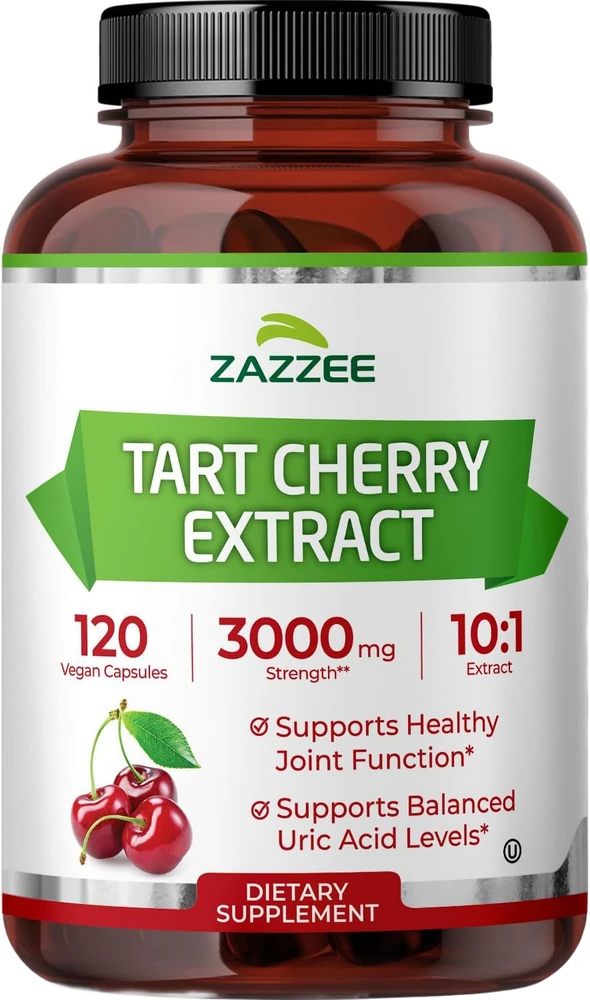
Real retailer photo, cut out. Label unedited.
Consider it. A one-capsule 10:1 concentrate that states its strength as a fruit equivalent. One capsule a day, 120 in the bottle, a stated four-month supply, certified kosher, and an allergen exclusion list spelled out in the listing (peanut and sesame are not among the names).
Why It Scores 6.7 — And The Label Line Behind Each Number
Form & Bioavailability
25% of scoreA dry 10:1 Montmorency extract in a vegan capsule, vegan down to the shell. Same form as Zazzee's other two entries on this list, and judged the same way. With the strength on the label the load is computable at roughly 300 mg of extract per capsule, but a dry extract is still not the juice form the uric-acid work in Martin 2019 actually used, and no anthocyanin content is disclosed anywhere.
- Form
- Vegan capsule (10:1 extract)
Standardization & Dose
25% of scoreThe ratio is defined, the cherry variety is named in the listing, and the strength is printed on the front of the label: 3000 mg carrying a double-asterisk footnote, directly next to 10:1 Extract. That footnote marks a raw-fruit equivalence, so the capsule holds roughly 300 mg of actual extract rather than 3000 mg of powder. The convention is normal and the arithmetic is honest once you know it. It is held back because the label does the multiplication for you and leaves the division to you, and because nothing is standardized to an active-compound figure. This lands on the same number as Zazzee's 200-count, which is the same 10:1 extract at the same 300 mg per capsule.
- Strength
- 3000 mg raw-fruit equivalent; about 300 mg of extract per capsule at 10:1
Third-Party Testing
20% of scoreCertified kosher and Non-GMO. Kosher certification is issued by an outside agency, but no certifying agency is named in the listing and no certificate is linked, so it cannot be checked at a certifier — and it verifies ingredient conformity, not potency or contaminant screening. The USA facility described as fully compliant with good manufacturing policies is a manufacturer statement, not a certificate, and no certificate of analysis and no named outside lab appears on the label or the listing. The printed 3000 mg therefore rests on the company's own word. Zazzee's 200-count listing additionally claims in-house and third-party checks; no such claim appears on this listing, which is the only reason this scores a notch below its sibling.
- Source
- Montmorency cherries
- Testing
- Certified kosher (certifier not named), Non-GMO; no COA and no named outside lab
Tolerability & Safety
15% of scoreOne capsule per serving, no sweeteners or artificial flavors, and a listing that declares the product free of wheat, gluten, soy, milk, egg, fish, shellfish, and tree nut ingredients. Peanut and sesame are not on that list and no cross-contamination statement appears, so read it as a declaration about ingredients, not a guarantee about the facility. The standing caveat with cherry is that it is an adjunct and should not delay proper gout treatment.
Value
15% of scoreJudged on structure: 120 capsules at one capsule per serving is 120 servings, a stated four-month run from a single bottle, and with the strength disclosed each of those servings can be sized at roughly 300 mg of extract. Zazzee's 200-count version of the same line holds 200 capsules to this bottle's 120, so a single bottle of this one covers fewer days at any given serving size. Sound structure, not the deepest bottle in the line.
- Serving
- 1 capsule
- Count
- 120 capsules (Pack of 1)
- Supply
- 120 servings, stated as a 4-month supply
Label verified. Every figure read from the Supplement Facts photo, Sep 7, 2026.
Marketing Claims Vs. Reality
The 3000 mg on the label is 3000 mg of tart cherry extract per capsule
The figure carries a double-asterisk footnote and sits next to 10:1 Extract, which marks it as a raw-fruit equivalence. At 10:1, 3000 mg of raw cherries concentrates down to roughly 300 mg of extract, and that is what the capsule holds. The convention is standard labeling, not deception, but the printed number is ten times the powder weight.
Tart cherry lowers the risk of recurrent gout attacks
Zhang 2012 found cherry intake associated with a ~35% lower risk of recurrent gout flares, but it was observational, so causation and the contribution of a capsule extract are not established. Martin 2019 is the closest dose-response evidence and it used 100% juice, not a dry capsule extract.
Can replace gout medication
No trial supports cherry as a substitute for urate-lowering therapy; it is at best an adjunct and should not delay medical management of gout.
What Our Test Actually Found
Same 300 mg capsule as the other two Zazzee bottles
The label prints 3000 mg Strength next to 10:1 Extract with a double asterisk — the standard footnote for a raw-fruit equivalence, so the capsule holds roughly 300 mg of powder. That is the same capsule strength as the 200-count and the USDA Organic 120 we already rank; it is not a point of difference between the three, only a number a first-time reader has to divide. Do it before you line this up against Zhang 2012, which counted cherry servings, or Martin 2019, which used 100% juice.
Three Zazzee bottles, and this is the plain one
Our list already ranks Zazzee's 200-count 10:1 and its USDA Organic 120. The 200-count holds 200 capsules to this bottle's 120; the organic version carries a USDA Organic certificate. This one is the non-organic 120, and what it carries is a printed 3000 mg strength on the label, plus a certified-kosher mark and a full allergen exclusion list in the listing. That is real, and it is modest.
Full analysis: all pros & cons (8), buy if / skip if
- One capsule per serving, so 120 capsules is a stated four-month supply
- Strength, ratio and count are printed on the label: 3000 mg equivalent, 10:1, 120 vegan capsules
- Certified kosher, Non-GMO, and vegan down to the capsule shell
- Listing declares no sweeteners or artificial flavors and no wheat, gluten, soy, milk, egg, fish, shellfish, or tree nut ingredients
- The headline 3000 mg is a raw-fruit equivalent, not powder weight; the capsule holds about 300 mg of extract and the label leaves that division to the reader
- No certificate of analysis and no named outside lab, and the kosher mark names no certifying agency; the GMP-compliant USA facility is a manufacturer statement
- Nothing is standardized to an active-compound figure, so the strength is a weight and not a potency
- Lacks the USDA Organic mark the organic 120 carries, and holds fewer capsules than the 200-count
- You want a plain, non-organic 10:1 Montmorency extract in a vegan capsule
- You want a strength figure printed on the label and are fine doing the 10:1 conversion
- You want a one-capsule daily routine and a bottle that runs a stated four months
- You want more than 300 mg of extract per capsule without taking several capsules a day
- You want a published certificate of analysis or a named outside lab, which this product does not publish
- You specifically want organic-certified fruit, which the USDA Organic 120 has and this one does not
- You want the most capsules from a single bottle, which is the 200-count version
One capsule a day, 120 in the bottle, a stated four-month supply, certified kosher, and an allergen exclusion list spelled out in the listing (peanut and sesame are not among the names). The strength is printed on the label: 3000 mg with a double-asterisk footnote next to 10:1 Extract, which is the raw-fruit equivalent of roughly 300 mg of actual extract per capsule. Read the small figure, not the big one.
This bottle sits inside a family the same brand already sells: a 200-capsule version of its 10:1 Montmorency line and a USDA Organic 120. Structurally it is the plain one. The label prints the count, the ratio and a strength figure right on the front: 120 Vegan Capsules, 10:1 Extract, and 3000 mg carrying a double-asterisk footnote. The listing adds the rest: Montmorency cherries, one capsule per serving, a stated four-month supply. That footnote is the part worth reading twice. At a 10:1 concentration, 3000 mg is the raw-fruit equivalent, not the powder inside the capsule; the capsule holds roughly 300 mg of actual tart cherry extract, which is the same capsule strength as the two Zazzee bottles we already rank. This is a standard labeling convention rather than a trick, but the number a shopper reads first is ten times the number that goes down. Add a certified-kosher mark and an allergen exclusion list spelled out in the listing, and what is left is a disclosed, competent bottle whose thinnest spot is outside verification, not dosing.
Disclosed and competent, still behind the bottle that holds more

This is a defined 10:1 Montmorency concentrate in a vegan capsule, one a day, certified kosher, allergen-declared in the listing, and a stated four months from a single bottle. The strength is on the label, which is more than many ratio extracts manage: 3000 mg with a double-asterisk footnote, which works out to roughly 300 mg of actual extract per capsule — the same capsule the other two Zazzee bottles deliver. What is thin here is outside verification, not disclosure. No certificate of analysis is published, no outside lab is named, and the kosher mark names no certifying agency, so the printed number rests on the company's word. Zazzee sells the same line in a 200-count that holds 200 capsules and an organic 120 that adds a USDA Organic certificate. Take this bottle if the one-capsule routine and the allergen declaration are what you were after.
If This Doesn’t Fit — Try These
 04
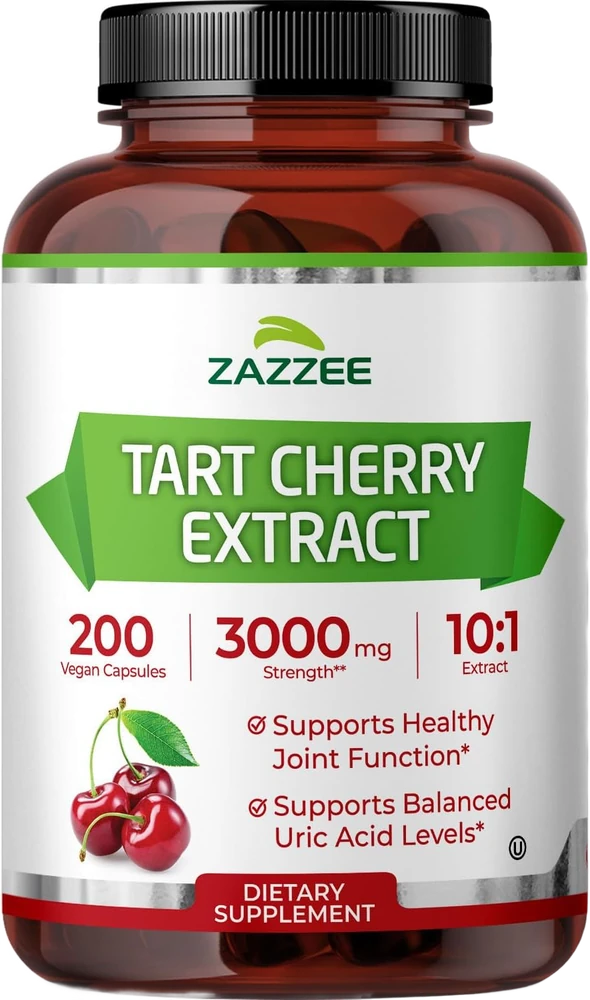
04Zazzee 10:1 (200 Caps)
For a daily maintenance dose aimed at uric-acid and antioxidant support, this is the best value on the board — a real 10:1 concentrate at eleven cents a capsule.
 05
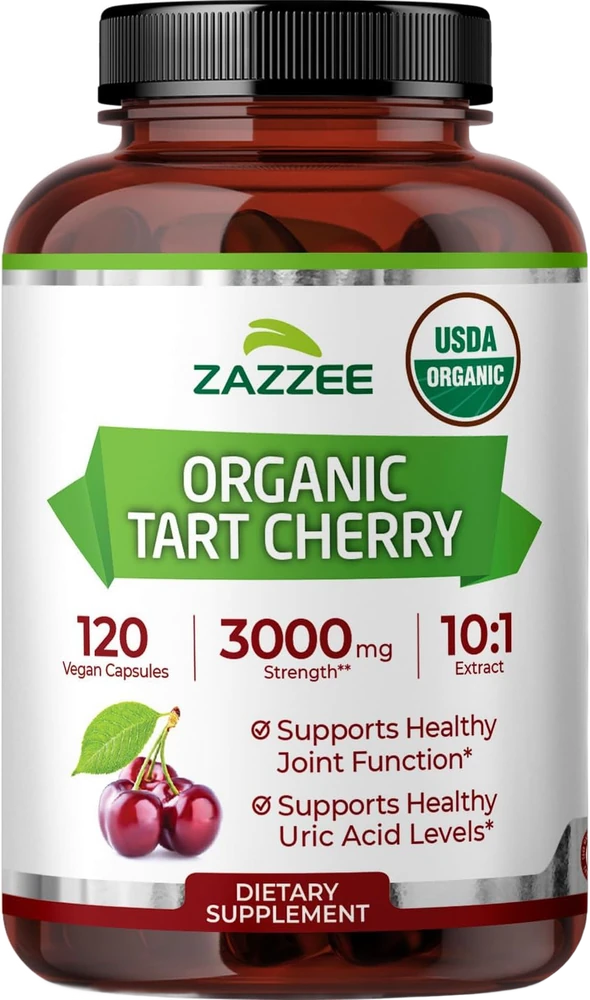
05Zazzee Organic 10:1
Effectively the organic sibling of our value pick — identical 10:1 concentrate, certified-organic fruit, higher cost per capsule.
Quick Answers
Can I stop my gout medication and use cherry instead?
No. The evidence supports cherry only as an adjunct; stopping prescribed urate-lowering therapy risks flares. Discuss any changes with your doctor.
How many milligrams of tart cherry does one capsule contain?
About 300 mg of extract. The label states 3000 mg Strength with a double-asterisk footnote next to 10:1 Extract, and that figure is the raw-fruit equivalent: at 10:1, 3000 mg of cherries concentrates down to roughly 300 mg of powder. Both numbers are true, they simply describe different things.
How is this different from the other two Zazzee tart cherry bottles we rank?
This is the non-organic 120-count. The capsule itself is the same 300 mg 10:1 extract in all three. The 200-count version holds 200 capsules to this bottle's 120, and the USDA Organic 120 carries an organic certificate this one does not.
Sources & Further Reading
2 peer-reviewed sources, each linked to PubMed
- [1] Zhang Y, et al. Arthritis Rheum. 2012;64(12):4004-11. PMID 23023818 — Cherry consumption and decreased risk of recurrent gout attacks. Cherry intake over 2 days was associated with a 35% lower risk of recurrent gout attacks in a case-crossover study.
- [2] Martin KR, Coles KM. Curr Dev Nutr. 2019;3(5):nzz011. PMID 31037275 — Consumption of 100% Tart Cherry Juice Reduces Serum Urate in Overweight and Obese Adults. Daily tart cherry juice modestly reduced serum urate in overweight and obese adults over four weeks.
Affiliate disclosure: every Amazon link uses our Associates tag (superachieverclub-20). We earn a small commission at no cost to you; it funds independent reviews. We never accept payment to change a ranking.