
Old School Labs 2-Stage Pre-Workout (Vintage Blast) Review
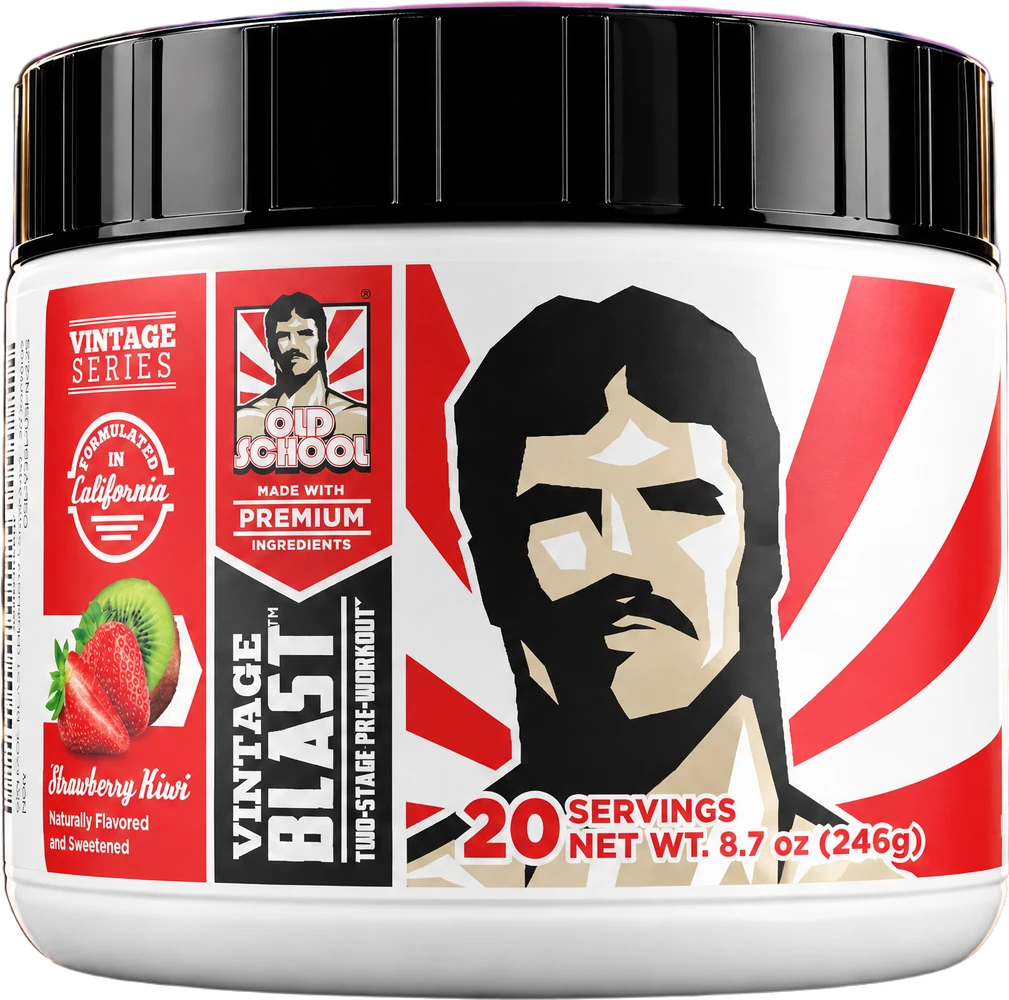 #9 of 9 · Two-stage caffeine✓ Label verified · Supplement Facts read Oct 21, 2026
Studio shot rebuilt from the retailer photo, cut out. Label text checked against the real pack.
Consider it if you want a fully printed label with 250 mg of caffeine split into two forms. The citrulline and beta-alanine doses are modest, it costs about $1.40 a scoop, and the testing claim names no lab.
$27.99 · 20 servings (Amazon US, Nov 22, 2026)$1.40 / serving
Why It Scores 7.4 — And The Label Line Behind Each Number
Clinically-dosed actives
30% of scoreThe 5 g of citrulline malate is the best line on the panel: far above C4's 1 g, but under the 8 g used in Pérez-Guisado 2010, and the panel does not print the malate ratio, so its citrulline is below 5 g. Beta-alanine is the weak line at 1 g, lower than every other pick that contains it, against a research dose of about 3.2 g a day (Hobson 2012), less than C4's 1.6 g and a quarter of Transparent Labs BULK. The panel declares no creatine and no betaine, and 1 g of L-arginine alpha-ketoglutarate, 250 mg of L-carnitine tartrate and 250 mg of N-acetyl L-tyrosine are small amounts, while D-aspartic acid is not one of the actives this ranking credits. That puts it level with C4: a much bigger citrulline malate dose, offset by lower beta-alanine and no creatine.
- Citrulline
- 5 g L-citrulline malate (Stage 1); the malate ratio is not printed
- Beta-alanine
- 1 g (Stage 1)
- Other actives
- 1 g L-arginine alpha-ketoglutarate, 250 mg L-carnitine tartrate (Stage 1); 2 g D-aspartic acid, 250 mg N-acetyl L-tyrosine (Stage 2)
Label transparency
25% of scoreEvery active has its own printed amount, the two stage groups are laid out clearly, both caffeine forms are stated separately, and the panel has no proprietary blend. That is the same level of disclosure as Kaged Elite and RYSE Loaded, and ahead of C4's blend. Two things hold it half a point under the cleanest labels: the printed serving size of 15.3 g disagrees with the Certificate of Analysis graphic (12.3 g per scoop), and the malate form of citrulline is printed without a ratio.
- Transparency
- Every amount printed, no proprietary blend, two labelled stage groups
- Serving size
- Panel prints 1 scoop (15.3 g); the pack front prints 8.7 oz (246 g) for 20 servings and the Certificate of Analysis graphic prints 12.3 g per scoop
Stimulant profile
20% of scoreA clearly stated 250 mg of caffeine in two forms, 150 mg anhydrous plus 100 mg microencapsulated, is a moderate dose with a deliberate split, well below the near-ceiling formulas such as Kaged Elite and more than the gentle C4 and Transparent Labs BULK. The panel prints no release timing for the microencapsulated part and no L-theanine, so the smoother 'no crash' effect the brand describes is a claim, not something the panel shows. That keeps it just under BULK's score, which pairs caffeine with L-theanine.
- Caffeine
- 250 mg in total: 150 mg caffeine anhydrous (Stage 1) + 100 mg microencapsulated caffeine (Stage 2); no L-theanine
Value per serving
15% of score$27.99 for 20 servings is about $1.40 a scoop (Amazon US, Nov 22, 2026). That is a little under Transparent Labs BULK at about $1.67 and Legion Pulse at about $1.56, and well under Kaged Elite at about $2.13, but all three print much larger citrulline and beta-alanine doses (Kaged also 5 g of creatine), and RYSE Loaded is slightly cheaper at about $1.33 with 3.5 g of beta-alanine. The price is fair for what is in the scoop but buys modest doses, so it scores below those four.
- Servings
- 20 per tub · 8.7 oz
- Price
- $27.99 · about $1.40 per scoop (Amazon US, Nov 22, 2026)
Taste & mixability
10% of scoreStrawberry Kiwi, naturally flavored, sweetened with 580 mg of stevia leaf extract, and coloured with fruit and vegetable juice; the panel declares no artificial sweetener or dye. We have not tasted it, so it is scored cautiously, below the products with broadly rated flavors. Stevia can leave an aftertaste for some people.
- Flavor
- Strawberry Kiwi, naturally flavored and sweetened
- Sweetener
- 580 mg stevia leaf extract; no artificial sweetener on the panel
- Other ingredients
- Pineapple fruit powder, silicon dioxide, calcium silicate, natural flavors, fruit and vegetable juice (color)
- More Specs
- Vitamins and minerals
- 250 mg vitamin C, 30 mg niacin (as inositol hexanicotinate), 10 mg vitamin B6, 50 mcg vitamin B12 (as methylcobalamin), 10 mg pantothenic acid, 50 mg magnesium, 50 mg sodium, 99 mg potassium
- Creatine
- None; the panel declares no creatine or betaine
- Certification
- Pack graphics say 'Third-Party Tested' and show GMP Compliant and Made in USA badges; no certifier named. Not found in NSF Certified for Sport (Oct 21, 2026) or the Informed Sport certified-brands list
- Certificate of Analysis
- Graphic in the gallery for Strawberry Kiwi; names no lab, lot or date; active rows use 'Input' as the method; microbiological rows cite AOAC methods
- Label
- Supplement Facts panel read Oct 18, 2026
Label verified. Every figure read from the Supplement Facts photo, Oct 21, 2026.
Marketing Claims Vs. Reality
2-stage caffeine for steady energy and focus: 150 mg fast plus 100 mg sustained.
The panel does print 150 mg of caffeine anhydrous in Stage 1 and 100 mg of microencapsulated caffeine in Stage 2, so the two amounts are verified. What the panel does not show is any release timing for the microencapsulated portion, so 'sustained' and 'no crash' are the brand's description. Caffeine is reliably ergogenic in the ISSN review (Guest 2021), but crash and jitter vary with the person.
5 g of L-citrulline malate for enhanced endurance and pumps.
The 5 g of L-citrulline malate is printed in Stage 1, so the amount is verified. It is under the 8 g of citrulline malate used in Pérez-Guisado 2010, and the panel prints no malate ratio, so the citrulline itself is below 5 g. A moderate pump dose, not the full trial dose.
Third-party tested: every batch is checked by independent labs for purity and quality.
A Certificate of Analysis graphic is shown, but it names no laboratory, lot or date, and its active-ingredient rows give 'Input' as the method rather than an assay of the finished product. Only its microbiological rows cite AOAC methods. We found no Old School Labs entry in NSF Certified for Sport (searched Oct 21, 2026) or the Informed Sport certified-brands list. The brand's own site refers to third-party certified factories. Treat it as a brand statement.
Naturally flavored and sweetened.
The panel prints stevia leaf extract (580 mg) and the other ingredients list natural flavors and fruit and vegetable juice for color, with no artificial sweetener or dye declared.
What Our Test Actually Found
A clean, fully printed label
Every ingredient has its own printed amount and nothing hides in a blend, which is the first test this ranking applies. The two stage groups are easy to read, both caffeine forms are listed separately, and the sweetener is stevia. That is better disclosure than C4's partly blended label and level with Kaged Elite. The only blemish is the serving-size figure: the panel prints 15.3 g while the pack front and the Certificate of Analysis graphic point to 12.3 g.
The two stages are really a caffeine split
The two labelled groups sound like a timed system, but the panel's only staged ingredient is caffeine: 150 mg anhydrous in Stage 1 and 100 mg microencapsulated in Stage 2. The rest of the actives are simply sorted into the two groups, and the panel prints no timing. The caffeine total of 250 mg is a sensible moderate dose, and the idea of a second, slower portion is reasonable, but it is a design choice, not a proven advantage.
Moderate pump dose, low beta-alanine, no creatine
5 g of citrulline malate is a real step up from C4 but under the 8 g trial dose (Pérez-Guisado 2010), and the 1 g of beta-alanine is lower than any other pick that contains it, against a research dose near 3.2 g a day (Hobson 2012). There is no creatine and no betaine on the panel. The remaining actives, L-arginine alpha-ketoglutarate, L-carnitine tartrate, N-acetyl L-tyrosine and D-aspartic acid, are not the ingredients this ranking credits for the pump or endurance case, so their grams add little to the score.
The testing claim is the one thing you cannot check
The pack graphics say 'Third-Party Tested' and one gallery image shows a Certificate of Analysis, but the certificate names no lab, lot or date, and its ingredient rows use 'Input' as the method. We searched NSF Certified for Sport's listing for the brand and the product on Oct 21, 2026 and found nothing, and Old School Labs is absent from the Informed Sport certified-brands list. Informed Choice and BSCG were not checked. For a recreational lifter that may be fine; for a drug-tested athlete it decides the purchase.
Mid-range price for modest doses
At about $1.40 a scoop it costs a little less than Transparent Labs BULK (about $1.67), which prints 8 g of citrulline malate and 4 g of beta-alanine, a little less than Legion Pulse (about $1.56) and well under Kaged Elite (about $2.13) with its 5 g of creatine, but a little more than RYSE Loaded (about $1.33). The gap is small, while the doses in those picks are much larger. You are paying for a clear label and a caffeine split rather than for larger doses, and that is why value is the lowest score here.
Full analysis: all pros & cons (8), buy if / skip if
- Every amount printed, with no proprietary blend
- 250 mg of caffeine in two stated forms: 150 mg anhydrous and 100 mg microencapsulated
- 5 g of citrulline malate, a much bigger dose than C4's 1 g
- Sweetened with stevia leaf extract; no artificial sweetener or dye on the panel
- 1 g of beta-alanine is lower than any other pick that contains it, against a research dose of about 3.2 g
- No creatine or betaine on the panel; 5 g citrulline malate is under the 8 g trial dose
- About $1.40 a serving for 20 servings, and the 'Third-Party Tested' claim names no lab or certifier
- Serving size is printed as 15.3 g on the panel but 12.3 g on the Certificate of Analysis graphic
- You want a fully printed label: every amount stated, no proprietary blend
- You like a caffeine split into a fast dose and a microencapsulated dose, 250 mg in total
- You want natural sweetening: stevia leaf extract, no artificial sweetener on the panel
- You want a moderate pump dose of 5 g citrulline malate and are not chasing the full 8 g
- You want a clinical beta-alanine dose; 1 g is well under the research level
- You want creatine or betaine in the scoop; the panel declares neither
- You are drug-tested; the testing claim names no certifier and the brand is not in the NSF or Informed Sport lists we checked
- You want the lowest cost per effective dose; Nutricost, C4 and ON Gold Standard cost less per serving than the about $1.40 here
Vintage Blast prints every amount, splits 250 mg of caffeine into 150 mg of anhydrous and 100 mg microencapsulated, and sweetens with stevia. The catches: 5 g of citrulline malate is under the trial dose, 1 g of beta-alanine is lower than any other pick that contains it, there is no creatine, the serving-size figures disagree between the panel and the Certificate of Analysis, and at about $1.40 a serving it is cheaper per scoop than Transparent Labs BULK, but BULK prints far larger doses. Consider it if the two-stage caffeine is what you want. For clinical doses, Transparent Labs BULK; for everything in one scoop, Kaged Elite.
Old School Labs sells this tub as Vintage Blast, a two-stage pre-workout; a badge in the label graphic says it was crafted with Mr. Olympia Samir Bannout. The Supplement Facts panel is the strongest part of it: every ingredient has its own printed amount, with no proprietary blend, in two labelled groups. Stage 1 prints 5 g of citrulline malate, 1 g of beta-alanine, 1 g of L-arginine alpha-ketoglutarate, 250 mg of L-carnitine tartrate and 150 mg of caffeine anhydrous. Stage 2 prints 2 g of D-aspartic acid, 250 mg of N-acetyl L-tyrosine and 100 mg of microencapsulated caffeine. The sweetener is stevia leaf extract, and the panel lists no artificial sweetener or dye. The formula is where it falls short of the leaders. Its citrulline malate is under the 8 g that Pérez-Guisado 2010 used, its beta-alanine, at 1 g, is lower than every other pick here that contains any, and it declares no creatine or betaine. It also costs about $1.40 a serving at the current Amazon price for only 20 servings. The testing claim is the other open question: the listing shows a Certificate of Analysis, but it names no lab, shows no lot, and its active rows rest on 'Input' rather than an assay. That is why it is a consider rather than a buy, and why Transparent Labs BULK and Kaged Elite sit well above it.
A clear, honest label with modest doses; consider it for the caffeine split, not the price.

Old School Labs Vintage Blast does the basic thing well: it tells you exactly what is in the scoop. 5 g of citrulline malate, 1 g of beta-alanine, 250 mg of caffeine in two forms, a stevia sweetener and nothing hidden in a blend. If a fast-plus-microencapsulated caffeine design appeals to you and you want a moderate dose without artificial sweeteners, it does that. What holds it down is dose and price rather than honesty. Its citrulline malate is under the 8 g trial dose, its beta-alanine is lower than any other pick that contains it, it has no creatine, it costs about $1.40 a serving, and its testing claim names nothing we could check. Transparent Labs BULK prints larger citrulline and beta-alanine doses for only about 27 cents more per scoop, Kaged Elite packs in creatine and more citrulline, and RYSE Loaded offers a delayed-release caffeine portion alongside more beta-alanine. Choose Vintage Blast if you specifically like its caffeine split.
If This Doesn’t Fit — Try These
Transparent Labs BULK Pre-Workout
The benchmark: 8 g citrulline malate and 4 g beta-alanine with 200 mg caffeine and 200 mg L-theanine, every dose printed, for only a little more per scoop.
Kaged Pre-Workout Elite
The loaded one-scoop option: 10 g L-citrulline, 5 g creatine and 3.2 g beta-alanine, all printed, with 388 mg of caffeine.
RYSE Loaded Pre-Workout
Another split-release caffeine design: 4.5 g L-citrulline and 3.5 g beta-alanine with a delayed-release caffeine portion.
Quick Answers
What does 'two-stage' actually mean on this label?
The Supplement Facts panel splits the formula into a Stage 1 group and a Stage 2 group. Stage 1 ('Start Strong') holds 5 g of L-citrulline malate, 1 g of beta-alanine, 1 g of L-arginine alpha-ketoglutarate, 250 mg of L-carnitine tartrate and 150 mg of caffeine anhydrous. Stage 2 ('Finish Strong') holds 2 g of D-aspartic acid, 250 mg of N-acetyl L-tyrosine and 100 mg of microencapsulated caffeine. In practice the only real 'stage' is the caffeine: a plain 150 mg dose followed by a 100 mg microencapsulated dose, for 250 mg in total. The panel prints no release timing for the microencapsulated portion, so the 'sustained' effect is the brand's description, not something the panel proves.
Is 5 g of citrulline malate enough for a pump?
It is a real dose, but it sits under the 8 g of citrulline malate that the trial this ranking relies on used (Pérez-Guisado 2010). The panel prints the malate form without its ratio, so the amount of citrulline itself is below 5 g. That is far more than C4 Original, which prints 1 g of citrulline malate, and less than Transparent Labs BULK at 8 g or Kaged Elite at 10 g of L-citrulline. Treat it as a moderate pump dose, not a full one.
Is the beta-alanine dose meaningful?
Not for the endurance benefit. The research dose is about 3.2 g a day taken over weeks (Hobson 2012), and this label prints 1 g per scoop, which is under C4's 1.6 g and a quarter of the 4 g in Transparent Labs BULK. At 1 g you may feel some tingle, but the muscular-endurance case rests on a larger daily dose than one scoop supplies.
Is Vintage Blast third-party tested?
We could not confirm a named certifier. The pack-side graphics say 'Third-Party Tested', and one gallery image shows a Certificate of Analysis for the Strawberry Kiwi flavor. That certificate names no laboratory and shows no lot number or date, its active-ingredient rows give 'Input' as the method (the amount put into the formula, not a lab assay of the finished powder), and only its microbiological rows cite AOAC test methods. We searched NSF Certified for Sport's product list for 'old school' and 'vintage blast' on Oct 21, 2026 and found no results, and Old School Labs is not in the Informed Sport certified-brands list. The brand's own site says it works with third-party certified factories, which describes the factory, not the product. If you are drug-tested, choose a product that is in a certifier's database.
Why do the serving-size numbers not agree?
The panel prints a serving size of 1 scoop (15.3 g) with 20 servings per container, while the pack front prints a net weight of 8.7 oz (246 g) and the Certificate of Analysis graphic prints 12.3 g for one scoop. Those figures cannot all be right at once. The amounts of each ingredient are printed per serving either way, so the doses we score are unaffected, but it is the kind of inconsistency a careful label should not have, and it is why transparency scores a little below the cleanest labels here.
Sources & Further Reading
3 peer-reviewed sources, each linked to PubMed
- [1] Pérez-Guisado 2010 PMID 20386132 — Citrulline malate enhances athletic anaerobic performance and relieves muscle soreness. In a randomized, double-blind crossover trial, a single 8 g dose of citrulline malate significantly increased the number of repetitions performed across a barbell bench-press session (by up to ~52% in later sets) and reduced muscle soreness at 24 and 48 hours versus placebo. The foundational human trial behind the 6-8 g citrulline dose this page credits for the pump and performance — and the reason an under-dosed proprietary-blend citrulline scores poorly here.
- [2] Hobson 2012 PMID 22270875 — Effects of β-alanine supplementation on exercise performance: a meta-analysis. Pooling 15 studies (360 participants), beta-alanine improved exercise outcomes versus placebo, with the benefit concentrated in efforts lasting 60-240 seconds — the classic 'muscular endurance' window. The core meta-analytic support for beta-alanine, dosed in trials around 3.2-6.4 g/day to saturate muscle carnosine, which is why this page credits 3.2 g and notes the effect builds over weeks rather than from a single pre-workout scoop.
- [3] Guest 2021 PMID 33388079 — International society of sports nutrition position stand: caffeine and exercise performance. The ISSN position stand concludes caffeine is reliably ergogenic for muscular endurance, strength, sprinting and aerobic performance and improves alertness and focus, with the effective range commonly 3-6 mg/kg of body mass taken ~60 minutes pre-exercise. The evidence basis for judging a pre-workout's caffeine dose as appropriate (roughly 3-6 mg/kg) rather than simply 'more is better' — and a reminder that tolerance and individual response vary.
Affiliate disclosure: every Amazon link uses our Associates tag (superachieverclub-20). We earn a small commission at no cost to you; it funds independent reviews. We never accept payment to change a ranking.