
Jarrow Formulas MagMind (Magtein Magnesium L-Threonate) Review
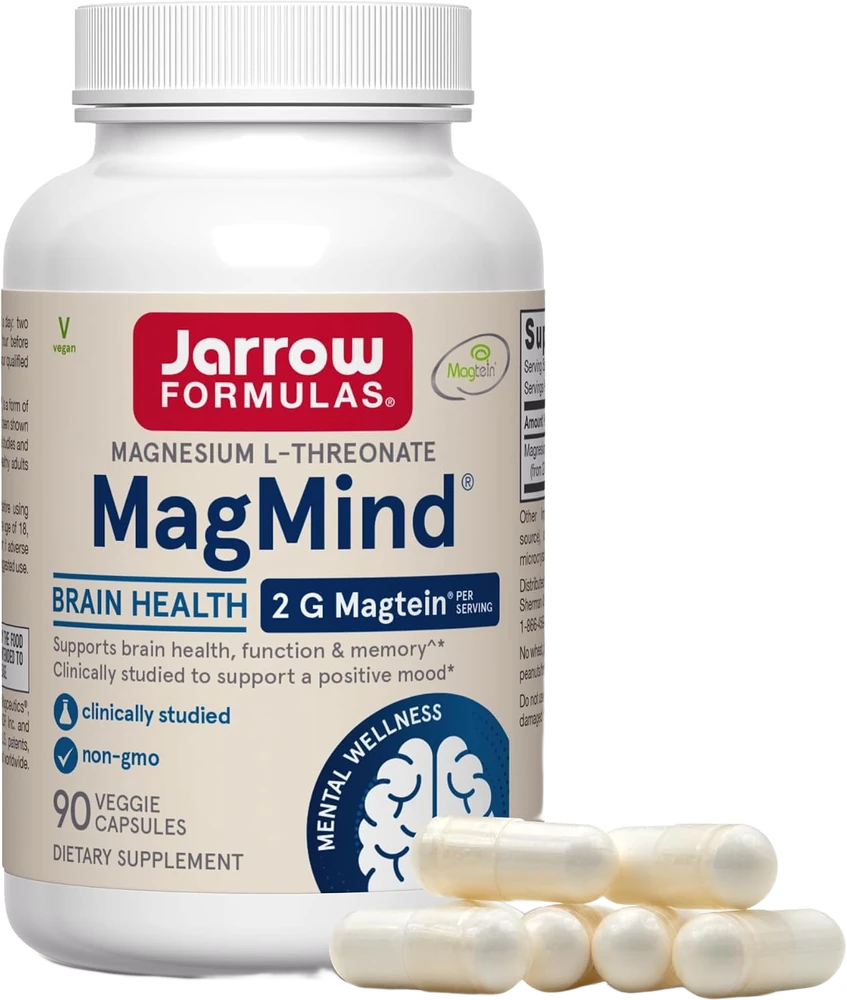 #3 of 8 · Best from a household brand✓ Label verified · Supplement Facts read Sep 7, 2026
Real retailer photo, cut out. Label unedited.
Consider it. Verified Magtein from a trusted household brand — solid, reliable, no standout edge. MagMind is licensed Magtein magnesium L-threonate at the exact 2000 mg Liu 2016 trial dose (144 mg elemental, 3 caps) from one of the original threonate brands.
$30 / 90 caps (30-day supply)~$1.00 / 3-cap serving
Why It Scores 8.4 — And The Label Line Behind Each Number
Form / Magtein verification
30% of scoreLicensed, patent-verified Magtein magnesium L-threonate — the same stereoisomer the published RCTs (Slutsky 2010, Liu 2016) measured. MagMind was one of the first threonate products to market, so the form is well-established here. No other magnesium form (glycinate, citrate, oxide, malate, taurate) shows comparable brain-magnesium uptake in human or animal trials.
- Active form
- Magnesium L-Threonate (licensed Magtein)
- Per capsule
- ~667 mg Magtein = ~48 mg elemental Mg
- Capsule shell
- Vegetarian (cellulose)
- Inactives
- Cellulose, magnesium stearate (vegetable source), silicon dioxide
Elemental Mg + dose honesty
25% of score144 mg elemental Mg per 3-cap serving (2000 mg Magtein) — the same low elemental yield as every Magtein product, because L-threonate is a heavy carrier molecule (~7% elemental Mg by weight vs ~14% for bisglycinate). The threonate is the feature for brain delivery, but it means MagMind isn't the form for peripheral magnesium needs. Hits the trial dose exactly at 3 caps; honest label.
- Per serving
- 2000 mg Magtein = 144 mg elemental Mg (3 capsules)
- Trial-dose alignment
- Matches Liu 2016 protocol exactly (2000 mg Magtein/day)
Third-party testing + QC
20% of scoreJarrow Formulas has a long, well-earned QC reputation and established batch testing — one of the most trusted household supplement names. The reason it scores a notch below Life Extension is public documentation: Jarrow's QC is solid but less publicly detailed than Life Extension's per-batch testing and documented Magtein chain-of-custody. Reliable, just less transparent on paper.
- Certifications
- Magtein-licensed (patent verified); non-GMO
- Manufacturer
- Jarrow Formulas (Los Angeles, CA · cGMP)
- Lab transparency
- Established in-house batch QC; Jarrow track record
Cost per elemental mg
15% of score≈$30/month at 3 caps/day = ~$1.00 per 144 mg elemental serving. That's mid-pack for the category — fair, but no price edge: Neuro-Mag (#1) is slightly cheaper (~$0.93) and Double Wood (#4) is cheaper still (~$0.77 at 4 caps/day). Like all threonate it's expensive per elemental mg, but you're paying for brain-Mg delivery, not elemental magnesium — there's no cheaper way to get that effect.
- Bottle size
- 90 vegetarian capsules — 30 days at 3 caps/day
- Price
- ≈$30 / month at 3 caps/day (~$1.00 / serving)
Real-world response + value
10% of scoreCognitive response is real but slow, and identical to the rest of the licensed-Magtein tier because the active form is the same. Liu 2016 showed ~9% improvement on executive-function tests at 12 weeks at this exact 2000 mg dose. Anecdotal reports (sharper word recall, less brain fog on demanding work) typically land at 4-6 weeks. Modest but reproducible; stack a glycinate for peripheral coverage.
Label verified. Every figure read from the Supplement Facts photo, Sep 7, 2026.
Marketing Claims Vs. Reality
Magtein patented magnesium L-threonate, clinically studied.
MagMind uses licensed Magtein, the patented L-threonate stereoisomer measured in Slutsky 2010 (Neuron) and Liu 2016 (J Alzheimer's Disease). The 'clinically studied' framing references those Magtein-specific RCTs. Accurate.
Supports memory, focus, and cognitive function.
Liu 2016 measured ~9% improvement on executive-function tests after 12 weeks at 2000 mg Magtein/day — the exact dose MagMind delivers. The effect size is modest but reproducible. Real evidence, accurately described.
Crosses the blood-brain barrier to raise brain magnesium.
The Slutsky 2010 MIT paper showed brain-magnesium levels rise measurably only with L-threonate (not other Mg forms). Since MagMind is licensed Magtein, the BBB-crossing claim is supported at trial-grade evidence level.
Supports brain health and healthy aging.
True at the mechanism level — NMDA-receptor density regulation matters for aging brains, and Liu 2016's population was older adults. But 'healthy aging' and 'brain health' are broad marketing phrases; the trial-measured outcomes are specifically cognition/executive function, not generalized healthy-aging endpoints.
2000 mg of magnesium L-threonate per serving.
On-label and accurate as stated — 2000 mg of the Magtein compound. Note this yields ~144 mg of ELEMENTAL magnesium (threonate is ~7% Mg by weight); the label states the compound dose, which is the convention for this category, not a misrepresentation.
What Our Test Actually Found
MagMind's value is reliability, not a unique edge — it's a household-brand backup to the #1 pick
MagMind does everything Life Extension Neuro-Mag (#2) does: licensed Magtein, the exact 2000 mg Liu 2016 trial dose, 3 capsules, a fair price. What it lacks is a standout advantage. Neuro-Mag edges it on public QC transparency (published per-batch testing, documented Magtein chain-of-custody); Double Wood (#4) undercuts it on price; Momentous (#1) adds NSF Certified for Sport. MagMind's role is the dependable, widely-stocked household name — the one to grab when it's the best-priced or best-stocked licensed Magtein on the day. That's a genuine use case, just not a 'best overall' one.
One of the original Magtein brands — Jarrow has a long track record with this exact form
MagMind was among the first magnesium L-threonate products to reach market, which matters more than it sounds: Jarrow has been sourcing and QC-ing licensed Magtein for years, not months. For a form whose entire value proposition is a specific patented stereoisomer, a brand with a long, established relationship to that ingredient is a meaningful trust signal. Jarrow's cGMP manufacturing and batch QC are well-regarded across the industry.
Dose by Magtein compound, not elemental Mg — and do the caps-per-dose math
The trial-validated dose is 2000 mg Magtein/day = 144 mg elemental magnesium = 3 MagMind capsules. Don't try to 'top up' to an elemental Mg target the way you would with glycinate — you'd be swallowing 7-8 capsules. And remember the 90-count bottle is a 30-day supply at 3 caps/day, not 90 days. That's the math that determines MagMind's true ~$1.00-per-serving cost.
Take it in the morning — and skip it entirely if your goal is sleep
Threonate's brain-magnesium effect is mildly stimulating for some people (more synaptic activity reads as subjective alertness), so take all 3 MagMind caps AM or split 2 AM + 1 mid-afternoon. Evening dosing can interfere with sleep onset for sensitive users. If sleep, cramps, or general magnesium status is your actual goal, MagMind is the wrong (and expensive) bottle — buy a magnesium glycinate instead. Many users run both: MagMind AM for the brain, glycinate PM for the body.
Verified Magtein beats the cheap generics — and MagMind is verified
Generic 'magnesium L-threonate' bottles are increasingly common on Amazon at a lower price, but the chemistry isn't guaranteed identical to the Magtein stereoisomer the RCTs measured, and there's no comparative trial data. MagMind carries licensed Magtein, so it sits firmly on the right side of that line. For the right user (cognition goal, wants a trusted brand), the small premium over an unverified generic is worth it.
Full analysis: all pros & cons (9), buy if / skip if
- Licensed, patent-verified Magtein — the form the RCTs measured
- One of the original Magtein brands — Jarrow's long QC track record
- Exact Liu 2016 trial dose: 3 caps = 2000 mg Magtein = 144 mg elemental
- Widely stocked online and in stores — easy, dependable backup pick
- Fair ~$1.00/serving price for verified Magtein from a household name
- No clear advantage over Neuro-Mag (#1) at a similar price
- QC documentation is solid but less publicly detailed than Life Extension's
- Low elemental yield — wrong form for sleep, cramps, or repletion (buy glycinate)
- Not NSF Certified for Sport — drug-tested athletes should pick Momentous (#1)
- Cognition, memory, or executive function is your primary goal
- You want verified, licensed Magtein from a long-trusted household brand
- MagMind is the better-stocked or better-priced licensed Magtein on the day
- You're stacking with a sleep-focused glycinate for full magnesium coverage
- Sleep, cramps, or general magnesium status is your goal — buy a glycinate instead
- You want the most publicly documented per-batch testing — Neuro-Mag (#1) edges it
- You need NSF Certified for Sport for drug testing — go Momentous (#1)
- You want the lowest cost per serving — Double Wood (#4) is cheaper at 4 caps/day
MagMind is licensed Magtein magnesium L-threonate at the exact 2000 mg Liu 2016 trial dose (144 mg elemental, 3 caps) from one of the original threonate brands. Jarrow's QC is well-earned and the ~$1.00/serving price is fair. It does everything the #1 pick (Neuro-Mag) does, just with less publicly detailed batch testing — so buy it when it's the better-stocked or better-priced licensed Magtein. If cognition is your goal, it's a dependable choice. If sleep or cramps are your goal, buy a magnesium glycinate instead — wrong form here.
Jarrow Formulas MagMind was one of the first magnesium L-threonate products to reach market, and it carries the same licensed Magtein form the science is built on — 2000 mg Magtein per serving (144 mg elemental), the exact Liu 2016 trial dose, taken as 3 capsules. This is the brain form of magnesium, not the sleep form: the only magnesium with trial data (Slutsky 2010 in Neuron, then the Liu 2016 human RCT) showing it meaningfully raises brain-magnesium levels and supports memory, focus, and executive function. MagMind's appeal is reliability — Jarrow's long QC pedigree, wide availability, and a fair ~$1.00-per-serving price. What it doesn't have is a standout edge over the #1 pick (Life Extension Neuro-Mag), which publishes more detailed per-batch testing at a similar price. That makes MagMind a strong 'consider': verified Magtein at the standard dose from a trusted name, ideal when it's the better-stocked or better-priced option on the day you buy.
A dependable, no-surprises Magtein — buy it when it's the best-priced or best-stocked licensed option.

Jarrow Formulas MagMind is the household-brand cognition pick: licensed Magtein magnesium L-threonate at the exact 2000 mg Liu 2016 trial dose, from one of the first brands ever to bring threonate to market. The form is verified, the dose is right, Jarrow's QC pedigree is well-earned, and the ~$1.00-per-serving price is fair. There's nothing wrong with it — and that's precisely the point. The 'consider' verdict (rather than a clear 'buy') reflects the lack of a standout edge. Life Extension Neuro-Mag (#2) does the same job with more publicly documented per-batch testing at a slightly lower price; Double Wood (#4) is cheaper at a 4-cap dose; Momentous (#1) adds NSF Certified for Sport for athletes. MagMind doesn't beat any of them on their strongest axis — but it ties on the fundamentals (same Magtein, same trial dose) and wins on availability and brand trust. So the honest recommendation is: reach for MagMind when it's the better-stocked or better-priced licensed Magtein on the day you're buying. You're getting the same brain magnesium as the #1 pick. The skip case is the category-wide one: if your goal is sleep, cramps, or correcting a magnesium deficiency, MagMind is the wrong, expensive form — its elemental yield is too low. Buy a magnesium glycinate instead. And if you do buy MagMind for cognition, run the protocol properly: 3 caps in the morning or early afternoon (it can be mildly activating at night), give it 4-12 weeks rather than judging it in days, and pair a glycinate at bedtime if you also want the peripheral magnesium benefits MagMind can't reach.
If This Doesn’t Fit — Try These
 01
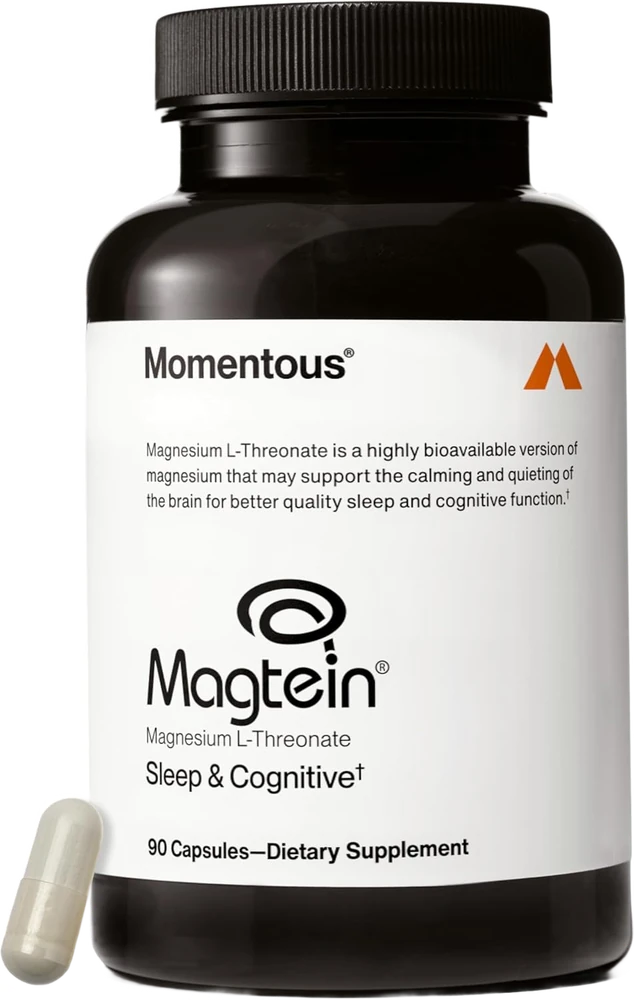
Momentous Magnesium L-Threonate
If you're drug-tested, this is the answer.
03Jarrow MagMind
A long-trusted, no-surprises Magtein.
 02
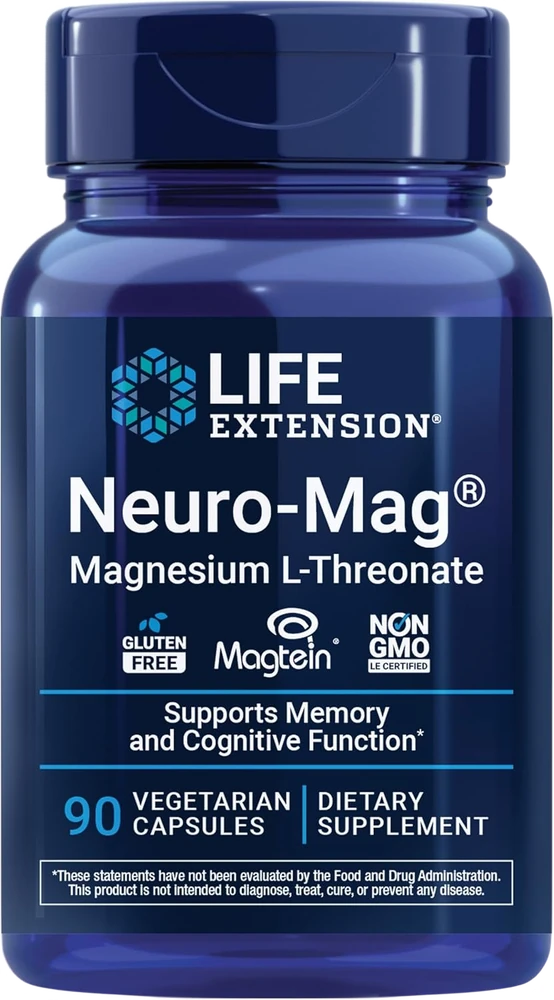
Life Extension Neuro-Mag
The QC benchmark, and the bottle the rest of the list is measured against.
Quick Answers
Is Jarrow MagMind the same form as Neuro-Mag and the other Magtein products?
Yes — MagMind uses licensed Magtein magnesium L-threonate, the same patented stereoisomer the published RCTs (Slutsky 2010, Liu 2016) measured. The active form is identical to Life Extension Neuro-Mag, Momentous, Double Wood, and NOW Foods Magtein products: 2000 mg Magtein per serving = ~144 mg elemental magnesium, taken as 3 capsules. The difference between these bottles is brand QC and price, not the magnesium itself. MagMind was one of the first threonate products to market, so Jarrow has a long track record with the form.
Why is the elemental magnesium only 144 mg if the label says 2000 mg?
Because L-threonate is a heavy carrier molecule. Magtein is the magnesium salt of L-threonic acid (a vitamin C metabolite), and magnesium is only about 7% of that compound by weight — so 2000 mg of Magtein yields ~144 mg of actual elemental magnesium. That's the single biggest misconception in the category: people see '2000 mg magnesium L-threonate' and assume 2000 mg of magnesium. It isn't. For brain delivery the threonate carrier IS the feature, but it means this is the wrong form for repletion, sleep, or cramps — for those you need the higher elemental dose from a glycinate.
How many capsules do I take, and how long does a bottle last?
Three capsules per day is the trial dose (2000 mg Magtein = 144 mg elemental). MagMind's 90-count bottle is therefore a 30-day supply, not 90 days — a point that trips up first-time threonate buyers who assume a 90-count lasts three months. Factor 3 caps/day into the real monthly cost (≈$1.00 per serving) before comparing MagMind to other brands.
Should I buy MagMind for sleep?
No — threonate is the wrong form for sleep, and MagMind is no exception. Its brain-magnesium effect can be mildly activating for some people, so evening dosing can interfere with sleep onset (the opposite of a glycinate, which is calming). If sleep, cramps, or general magnesium status is your goal, buy a magnesium glycinate instead: more elemental magnesium, gentle on the gut, a fraction of the cost. Keep MagMind for cognition and take it in the morning or early afternoon.
When will I notice anything from MagMind?
Expect subtle and slow, not a same-day stimulant. The Liu 2016 trial measured executive-function improvement at 12 weeks on the same 2000 mg Magtein dose MagMind delivers. Anecdotally, users report sharper word recall and less brain fog on demanding mental work around weeks 4-6. The mechanism is structural — threonate raises brain magnesium, which regulates NMDA glutamate-receptor density and synaptic plasticity — so the benefit accrues over time. If you want acute focus, that's caffeine + L-theanine; MagMind is the long-game lever.
Is MagMind worth it over the cheaper generic 'magnesium L-threonate' bottles?
Yes, for the same reason the licensed-Magtein premium is worth it across this category. MagMind uses the verified, patented Magtein stereoisomer that the published RCTs actually measured. Generic 'magnesium L-threonate' on Amazon is cheaper, but the chemistry isn't guaranteed identical and there's no comparative trial data showing generics deliver the same brain uptake. For a form whose entire value proposition is crossing the blood-brain barrier, paying for verified Magtein from a long-trusted brand like Jarrow is the safer call. Check the supplement-facts panel for the Magtein trademark.
How does MagMind compare to Life Extension Neuro-Mag, the #2 pick?
They're very close. Both use licensed Magtein at the exact 2000 mg trial dose (3 caps), and both come from long-trusted brands at a similar price (~$30 vs ~$28). The edge goes to Neuro-Mag mainly because Life Extension publishes per-batch testing data and documents its Magtein chain-of-custody more publicly than Jarrow does — that transparency is the category benchmark. MagMind's QC is solid and well-earned; it's just less publicly detailed. Practically, buy whichever is better-stocked or better-priced on the day — you're getting the same magnesium.
Sources & Further Reading
5 sources — studies link to PubMed, product specs to the manufacturer
- [1] Slutsky 2010 PMID 20152124 — Enhancement of learning and memory by elevating brain magnesium. The MIT paper that anchored the magnesium L-threonate category. Showed brain-Mg levels increase only with L-threonate (not other forms) in rats, with downstream effects on NMDA-receptor density, synaptic plasticity, and learning + memory. The foundational evidence for the form MagMind uses.
- [2] Liu 2016 PMID 26519439 — Efficacy and safety of MMFS-01, a synapse density enhancer, for treating cognitive impairment in older adults: a randomized, double-blind, placebo-controlled trial. The human RCT anchoring the cognitive evidence: 2000 mg Magtein/day for 12 weeks improved executive function by ~9% on standardized tests vs placebo in older adults. Establishes the exact trial dose MagMind delivers (2000 mg Magtein = 144 mg elemental).
- [3] Abumaria 2011 PMID 22016520 — Effects of elevation of brain magnesium on fear conditioning, fear extinction, and synaptic plasticity. Follow-up to Slutsky 2010 — L-threonate-driven brain-Mg elevation enhanced fear extinction and synaptic plasticity in prefrontal cortex. Expands the mechanistic case for the Magtein form beyond memory toward emotional regulation.
- [4] Zhang 2022 — A Magtein, Magnesium L-Threonate, based formula improves cognitive ability in healthy older adults: a 12-week randomized, double-blind, placebo-controlled trial. A more recent randomized, placebo-controlled trial of a Magtein-based formula in healthy older adults showing improvement on cognitive-ability measures over 12 weeks. Reinforces the Liu 2016 dose and timeline that MagMind matches.
- [5] Rosanoff 2012 PMID 22364157 — Suboptimal magnesium status in the United States: are the health consequences underestimated?. Population-level case that a large share of US adults fall below the magnesium RDA. Important context: this peripheral magnesium gap is best closed with a high-elemental form like glycinate, NOT threonate — which is why MagMind buyers should ensure peripheral Mg adequacy separately.
Affiliate disclosure: every Amazon link uses our Associates tag (superachieverclub-20). We earn a small commission at no cost to you; it funds independent reviews. We never accept payment to change a ranking.