
Akarkara | Irani Roots | Anacyclus Pyrethrum अकरकरा 100g Review
 #6 of 8 · Origin claim: Iran✓ Label verified · Supplement Facts read Sep 7, 2026
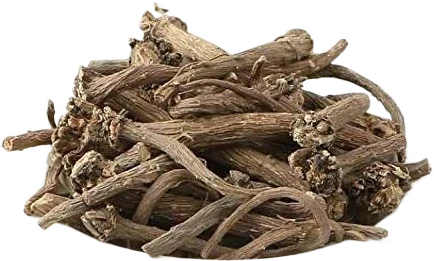
Real retailer photo, cut out. Label unedited.
Skip it. Provenance claim, no label to check. States Irani origin and names the Devanagari script in its title - the strongest traditional-authenticity language on US Amazon.
$14.60$0.146 per gram
Why It Scores 4.5 — And The Label Line Behind Each Number
Label identity & botanical naming
30% of scoreNo packaging or label photo exists in this listing - both gallery images show loose dried roots on a plain background, nothing else. The title states the Latin binomial, common name and Devanagari script, but nothing confirms any of it appears on a physical label. Scored low: unverified, unlike bixa BOTANICAL's label, which we could actually check.
Processing transparency
25% of scoreThe listing states no processing information, and there is no packaging photo to check whether a physical label says more. We can't credit transparency we have not verified - scored at the bottom of the category range.
- Label check
- Not verifiable — no legible Supplement Facts photo in the listing (checked Sep 7, 2026)
Dose reproducibility
20% of scoreLoose powder, no standardisation - the category-wide 4.0 on dose control.
Cost per gram
15% of score$0.146 per gram sits mid-field - reasonable for a 100 g pack with a provenance claim.
- Size
- 100 g
- Cost per gram
- $0.146
- Price
- $14.60
Availability
10% of scoreIn stock on our check date with steady availability history.
- More Specs
- Form
- Whole dried root (listing photos show loose roots, no packaging)
- Standardisation
- Not verifiable — no label photo in the listing
Label verified. Every figure read from the Supplement Facts photo, Sep 7, 2026.
Marketing Claims Vs. Reality
Irani (Iranian-origin) roots
The claim is stated plainly but no certification or audit trail exists. In this category origin claims are taken on trust or not at all.
Authentic अकरकरा
अकरकरा appears in the product's own listing title - a genuine signal of a tradition-focused supplier. No packaging photo confirms whether it also appears on a physical label, and presence in the title is not proof of origin.
What Our Test Actually Found
Label not verifiable: no packaging photo in the listing
An earlier version of this review said the Irani-origin and Devanagari naming were printed on the label, and scored the identity/naming and processing criteria as if that label had been seen. The listing's only two gallery images show loose dried roots on a plain background - no packaging, no printed panel of any kind. We re-checked the listing on Sep 7, 2026 and could not confirm what any physical label says, or whether the pack even carries one. We corrected the lead, tldr, pros/cons, verdict, and two criteria scores (label identity & botanical naming, processing transparency) to attribute the Irani and Devanagari claims to the listing title - which we can read - rather than to a label we have never seen.
Provenance is the entire premium
Against Yuvika at $0.087/g you pay ~68% more per gram. Everything else being equal - form, standardisation, evidence - the Irani claim is what the difference buys.
Tradition-correct, evidence-silent
The listing speaks the vocabulary of Unani sourcing but, like the whole field, carries no human efficacy data.
Full analysis: all pros & cons (6), buy if / skip if
- States Irani-origin roots right in the listing title
- Names अकरकरा (Devanagari) alongside the Latin binomial in the title
- $0.146/g in a 100 g pack
- Origin claim is not certified
- No packaging or label photo in the listing - nothing printed to check the title's claims against
- Loose powder, no standardisation
- The Devanagari naming in the listing title is enough of a signal for you, on its own, without label confirmation
- You're comparing pack sizes and $0.146/g fits your budget regardless of provenance
- You want any confirmation of what's actually printed on the physical label - none is shown in this listing
- You want certified or audited origin - no Akarkara listing offers that
- Price per gram is your priority - Yuvika is 40% cheaper
States Irani origin and names the Devanagari script in its title - the strongest traditional-authenticity language on US Amazon. Nobody certifies it, and no packaging photo in the listing shows a physical label to check it against. Mid-field price, category-standard limitations.
In the Unani and Ayurvedic traditions, Iranian-origin Akarkara (Akarkara Irani) is considered the authentic article, and HerboMeds is the listing that states it most plainly - naming अकरकरा alongside the Latin binomial right in the product title. At $0.146 per gram in a 100 g pack, you pay a modest premium for that provenance claim. Understand what you are paying for: no certification body verifies botanical origin claims on Amazon listings, and this listing carries no packaging photo either - we could not check whether any of it appears on a physical label. If tradition-correct sourcing language matters to you, this is its clearest expression in text; if not, cheaper packs hold the same unstandardised, unverifiable root powder.
The provenance claim you can't check

HerboMeds names Irani-origin roots and अकरकरा in Devanagari right in its title - the plainest traditional-authenticity language in this comparison. But the listing shows no packaging or label photo at all, only loose dried roots, so none of it is confirmed beyond the title text. Pay the modest premium only if that title-level claim is enough for you; if you want anything closer to proof, no Akarkara listing offers it, and this one gives you less to look at than most.
If This Doesn’t Fit — Try These
Quick Answers
Is Iranian Akarkara actually better?
The traditions rate it higher, and wild Iranian A. pyrethrum is the historical source. No modern assay we could find compares alkylamide content by origin - so the premium is cultural, not measured.
Can the Irani claim be verified?
Not with what the listing provides. No certificate of origin or third-party audit is published; you are trusting the supplier's statement.
Sources & Further Reading
3 peer-reviewed sources, each linked to PubMed
- [1] Sharma V, Thakur M, Chauhan NS, Dixit VK. Androgenic and spermatogenic activity of alkylamide-rich ethanol solution extract of Anacyclus pyrethrum DC. Phytother Res. 2013;27(1):99-106. PMID 22473789 — Androgenic and spermatogenic activity of alkylamide-rich ethanol solution extract of Anacyclus pyrethrum DC.. An alkylamide-rich ethanol extract showed androgenic and spermatogenic activity in rats. Animal model - not tested in humans.
- [2] Sharma V, Thakur M, Chauhan NS, Dixit VK. Effects of petroleum ether extract of Anacyclus pyrethrum DC. on sexual behavior in male rats. Zhong Xi Yi Jie He Xue Bao. 2010;8(8):767-73. PMID 20727332 — Effects of petroleum ether extract of Anacyclus pyrethrum DC. on sexual behavior in male rats. Changes in sexual behaviour in male rats. Animal model.
- [3] Elazzouzi H, Soro A, Elhilali F, Bentayeb A, El Belghiti MA, Zair T. Phytochemistry, Biological and Pharmacological Activities of the Anacyclus pyrethrum (L.) Lag: A Systematic Review. Plants (Basel). 2022;11(19):2578. PMID 36235444 — Phytochemistry, Biological and Pharmacological Activities of the Anacyclus pyrethrum (L.) Lag: A Systematic Review. Systematic review of the phytochemistry; summarises animal and in vitro work and names the absence of clinical data.
Affiliate disclosure: every Amazon link uses our Associates tag (superachieverclub-20). We earn a small commission at no cost to you; it funds independent reviews. We never accept payment to change a ranking.