
Top 7 Best Adjustable Kettlebells for Muscle Gain (2026)
 01 · Best overall
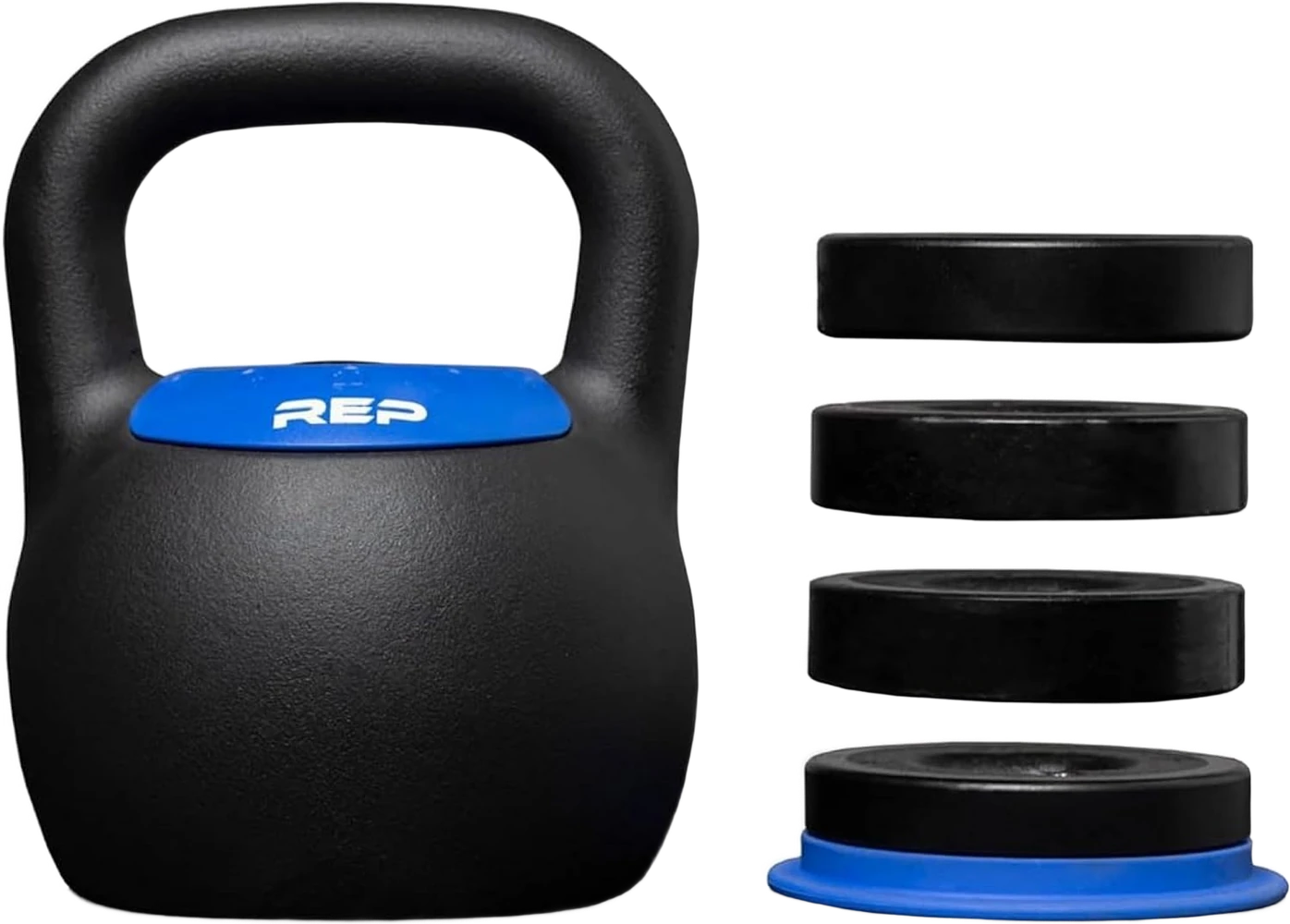
Best overall: REP Fitness Adjustable Kettlebell (Push-and-Twist, Powder-Coated Steel)
The fast, secure, do-it-right default for home kettlebell training — a push-and-twist selector that locks each plate with an internal fastener for minimal rattle when you swing, on a powder-coated steel bell with a matte non-slip handle.
~$179
Why it wins: all five scores, pros & cons, full label
- Fastest secure change here — push down and twist, with each plate locked by an internal fastener (minimal rattle when you swing)
- Powder-coated STEEL bell and a matte, non-slip handle — the material and grip leader on this list
- Five settings per band cover real progressive overload on swings, squats, and presses
- Reviewers highlight the quick, secure selector and the grippy matte finish — a genuinely do-it-right bell
- Sold in weight bands (8–16, 16–24, 20–40 lb) rather than one 8–40 lb bell — pick the band for your strength
- Priced above the cheap dial bells; not a bell to bail or drop like a one-piece competition kettlebell
- Mechanism
- Push-down-and-twist selector; each weight locked by an internal nylon fastener
- Range / settings
- Steel bell in 8–16, 16–24, or 20–40 lb bands; 5 settings each
- Material
- Powder-coated STEEL bell; internal nylon thermoplastic fasteners
- Handle / footprint
- Matte powder-coated handle (not slippery); compact single bell

Our take — This is the adjustable kettlebell to buy if you want one and want it right. It pairs the fastest, most secure mechanism here — a push-down-and-twist selector that locks each plate with an internal nylon fastener, so there's minimal rattle when you swing the load overhead — with the best materials on the list: a powder-coated steel bell and a matte, non-slip handle that's kind to your palms on high-rep swings. Five settings per band cover real progressive overload. It's sold in weight bands rather than one do-everything bell, and it costs more than the budget dials, but on our mechanism-and-build-first criteria it's the clear leader. For serious home kettlebell training, it's the cornerstone purchase.
 02
02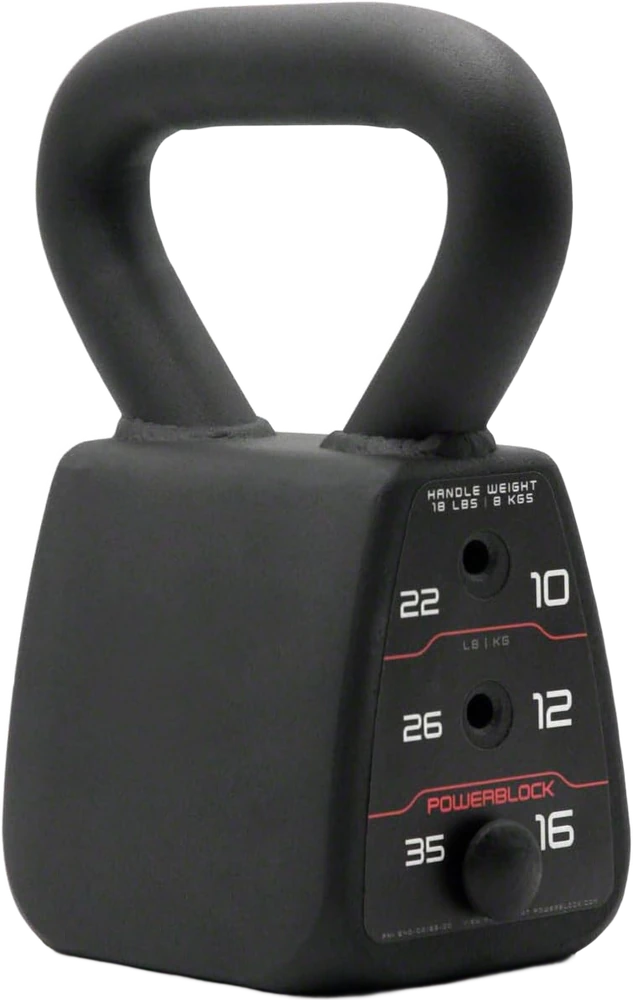 03
03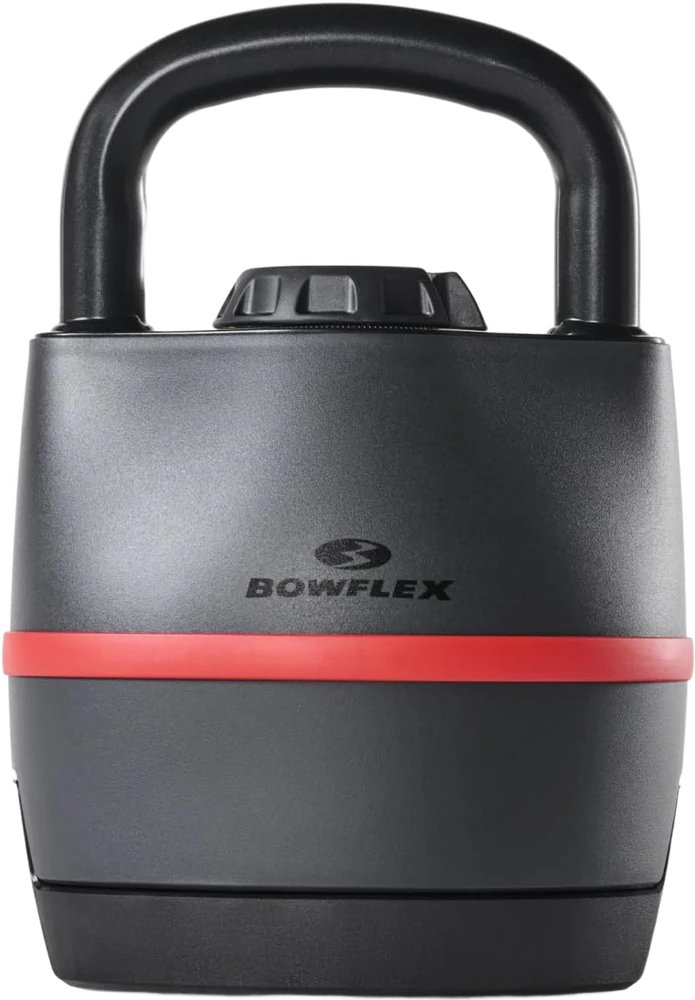 04
04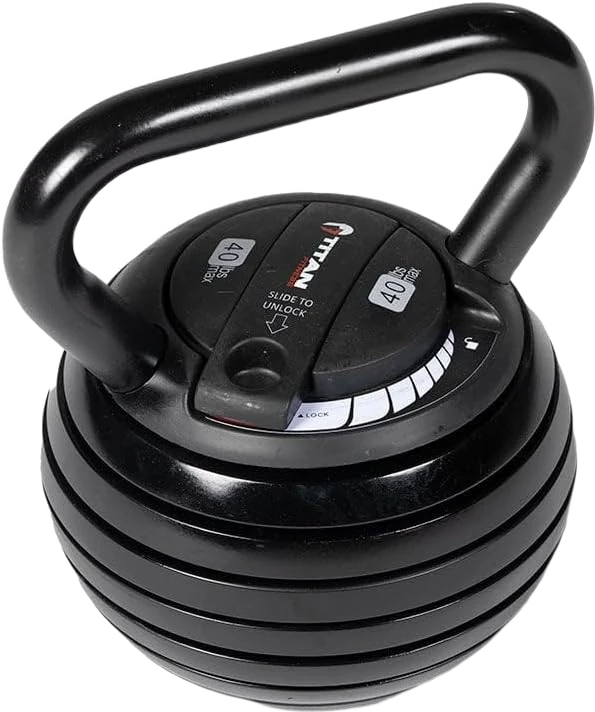 05
05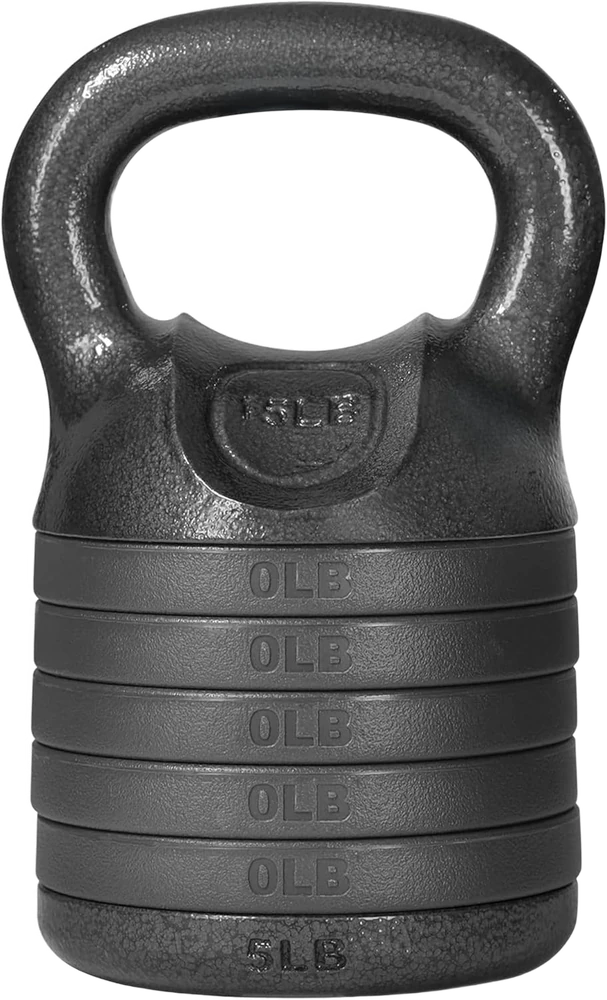 06
06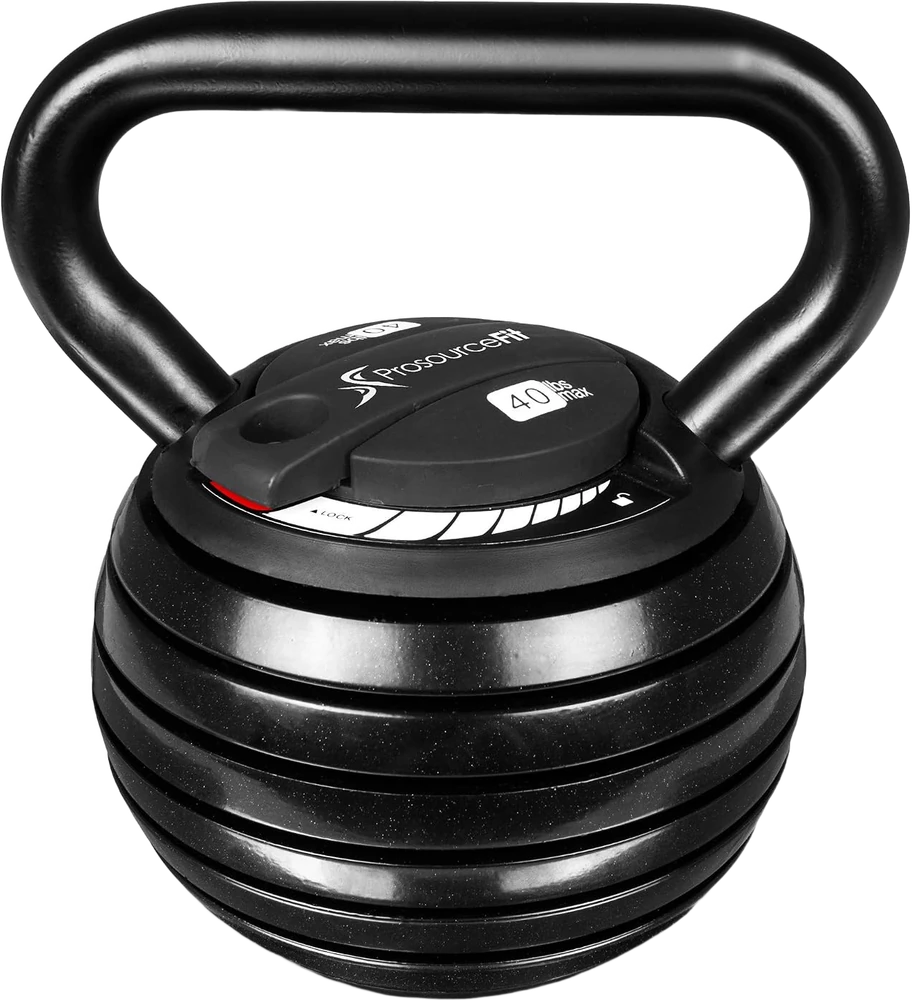 07
07Who Wins Which Aspect
Sorted by overall SAC Product Score™ — the official ranking.
| # | Pick | Score | Adjustment mechanism30% | Build quality & materials25% | Weight range15% | Handle & footprint15% | Value15% | Buy |
|---|---|---|---|---|---|---|---|---|
| 01 | | 9.1 | 9.41 | 9.22 | 8.42 | 9.02 | 8.82 | Check price |
| Fastest secure change here — push down and twist, with each plate locked by an internal fastener (minimal rattle when you swing)Sold in weight bands (8–16, 16–24, 20–40 lb) rather than one 8–40 lb bell — pick the band for your strength | ||||||||
| 02 | | 8.8 | 8.4 | 9.41 | 9.61 | 8.63 | 8.2 | Check price |
| One bell IS a full 12–32 kg set — the widest range and heaviest loads (to 70 lb) on this listChanging weight means unbolting and re-bolting plates — slower than a dial or selector | ||||||||
| 03 | | 8.6 | 8.82 | 9.03 | 8.03 | 9.21 | 8.2 | Check price |
| Positive magnetic selector pin locks the weight securely and changes quickly — no plates to boltThe base 18–35 lb range is narrower than the dial and competition bells (step up to the 35–62 lb model for heavy work) | ||||||||
| 04 | | 8.4 | 8.63 | 8.2 | 8.42 | 8.0 | 8.63 | Check price |
| Adjusts 8–40 lb with the turn of a dial — the simplest, most beginner-friendly change on the listThe molded body is bulkier at its lightest settings than a matching fixed bell | ||||||||
| 05 | | 8.4 | 8.0 | 8.6 | 8.42 | 7.8 | 9.21 | Check price |
| All solid cast iron — base and six drop plates — for excellent durability and weight per dollar28 mm handle is thinner than the 32–35 mm competition handles — less ideal for big two-hand swing sets | ||||||||
| 06 | | 7.8 | 7.0 | 8.4 | 7.6 | 7.4 | 9.21 | Check price |
| Cheapest way here to get solid, near-indestructible cast-iron weight (20–40 lb)Changing weight means adding/removing plates and re-securing the lock — the slowest method here | ||||||||
| 07 | | 7.0 | 6.8 | 6.4 | 7.0 | 7.2 | 8.4 | Check price |
| Lowest-cost adjustable here — an inexpensive way to try kettlebell trainingPlastic/vinyl body is the lightest-duty build on the list — not for heavy or high-rep swings | ||||||||
The Other 6, Ranked
- 02
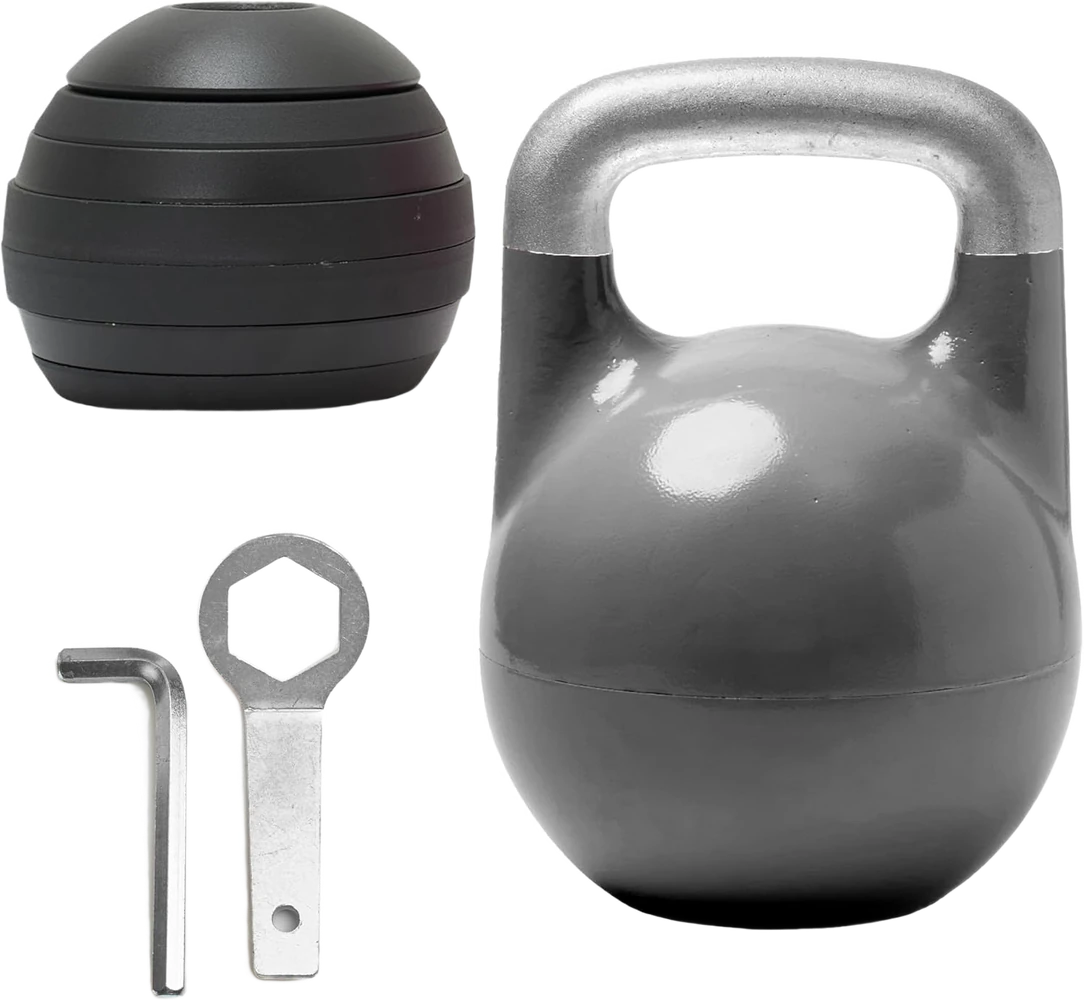
Best premium / widest range: Kettlebell Kings 12–32 kg Adjustable Competition Kettlebell (26–70 lb)
8.8SAC Score™The widest-range, best-built bell here — a steel competition shell holding seven bolted cast-iron plates that make one bell a full 12–32 kg (26–70 lb) set with 1 kg jumps.
StrongestWeight range9.61WeakestValue8.2- Mechanism
- Bolted cast-iron plates inside a steel shell; screw in/out — no plate movement
- Range / settings
- 26–70 lb (12–32 kg) in ~1 kg increments (except 13 & 31 kg)
- Material
- Steel outer shell + 7 solid cast-iron plates (2,2,2,3,3,4,4 kg)
All five scores, pros & cons, full label
What We Like- One bell IS a full 12–32 kg set — the widest range and heaviest loads (to 70 lb) on this list
- Steel outer shell with 7 solid cast-iron plates bolted in — bombproof, with no rattle or plate movement
- Competition-standard 35 mm handle and fixed dimensions give a consistent swing groove at every weight
- Replaces a whole rack of competition bells that would cost roughly $1,000 separately
What You Live With- Changing weight means unbolting and re-bolting plates — slower than a dial or selector
- Heavier and pricier than the dial bells; overkill if you only train light
- Handle / footprint
- Competition-standard 35 mm handle; fixed competition dimensions
Our take — The Kettlebell Kings adjustable competition bell is the one to get when range and build are the priority and you swing and squat with real weight. A steel competition shell holds seven solid cast-iron plates that bolt in and out, so a single bell covers 12–32 kg (26–70 lb) in 1 kg jumps with zero plate movement — and the competition-standard 35 mm handle and fixed dimensions mean the swing feels identical at every weight. It ranks #3 rather than higher only because unbolting plates is slower than a dial or push-and-twist selector, and it's heavier and pricier than the mainstream bells. But for the widest range, the heaviest usable loads, and a bombproof cast-iron build, nothing else here competes.
- 03
Best compact / selector pin: PowerBlock Adjustable Kettlebell (18–35 lb, Magnetic Selector Pin)
8.6SAC Score™The most compact, positively-locked bell here — a magnetic steel selector pin and a competition 32 mm steel handle in the smallest footprint, with a heavy 35–62 lb version available.
StrongestHandle & footprint9.21WeakestWeight range8.0- Mechanism
- Magnetic steel selector pin; positive lock, quick change
- Range / settings
- 18–35 lb (18, 22, 26, 35 lb); separate 35–62 lb model available
- Material
- Welded steel construction; competition-standard 32 mm steel handle
All five scores, pros & cons, full label
What We Like- Positive magnetic selector pin locks the weight securely and changes quickly — no plates to bolt
- Welded steel build with a competition-standard 32 mm steel handle — durable and grippy
- The most space-efficient bell on the list; a heavy 35–62 lb version covers serious swings
- Compact, secure, and built by a brand known for bombproof adjustable weights
What You Live With- The base 18–35 lb range is narrower than the dial and competition bells (step up to the 35–62 lb model for heavy work)
- The squarer, compact body feels less like a traditional round bell to some lifters
- Handle / footprint
- Most compact body here; replaces ~4 kettlebells
Our take — The PowerBlock adjustable kettlebell is the one to get when space is the constraint and you still refuse to compromise on security or build. Its magnetic steel selector pin gives a positive, quick change with no plates to bolt, the welded-steel construction and competition 32 mm handle are durable and grippy, and it's the most compact bell here. It ranks #4 because the base model's 18–35 lb range is narrower than the dial and competition bells — though a separate 35–62 lb version covers heavier swings — and the squarer body feels a little less traditional than a round bell. But for a compact, positively-locked, all-steel bell, it's an excellent pick.
- 04
Best dial / for beginners: Bowflex SelectTech 840 Adjustable Kettlebell (8–40 lb)
8.4SAC Score™The friendliest bell for a new lifter — 8–40 lb with the turn of a dial, replacing six kettlebells in one proven, widely available design.
StrongestAdjustment mechanism8.63WeakestHandle & footprint8.0- Mechanism
- Dial selector; turn the dial and lift out; re-dock to change
- Range / settings
- 8–40 lb; 6 settings (8, 12, 20, 25, 35, 40 lb)
- Material
- Steel/iron weight stack in a molded body with a metal handle
All five scores, pros & cons, full label
What We Like- Adjusts 8–40 lb with the turn of a dial — the simplest, most beginner-friendly change on the list
- Replaces 6 kettlebells in one proven, widely available bell with a stable base
- Comfortable handle for goblet squats, presses, and moderate swings
- A well-supported mainstream name at a fair mid-price
What You Live With- The molded body is bulkier at its lightest settings than a matching fixed bell
- Dial bells re-dock to change, and the plastic base/body isn't built to be dropped
- Handle / footprint
- Comfortable handle; single bell + base; bulkier at low weights
Our take — The Bowflex SelectTech 840 is the pick for someone starting out who wants the gentlest learning curve. Its dial is smooth and dead simple — turn it, lift the bell, and you've selected 8, 12, 20, 25, 35, or 40 lb — and it replaces six kettlebells in one proven, widely available design with a stable base. It ranks #2 because its molded body is bulkier at the lightest settings than a matching fixed bell, and a dial system re-docks to change and isn't built to be dropped, so it trails the all-steel REP on mechanism security and material. But for a first adjustable kettlebell, or anyone who prizes a simple dial over maximum range, it's an easy recommendation.
- 05
Best all-cast-iron value: Titan Fitness 10–40 lb Adjustable Kettlebell (6 Drop Cast-Iron Plates)
8.4SAC Score™The most cast iron per dollar — a 10 LB base that adds six drop cast-iron plates to 40 LB with a quick-lock design, at a keen price.
StrongestValue9.21WeakestHandle & footprint7.8- Mechanism
- Quick-lock design; attach/remove drop cast-iron plates
- Range / settings
- 10–40 lb; 6 drop cast-iron plates (4.6–6 lb each)
- Material
- Solid cast iron (base + 6 drop plates)
All five scores, pros & cons, full label
What We Like- All solid cast iron — base and six drop plates — for excellent durability and weight per dollar
- Quick-lock design keeps the discs secure during your workout while staying easy to change
- 10–40 lb covers swings, squats, and presses in a compact single bell
- Among the best-value bells here for an all-cast-iron build
What You Live With- 28 mm handle is thinner than the 32–35 mm competition handles — less ideal for big two-hand swing sets
- Attaching/removing plates is slower than a dial or selector; balance shifts slightly as plates change
- Handle / footprint
- 28 mm smooth handle; compact single bell
Our take — The Titan Fitness adjustable kettlebell is the value pick for someone who wants an all-cast-iron bell without paying a premium. It transitions from a 10 LB base to 40 LB by attaching six drop cast-iron plates, the quick-lock design keeps them secure through a workout, and the whole thing is solid iron — durable and heavy per dollar in a compact single bell. It ranks #5 because its 28 mm handle is thinner than the competition handles (a touch less comfortable for big two-hand swing sets), and swapping plates is slower than a selector with the balance shifting slightly across settings. But for a rugged, honest, all-cast-iron bell at a keen price, it's a lot of kettlebell for the money.
- 06
Best budget: Yes4All Adjustable Kettlebell Set, 20–40 lb (Solid Cast Iron)
7.8SAC Score™The honest bombproof-budget buy — a solid cast-iron handle and plates with spacer disks and a secure lock, giving 20–40 lb of near-indestructible weight for the least money.
StrongestValue9.21WeakestAdjustment mechanism7.0- Mechanism
- Add/remove solid cast-iron plates on the handle; spacer disks + secure lock
- Range / settings
- 20–40 lb via stacked plates
- Material
- Solid cast-iron handle and plates (no plastic shell)
All five scores, pros & cons, full label
What We Like- Cheapest way here to get solid, near-indestructible cast-iron weight (20–40 lb)
- Spacer disks and a secure lock keep the plates seated on the handle
- All cast iron with no plastic shell — nothing to crack or chip
- Compact and simple; strong durability-and-weight per dollar
What You Live With- Changing weight means adding/removing plates and re-securing the lock — the slowest method here
- Cast-iron handle is less refined than a machined competition grip; check the lock before heavy swings
- Handle / footprint
- Cast-iron handle; compact, stores as stacked plates
Our take — The Yes4All adjustable set rounds out the value end as the honest bombproof-budget pick — and an honest budget pick is exactly what it is, not a flimsy one we're punishing. It's a solid cast-iron handle and plates with spacer disks and a secure lock, giving 20–40 lb of near-indestructible weight with nothing to crack or chip, at the lowest price on this list. It ranks #6 on convenience: changing weight means physically adding or removing plates and re-securing the lock (the slowest method here), and the cast-iron handle is less refined than a machined competition grip, so check the lock before heavy swing sets. We deliberately did not crown it #1 for being cheap, but if maximum durability and weight for the least money is your priority, it delivers exactly that.
- 07
Lightest / simplest: ProsourceFit Adjustable Kettlebell (Multi-Weight)
7.0SAC Score™The lightest, simplest entry bell — a low-cost adjustable for beginners easing into goblet squats and presses, honestly placed last on build.
StrongestValue8.4WeakestBuild quality & materials6.4- Mechanism
- Simple multi-weight adjustment; re-secure to change
- Range / settings
- Multiple light-to-moderate settings (entry range)
- Material
- Plastic/vinyl body — the lightest-duty build here
All five scores, pros & cons, full label
What We Like- Lowest-cost adjustable here — an inexpensive way to try kettlebell training
- Light and compact, easy to store and handle for a true beginner
- Fine for goblet squats, presses, and light get-ups while you learn technique
- Simple, no-fuss adjustment for casual home use
What You Live With- Plastic/vinyl body is the lightest-duty build on the list — not for heavy or high-rep swings
- Handle and balance trail the steel and cast-iron bells; you'll outgrow the range if you progress
- Handle / footprint
- Molded handle; compact, light, easy to store
Our take — The ProsourceFit adjustable kettlebell closes the list as the lightest, simplest entry option — and we place it honestly last on build, not as a bell we're punishing. It's an inexpensive, compact, light adjustable that's fine for a true beginner easing into goblet squats, presses, and light get-ups while learning technique. It ranks #7 squarely on our material principle: the plastic/vinyl body is the lightest-duty construction here, its handle and balance trail the steel and cast-iron bells, and it's not the tool for heavy or high-rep swings. If your budget is rock-bottom and you just want to try kettlebell work, it does that job — but if you can stretch, the Titan (#5) or Yes4All (#6) give you real cast iron that lasts and grows with you.
The Guide In Four Short Lessons
The case in four numbers
- ~6
- Fixed bells one adjustable replaces
- 70 lb
- Top-end load on the widest pick here
- Locked
- The non-negotiable for a swung bell
- $1,000
- What the equivalent fixed rack costs
Sources: Manufacturer specifications and named equipment-review testing (Garage Gym Reviews, BarBend, Breaking Muscle). Spec and editorial-review figures, not clinical research.
Treat the lock as a safety feature.
You swing this weight overhead, so a plate that rattles or works loose mid-swing is an impact hazard. The adjustment mechanism carries 30% of our score, ahead of everything else.
Buy iron and steel before plastic.
Cast-iron and steel bells rank ahead of plastic and ABS shells. Price is a 15% tie-breaker; the cheapest bell never wins by being cheap.
Match the weight range to your training.
One adjustable bell stands in for roughly six fixed kettlebells and changes in seconds. Check that its lightest and heaviest settings cover the moves you do; every number in this list is a manufacturer spec.
Full scoring logic in “How we ranked these” below.
Each pick was scored 0–10 across the five criteria below, then weighted to a final composite — the mechanism leads at 30% because you swing this load overhead, and price is a 15% tie-breaker, never the crown. Every per-pick spec is the manufacturer's own; comparative judgments cite named equipment reviewers (Garage Gym Reviews, BarBend, Breaking Muscle) — gear, not a supplement, so no PubMed here.
Adjustment mechanism · 30%
The most important factor — and a safety issue on a kettlebell, because you swing the load overhead. We reward fast, positive, secure changes (push-and-twist with internal fasteners, bolted plates, magnetic selector pins, screw collars) and penalize plates that rattle or could shift mid-swing. Security comes before raw speed.
Build quality & materials · 25%
Our material principle applied: a cast-iron or steel bell — iron plates with a steel or aluminum handle — is drop-tolerant, balances consistently, and lasts, ranking ahead of a plastic or ABS shell over the plates. Overall construction and a smooth, chip-free handle live here.
Weight range · 15%
The bell must outlast your progression. An 8–20 lb toy stalls fast on swings and squats, so wider ranges (Bowflex 840 8–40, Titan 10–40) and competition-style systems (Kettlebell Kings to 70 lb, PowerBlock's 35–62 lb option) score higher.
Handle & footprint · 15%
A kettlebell isn't a dumbbell: a smooth, chip-free handle around 32–35 mm with a wide window is essential for two-hand swings, and balance must stay consistent across settings. How compactly the bell stores, and any base it needs, are here too.
Value (price) · 15%
Price for the mechanism and build delivered. Tie-breaker — the first four criteria do most of the ranking. PRICE IS SUBORDINATE: a better-built, more secure bell can rank higher even if it costs more, while affordability is recognized with a 'Best budget' badge rather than by crowning the cheapest plastic bell.

How an adjustable kettlebell builds muscle
- 1
Muscle growth needs progressive overload
Muscles adapt to a training stimulus, then stop. To keep building you have to keep adding load, reps, or volume over time on your main movements — swings, squats, presses, rows. That requires having the next weight up available exactly when you're ready for it.
- 2
One adjustable bell is the whole ladder of loads
Instead of buying and storing 5–7 fixed kettlebells, a single adjustable bell holds every step from light to heavy and changes in seconds. You jump to the next setting the moment you own your current one — and because a kettlebell is swung ballistically, a secure, positively-locked mechanism is what makes that safe.
- 3
Consistency over months does the building
With the right load always at hand, the only variable left is showing up and progressing. Train the main lifts, add weight when you can do all your reps cleanly, eat enough protein and recover — and the bell quietly compounds those increases into real muscle. The kettlebell doesn't build muscle; it makes the progression possible.
What to expect in your first few months of training
Technique and the habit
Early gains are mostly skill — you learn the hip hinge, the swing groove, and the rack position. The convenience of fast, secure weight changes is what makes the habit stick: no excuse not to do the next set at the right load.
The weight starts climbing
You'll move up the settings regularly as swings and squats that felt hard get easy. This is progressive overload in action, and it's why range and secure plate locking matter — you don't want to stall because the bell ran out of weight or you don't trust it overhead.
Visible, usable strength and muscle
Consistent overload plus protein and recovery turns into noticeable muscle — especially in the posterior chain, shoulders, and grip. A wide-range or competition bell keeps heavy swings and squats challenging deep into this phase; light bells are where some lifters wish they'd bought more range up front.
The bottom line
Just want the answer: buy the REP Fitness Adjustable (#1).
Fastest secure change on the list, internal fasteners that keep plates from rattling mid-swing, powder-coated steel — it leads on the two things that matter most: mechanism security and build.
Heavy swings? Kettlebell Kings (#2). Simplest dial? Bowflex 840 (#4). Tight budget? Yes4All (#6).
The Kings reaches 70 lb with bolted cast-iron plates; the Bowflex covers 8–40 lb with one dial; the Yes4All is bombproof cast iron at $1.75/lb — slow to change, honestly placed.
Whatever you buy: lock first, range second, price last.
Judge the mechanism on how securely it locks (you swing it), buy enough range to outlast your progression, and inspect the plates before heavy sets. Don't bail or drop an adjustable bell like a competition kettlebell.
Quick Answers
Are adjustable kettlebells good enough for building muscle, or do I need a rack of fixed bells?
For the vast majority of home lifters, a good adjustable bell IS a rack — that's the point. Muscle is built through progressive overload (adding load and volume as you get stronger), and one adjustable kettlebell replaces roughly 5–7 fixed bells while letting you jump to the next weight the moment you can. A wide-range bell (Bowflex 840 at 8–40 lb, or a competition-style Kettlebell Kings at 26–70 lb) covers swings, goblet squats, presses, cleans, rows, and get-ups for a long time. The honest limits: adjustable bells are bulkier at their lightest settings than a matching fixed bell, and you shouldn't bail or drop them like a competition kettlebell. But as the space-saving core of a home setup, they're hard to beat.
Which adjustment mechanism is best — dial, push-and-twist selector, selector pin, or plates-and-collar?
With a kettlebell the question is security first, because you swing the load. Push-down-and-twist selectors (REP) are fast and lock each plate with an internal fastener, so there's minimal rattle. Dial selectors (Bowflex 840) are fast and simple but you re-dock the bell to change, and plate security varies by model. Magnetic selector pins (PowerBlock) are positive and very compact. Bolted cast-iron plates inside a steel shell (Kettlebell Kings) and screw-collar plate systems (Yes4All) are the most bombproof but the slowest to change. We weight security first, then speed — a bell you swing overhead has to hold together.
Is it safe to swing an adjustable kettlebell?
Yes, with the right bell and a habit of checking it — and this is exactly why we weight the mechanism first. A kettlebell is swung ballistically overhead and between the legs, so the plates must be held by a positive lock, not just friction. The bells we rank highest use secure fasteners: REP's internal nylon thermoplastic fasteners, Kettlebell Kings' bolted plates, PowerBlock's magnetic selector pin, and screw collars on the Yes4All. Whatever you buy, make a two-second inspection part of your setup — confirm the plates are seated and locked before a heavy swing set — and don't bail or drop an adjustable bell the way you might a one-piece competition kettlebell. Treat it with a little care and it's perfectly safe.
Why are the cast-iron and steel kettlebells ranked above the cheaper plastic ones?
Because you load, swing, and sometimes set these down hard, and material decides how long they last, how well they balance, and how secure they feel. Per our material principle, a cast-iron or steel bell — iron plates with a steel or aluminum handle — is drop-tolerant, holds consistent balance across settings, and survives years of use. A plastic or ABS shell over the plates is the durability ceiling and can crack or chip, and coated/plastic handles are rougher on the hands during swings. So the iron/steel bells (REP, Bowflex 840, Kettlebell Kings, PowerBlock, Titan) rank ahead, and the plastic-handled bells sit lower. We don't punish a cheap bell for being cheap — we place it honestly on build, then flag genuine value with a 'Best budget' badge.
What weight range should I get — 40 lb or 70 lb?
Buy enough to outlast your progression, because outgrowing a bell fast is a false economy — and swings and goblet squats climb quickly. A single 8–40 lb bell (Bowflex 840) or 10–40 lb (Titan) is a great all-round starting range that covers presses, get-ups, and early swings and squats. If you already swing and squat with real weight, step up to a competition-style system: the Kettlebell Kings 12–32 kg reaches 70 lb with 1 kg jumps, and PowerBlock offers a heavy 35–62 lb option. Heavier bells cost more, but for two-hand swings and squats they're the ones you won't outgrow in a season.
Does the handle really matter that much on a kettlebell?
More than on any other free weight. Unlike a dumbbell you grip a kettlebell's handle for high-rep two-hand swings, so it needs to be smooth and chip-free, around 32–35 mm thick, with a window wide enough for both hands, and it has to keep consistent balance as you change plates. A rough, thin, or wobbling handle tears up your palms and ruins the swing groove. This is why machined steel and competition handles (REP's matte powder-coat, Kettlebell Kings' 35 mm competition handle, PowerBlock's 32 mm steel handle) rank ahead of the coated and plastic grips on the budget bells — the handle is a big part of what you're paying for.
How is an adjustable kettlebell different from an adjustable dumbbell?
They complement each other, but they're not interchangeable. A kettlebell's offset center of mass and single thick handle make it the tool for ballistic, full-body moves — swings, cleans, snatches, get-ups — and for goblet squats and single-arm presses that build the posterior chain and core. An adjustable dumbbell is better for isolation and bilateral pressing/rowing volume. For hypertrophy, many home lifters run both: kettlebell swings and squats for explosive full-body work, dumbbells for targeted volume. If you can only pick one to start and you like ballistic training, an adjustable kettlebell is a superb, space-saving choice — just judge the mechanism on security, since you swing it.
Why is a slow cast-iron plate-and-collar set (Yes4All) on a 'best' list at all?
Because it's honestly the best pick for one real buyer: someone who wants maximum durability and weight for the least money and doesn't mind slow changes. The Yes4All adjustable set uses solid cast-iron plates on a handle with spacer disks and a secure lock, at a low price per pound — it's essentially indestructible on the plate side and a fraction of the cost of a selector bell. The trade-offs are equally honest: changing weight means adding or removing plates and re-securing the lock (the slowest method here), and it doesn't feel as seamless as a competition bell. So we place it on convenience, not as a flimsy bell we're punishing, and badge it 'Best budget'. Quality leads our ranking; this is value done honestly.
Every Claim Ranked Above Traces Back To One Of These
3 sources — studies link to PubMed, product specs to the manufacturer
- [1] Garage Gym Reviews — Best Adjustable Kettlebells — hands-on testing of mechanism, build, and handle. Independent equipment reviewers who hands-on test adjustable kettlebells for adjustment speed and security, build quality, handle feel, and balance. Source for comparative judgments such as the security of push-and-twist and selector-pin mechanisms, the durability of cast-iron and steel bells versus plastic shells, and the caution that adjustable bells should not be bailed or dropped like one-piece competition kettlebells. (Equipment review, not research.)
- [2] BarBend — Best Adjustable Kettlebells — scored on adjustability, build, range, handle, and value. Equipment reviewers who score adjustable kettlebells across ease and security of adjustment, build, weight range, handle quality, and value. Source for the Bowflex SelectTech 840 as a go-to beginner dial, the REP Fitness bell's quick secure selector and grippy matte handle, and per-product pros/cons cited above. (Editorial product testing, not a clinical study.)
- [3] Breaking Muscle — Best Adjustable Kettlebells — including competition-style plate-loaded bells. Equipment reviewers who evaluate adjustable and competition-style kettlebells for range, plate security, handle, and value. Source for the comparative judgment that competition-style plate-loaded bells (Kettlebell Kings) offer the widest range and heaviest usable loads per dollar, at the cost of slower plate changes. (Editorial product testing, not research.)
Affiliate disclosure: every Amazon link uses our Associates tag (superachieverclub-20). We earn a small commission at no cost to you; it funds independent reviews. We never accept payment to change a ranking.