
Top 8 Best CBT-i Apps & Programs to Beat Insomnia (2026)
8 picks — ranked by our 50/50 methodology
- #1Best overall — strongest evidence
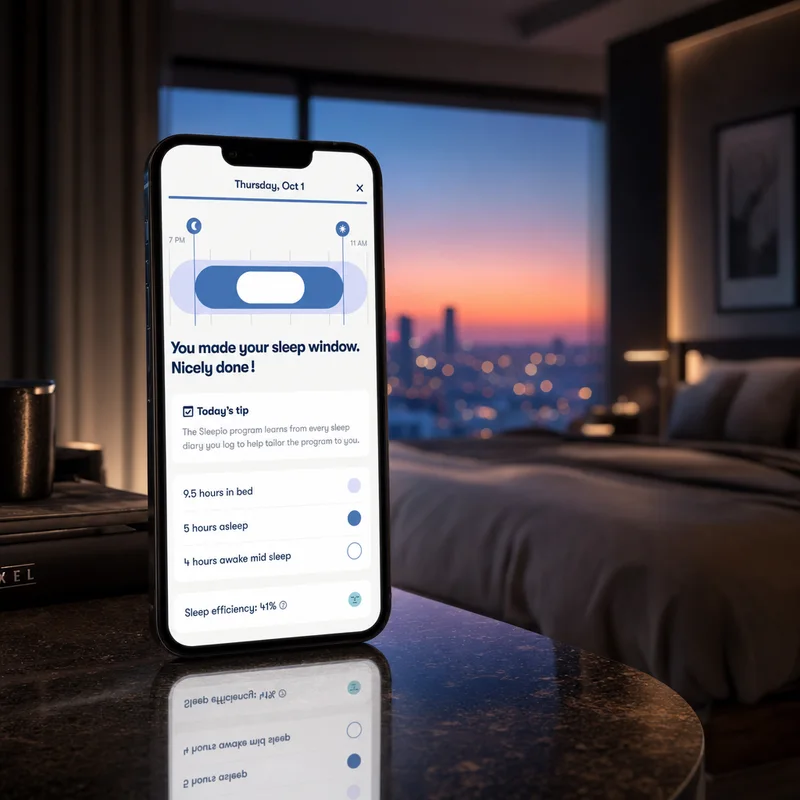
Sleepio (Big Health)
Big Health · self-guided digital CBT-i with the strongest independent RCT base9.1/10SAC Product Score™SAC Product Score™ — how it breaks down- Evidence35%9.6
- Guidance & structure30%9.4
- Access & value25%7.8
- Experience / support10%9.2
The best-evidenced guided CBT-i program in the world: the full protocol delivered by an animated sleep expert, backed by the strongest independent randomized trials in the category.
- Maker
- Big Health
- Delivery
- Self-guided app — weekly sessions with an animated 'Prof'
- Evidence
- Espie 2012 (SLEEP) + Espie 2019 (JAMA Psychiatry, n=1,711)
- Access
- Usually via employer benefit or the NHS, not freely purchasable
Pros- The strongest independent RCT evidence of any digital CBT-i program — the science benchmark for the category
- Delivers the complete protocol: sleep restriction, stimulus control, cognitive work, and progress tracking
- Polished, engaging program guided by an animated sleep expert that adapts to your sleep diary
- Recognised by NICE in the UK and offered as a covered benefit by many large US employers and health plans
Cons- Access is the real limitation — it's usually provided through an employer or the NHS rather than something you can simply buy
- Fully automated: there's no human coach, so the support is in the program design, not a person
Our take — On independent evidence, nothing else here is close. Sleepio is the digital CBT-i program with the strongest randomized-trial base in the category — a placebo-controlled trial in the journal SLEEP (Espie 2012) and a 1,711-person trial in JAMA Psychiatry (Espie 2019) — and it delivers the full protocol through an engaging, adaptive program led by an animated sleep expert. The single honest caveat is access: it's largely gated behind an employer benefit or the NHS rather than freely purchasable, which is exactly why its value score sits below the free apps. If you can get Sleepio through work or the NHS, it's the best-evidenced guided way to do CBT-i, full stop. If you can't, the free VA apps below run the same protocol for nothing.
- #2Best free
CBT-i Coach (US VA + Stanford + DoD)
US Dept. of Veterans Affairs · genuinely free, evidence-aligned CBT-i companion app8.9/10SAC Product Score™SAC Product Score™ — how it breaks down- Evidence35%8.6
- Guidance & structure30%8.7
- Access & value25%10.0
- Experience / support10%8.0
The best free way to run real CBT-i: built by the US VA with Stanford and the DoD, it walks anyone through the core protocol tools for exactly zero dollars.
- Maker
- US VA National Center for PTSD + Stanford + DoD
- Delivery
- Free self-guided app (solo or alongside a therapist)
- Cost
- Free — open to anyone, not just veterans
- Tools
- Sleep diary, stimulus control, sleep restriction, relaxation
Pros- Genuinely free and open to anyone — the best evidence-per-dollar option on the entire list
- Built by serious institutions: the VA's National Center for PTSD with Stanford School of Medicine and the DoD
- Delivers the real CBT-i tools and is actively maintained, with recent (2025) research examining its use
- Works solo or as a companion to therapy — a perfect pairing with a self-help book to learn the method
Cons- Plainer, more utilitarian UX than the slick paid apps — it's a clinical tool, not a consumer-polished experience
- No human coach and designed partly as a therapy companion, so motivated self-direction is on you
Our take — The best free CBT-i app, and our pick for anyone who wants maximum evidence per dollar. CBT-i Coach was developed by the US Department of Veterans Affairs with Stanford and the DoD's telehealth center, and it puts the core protocol — sleep diary, stimulus control, sleep restriction, relaxation — in your pocket for nothing. It scores a perfect 10 on access because anyone, anywhere can download it today at zero cost, and it's evidence-ALIGNED: built on the established protocol by credible institutions and still studied in 2025. It ranks #2 rather than #1 only because its independent trial evidence as a standalone program isn't as strong as Sleepio's, and its UX is plainer. Pair it with our books guide to learn the method, and you have the gold-standard treatment for free.
- #3Best clinician-supported
Sleepstation
Sleepstation (UK) · clinician-supported 6-week CBT-i course, available on the NHS8.7/10SAC Product Score™SAC Product Score™ — how it breaks down- Evidence35%8.8
- Guidance & structure30%9.2
- Access & value25%7.8
- Experience / support10%8.8
The closest thing to formal care without leaving home: a clinician-supported 6-week CBT-i course with a real human team, free on the NHS across most of England.
- Maker
- Sleepstation (UK)
- Delivery
- 6-week course with sleep coaches + clinicians, overseen by a doctor
- Access
- Free on the NHS in ~36 of 41 ICS regions; otherwise paid
- Support
- Human team — personalised guidance throughout
Pros- A real human team — sleep coaches and clinicians overseen by a doctor — guides you through the full course
- Free on the NHS across most of England, with no waiting lists and strong real-world outcomes
- The most support of any non-prescription option here — the pick if you'd stall on a solo app
- Structured, personalised 6-week programme built around the full CBT-i protocol
Cons- Geographically limited — NHS access is UK-only, and self-pay applies where it isn't commissioned
- Not an instant self-serve download: you go through a referral or sign-up rather than tapping 'install'
Our take — The best option if you want a human in the loop. Sleepstation delivers a structured six-week CBT-i course supported by a real team of sleep coaches and clinicians, overseen by a doctor — the closest thing to formal behavioural-sleep care without leaving home. It's free on the NHS across most of England with no waiting lists, and reports strong real-world improvement. It ranks just behind the top two because access is geographically limited (UK-focused, self-pay elsewhere) rather than universally open like the free apps, and because it isn't an instant download. But for a reader who knows they'd stall on a purely self-guided app — and who can access it — the human support makes it the strongest non-prescription program here.
- #4Best free self-guided plan
Insomnia Coach (US VA)
US Dept. of Veterans Affairs · free 5-week guided self-management program8.6/10SAC Product Score™SAC Product Score™ — how it breaks down- Evidence35%8.0
- Guidance & structure30%8.5
- Access & value25%10.0
- Experience / support10%7.6
The free VA app with the most structure for going solo: a guided 5-week training plan, a feedback 'sleep coach', an interactive diary, and a full CBT-i toolkit — all for $0.
- Maker
- US VA National Center for PTSD
- Delivery
- Free, fully self-guided 5-week training plan
- Cost
- Free — open to anyone
- Tools
- Weekly plan, sleep coach feedback, interactive diary, 17 tools
Pros- Free and open to anyone — a complete, structured 5-week guided CBT-i self-management program
- More self-contained than CBT-i Coach for going solo: a weekly training plan plus an in-app feedback coach
- Interactive sleep diary and 17 tools cover the real protocol end to end
- From the VA's National Center for PTSD — credible, evidence-based design at zero cost
Cons- Like the other VA app, the UX is functional rather than polished, and there's no human coach
- Designed as a self-management tool — it explicitly doesn't replace professional care for severe insomnia
Our take — The free app to choose if you want more structure for going it alone. Where CBT-i Coach is partly a therapy companion, Insomnia Coach is a self-contained, guided five-week program: a weekly training plan, an in-app 'sleep coach' that gives feedback, an interactive diary, and a 17-tool kit — all from the VA's National Center for PTSD, and all free. It ties the other VA app on access (a perfect 10 — anyone can install it today) and edges it on structure for solo use, landing at #4. Its independent evidence as a standalone program is lighter than Sleepio's and its UX is plain, but as a free, complete, guided CBT-i program, it's outstanding value and a genuinely strong place to start.
- #5Only FDA-cleared (prescription)
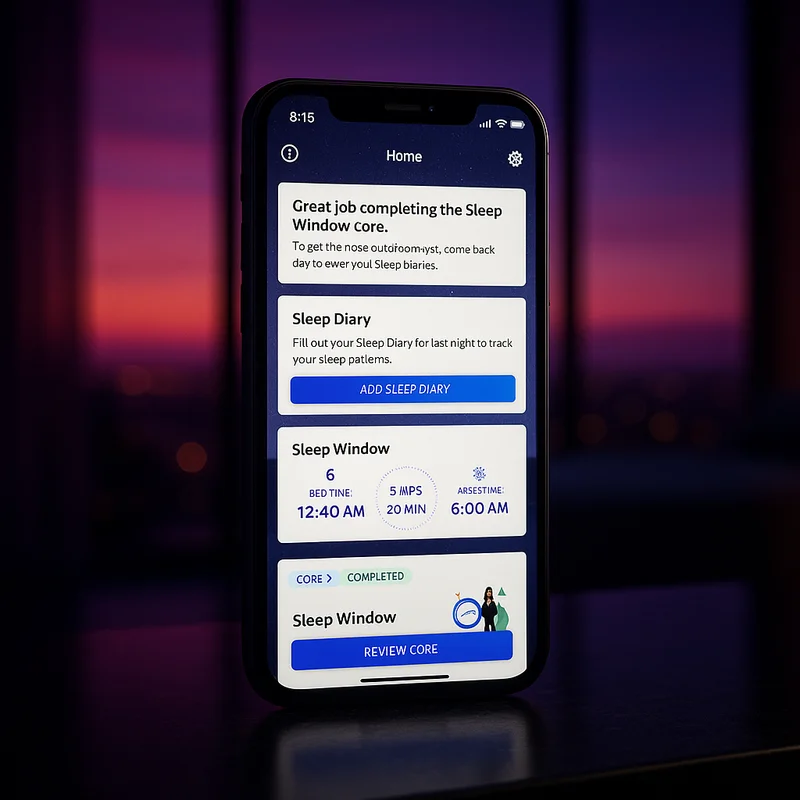
Somryst (Nox Health)
Nox Health · the only FDA-cleared CBT-i prescription digital therapeutic7.7/10SAC Product Score™SAC Product Score™ — how it breaks down- Evidence35%9.0
- Guidance & structure30%8.6
- Access & value25%5.2
- Experience / support10%7.0
The only FDA-cleared CBT-i prescription digital therapeutic — it survived Pear Therapeutics' bankruptcy under Nox Health and is still obtainable in 2026, by prescription.
- Maker
- Nox Health (acquired from Pear Therapeutics, 2023)
- Delivery
- 9-week FDA-cleared prescription digital therapeutic (PDT)
- Access
- By prescription only, through an employer / health plan / system
- Status
- Survived Pear's 2023 bankruptcy; live + updated clinician docs (2025)
Pros- The only FDA-cleared CBT-i prescription digital therapeutic — the highest regulatory bar of any program here
- Survived Pear Therapeutics' 2023 bankruptcy intact: acquired by Nox Health and still obtainable in 2026
- Delivers a structured 9-week CBT-i program under clinician supervision — closest to formal medical treatment
- FDA clearance means its evidence package met a regulatory standard the consumer apps haven't faced
Cons- Access is the real weakness — prescription-gated through an employer or health plan, far harder to get than any app
- Not a consumer self-serve product, and its individual-patient enrolment path in 2026 can be unclear; check current availability
Our take — The honest outlier: highest evidence bar, hardest to actually get. Somryst is the only FDA-cleared CBT-i prescription digital therapeutic, and the obvious worry — that it died when its maker Pear Therapeutics went bankrupt in 2023 — turns out to be wrong. We verified that Nox Health acquired Somryst out of that bankruptcy, the product survives, and Nox published updated clinician instructions in 2025, so it remains obtainable in 2026. The catch is access: it's prescription-only, routed through an employer or health plan rather than downloadable, which is why its access score is the lowest here and it lands at #5 despite top-tier evidence. If you can get a prescription and want the FDA-cleared option, it's a genuine choice; if you can't, Sleepstation or the free VA apps deliver the same protocol with far less friction. (Confirm current availability directly, as the individual-patient path can shift.)
- #6Best coach-guided
Sleep Reset
Sleep Reset · coach-guided, CBT-i-based, medication-free program7.1/10SAC Product Score™SAC Product Score™ — how it breaks down- Evidence35%6.8
- Guidance & structure30%8.4
- Access & value25%5.5
- Experience / support10%8.2
A coach-guided, medication-free CBT-i program with a real human sleep coach and 1:1 messaging — the pick if accountability is what keeps you on track.
- Maker
- Sleep Reset (from Simple Habit's founder)
- Delivery
- Coach-guided CBT-i-based program with 1:1 messaging
- Cost
- Paid subscription — check the site for current pricing
- Support
- Real human sleep coaches / clinicians
Pros- Pairs a CBT-i-based program with a real human sleep coach and dedicated 1:1 messaging for accountability
- Medication-free and built around the protocol — sleep restriction, consolidation, and behavioural change
- A polished, structured experience with a personal coach — good if a fully self-guided app would lose you
- Reports strong member outcomes within the first few weeks (company-reported)
Cons- Little independent trial evidence — its effectiveness figures are company-reported, not external RCTs
- Paid subscription with a low-cost trial that steps up to a larger charge — read the pricing before committing
Our take — The best coach-guided pick, and a reasonable choice if accountability is your missing ingredient. Sleep Reset wraps a CBT-i-based, medication-free program around a real human sleep coach with 1:1 messaging — exactly the kind of support that helps people push through sleep restriction, the hardest part of the protocol. It's polished and structured, and members report good results within a few weeks. It ranks #6 because of the honest evidence gap: unlike Sleepio, it doesn't have independent randomized trials, so its outcome claims are company-reported rather than externally validated, and it's a paid subscription. The underlying method is sound CBT-i; just go in knowing you're paying for coaching and convenience, not trial-grade proof of this specific app.
- #7Best app + human coaching
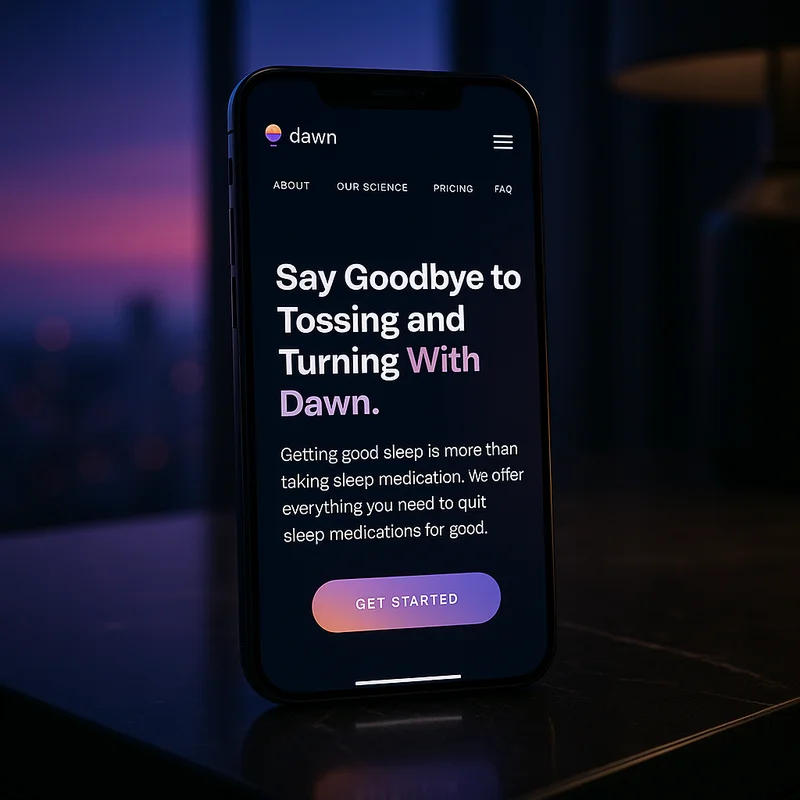
Dawn (Dawn Health)
Dawn Health · CBT-i program with dedicated human sleep coachingSAC Product Score™ — how it breaks down- Evidence35%6.6
- Guidance & structure30%8.6
- Access & value25%5.0
- Experience / support10%8.4
A CBT-i program built around a dedicated human sleep coach — weekly check-ins and unlimited chat, with some insurance coverage to soften the cost.
- Maker
- Dawn Health
- Delivery
- CBT-i program with a dedicated coach, weekly check-ins + chat
- Cost
- Paid subscription; in-network with some insurers — check eligibility
- Support
- Dedicated human sleep coach throughout the program
Pros- Combines a structured CBT-i program with a dedicated human sleep coach, weekly check-ins, and unlimited chat
- In-network with some insurance providers, which can meaningfully lower the cost for eligible users
- Strong on guidance and the human-support axis — a genuine coached program, not just a content library
- Personalised plan that adapts to your daily sleep data with a coach in the loop
Cons- Little independent trial evidence yet — score it on the established method, not on app-specific RCTs
- Paid program (insurance aside), and coverage/eligibility varies — confirm what you'd actually pay
Our take — A strong coached program that loses only on independent evidence. Dawn builds its CBT-i program around a dedicated human sleep coach with weekly check-ins and unlimited chat, and being in-network with some insurers can soften the cost — both real advantages on the guidance and support axes. The reason it sits at #7 is the same honest caveat that applies to the other newer commercial apps: it doesn't yet have independent randomized trials, so its evidence rests on the established CBT-i method rather than app-specific proof. If a dedicated coach and possible insurance coverage matter most to you, Dawn is a credible pick; if independent evidence is your priority, Sleepio or a free VA app comes first.
- #8Modern self-guided app
Stellar Sleep
Stellar Sleep · modern CBT-i + behavioural-psychology app6.9/10SAC Product Score™SAC Product Score™ — how it breaks down- Evidence35%6.4
- Guidance & structure30%8.2
- Access & value25%5.8
- Experience / support10%8.0
The slickest modern self-guided app on the list — CBT-i plus behavioural psychology in a polished package — but the newest and least independently studied.
- Maker
- Stellar Sleep (began at Harvard Innovation Labs)
- Delivery
- Self-guided CBT-i + behavioural-psychology app
- Cost
- Paid subscription; FSA/HSA-eligible — check current pricing
- Method
- Built around sleep restriction and consolidation
Pros- A polished, modern, self-guided app built on CBT-i and behavioural psychology, with a fast-growing user base
- FSA/HSA-eligible, and built around the real levers — sleep restriction and consolidation
- Strong consumer-app experience for people who'll engage more with a slick, well-designed interface
- Reports many users improving within the first couple of weeks (company-reported)
Cons- The least independent trial evidence on this list — the newest of the commercial apps
- Paid subscription with a low intro price that steps up — and some users note it skews toward sleep-onset over staying asleep
Our take — The most modern self-guided experience, ranked last on purpose — because this list leads with evidence, not polish. Stellar Sleep, which began at Harvard Innovation Labs, delivers CBT-i and behavioural psychology in a genuinely slick, well-designed app, is FSA/HSA-eligible, and is built around the real mechanisms of sleep restriction and consolidation. For someone who'll engage more with a polished consumer app, it's appealing. But it has the thinnest independent evidence of any program here — it's the newest commercial entrant, and its outcome figures are company-reported rather than from external trials — so it scores lowest on the heaviest criterion and lands at #8. The method is legitimate CBT-i; just know you're choosing it for the experience, with the least independent proof of the eight. If evidence leads your decision, start higher up the list.

▸ Affiliate disclosure: every Amazon link uses our Associates tag (superachieverclub-20). We earn a small commission at no cost to you; it funds independent reviews. We never accept payment to change a ranking.
The first-line insomnia treatment was never a pill
- 01
CBT-i isn't one option among many — it's the guideline-mandated first choice.
Both the American College of Physicians (Qaseem 2016) and the American Academy of Sleep Medicine (Edinger 2021) recommend CBT-i as the first-line treatment for chronic insomnia, ahead of sleeping pills. A meta-analysis of 20 randomized trials (Trauer 2015) shows it durably improves how fast you fall asleep, how long you lie awake, and sleep efficiency — without tolerance, dependence, or next-day grogginess.
- 02
The problem was never whether CBT-i works — it's getting access to it.
Formal CBT-i with a specialist is expensive and waitlisted. Digital programs deliver the same protocol — sleep restriction, stimulus control, cognitive work, progress tracking — and the 1,711-person Espie 2019 trial in JAMA Psychiatry showed a guided digital program meaningfully improves sleep and daytime functioning.
- 03
This ranking surfaces the uncomfortable tradeoffs instead of hiding them.
Sleepio has the strongest independent randomized-trial evidence of any digital CBT-i product — Espie 2012 in SLEEP, Espie 2019 in JAMA Psychiatry — but it's largely gated behind an employer benefit or the NHS, and we say so rather than crowning it on evidence alone. The genuinely free US VA apps (CBT-i Coach, Insomnia Coach) rank very high because anyone can run the full protocol today for $0, plainer UX and all.
- 04
The newest commercial apps are scored on the evidence they actually have — which is thin.
Sleep Reset, Dawn, and Stellar Sleep deliver real CBT-i with genuine human coaching, but they have little-to-no independent trial data yet — most of their outcome figures are company-reported. We rank them lower on evidence and never imply trials they don't have.
Five PubMed-verified sources: Espie 2012 (PMID 22654196), Espie 2019 (PMID 30264137, n=1,711), Trauer 2015 (PMID 26054060), Qaseem 2016 (PMID 27136449), Edinger 2021 (PMID 33164742).
How we ranked these eight
Each program was scored 0-10 across four criteria, then weighted to a final composite. Evidence carries the most weight (35%) because the entire promise of CBT-i is that it's proven: does the app have independent randomized-controlled-trial validation, or just the right method and a marketing page? This is where Sleepio pulls decisively ahead (it has the strongest independent trials of any digital program), the FDA-cleared Somryst and the VA apps form a strong second tier, and the newest commercial apps score lower because their evidence is largely company-reported. Guidance and structure (30%) asks whether the program delivers the FULL protocol — sleep restriction, stimulus control, cognitive work, and progress tracking — with a real plan, not just sleep tips. Access and value (25%) rewards being free, cheap, and easy to get: the free VA apps win here, while prescription- or eligibility-gated programs score lower no matter how good they are, because a treatment you can't obtain doesn't help you. Experience and support (10%) is the lightest weight — UX polish and human coaching, the tie-breaker. We rank by Evidence and Guidance primarily, so the #1 is genuinely the best-evidenced guided way to do CBT-i; and it's deliberately legitimate for a plain, free app to rank near the top on value, because honest access matters more than a slick interface. We do not invent figures — every clinical claim rests on five verified sources (Espie 2012, Espie 2019, Trauer 2015, Qaseem 2016, Edinger 2021).
- Evidence35%
Independent RCTs and clinical validation. Sleepio scores highest — it has the strongest independent randomized-trial base of any digital CBT-i program (Espie 2012 in SLEEP; Espie 2019 in JAMA Psychiatry, n=1,711). The FDA-cleared Somryst and the evidence-aligned VA apps are a strong second tier. Brand-new commercial apps score lower: real method, but little-to-no independent trial data — we never imply evidence they don't have.
- Guidance & structure30%
Does it deliver the FULL CBT-i protocol with a real plan — sleep restriction, stimulus control, cognitive work, and progress tracking — rather than just sleep hygiene tips? The dedicated programs and clinician-led courses score highest. A generic 'sleep' app with only meditations and white noise would score near zero here, however polished; this is the line between real CBT-i and a relaxation app.
- Access & value25%
How free, cheap, and easy to obtain it is. The free US VA apps score highest — anyone can run the full protocol with them today for $0. Subscription apps sit in the middle. Eligibility- or prescription-gated programs (Sleepio via employer/NHS; Somryst by prescription) score lower on access, because a treatment you can't easily get is worth less to a real reader, regardless of its quality.
- Experience / support10%
The lightest weight and the tie-breaker: UX polish and human coaching. Coach- and clinician-supported programs (Sleepstation, Sleep Reset, Dawn) and slick modern apps (Stellar Sleep) earn back ground here. But it's deliberately light — a plain, free app that runs the real protocol beats a beautiful one you can't afford or that lacks evidence.

Prefer to read or do it yourself? — and the bottom line
- 01
If you can get it through an employer or the NHS, Sleepio (#1) is the best-evidenced guided CBT-i program, full stop.
It has the strongest independent randomized trials in the category — Espie 2012 in the journal SLEEP and the 1,711-person Espie 2019 trial in JAMA Psychiatry — and delivers the full protocol through an adaptive guided program. The one honest catch is access: it's usually provided as a benefit, not freely purchasable.
- 02
Can't access Sleepio? There's a right pick for every situation — including free.
The US VA apps win on value: CBT-i Coach (#2) runs the full protocol for $0, and Insomnia Coach (#4) adds a more structured 5-week plan, also free. UK readers get clinician-supported Sleepstation (#3) free on the NHS; Somryst (#5) is the only FDA-cleared program, prescription-only; Sleep Reset (#6), Dawn (#7), and Stellar Sleep (#8) add human coaching or polish but carry thinner independent evidence.
- 03
The rule: rank by evidence and protocol completeness — then be honest about access.
The best program is the one that actually gets you doing the gold-standard treatment: for many people on a budget that's a free VA app, while the best evidence sits with Sleepio. Prefer to read or DIY? A self-help book teaches the same protocol (/best/sleep-books) — and if a self-guided program stalls, escalate to a behavioural-sleep specialist.
Every claim ranked above traces back to one of these
Peer-reviewed studies, meta-analyses and clinical trials behind the picks. Click any citation to read the abstract on PubMed.
- [1]Espie 2019
Effect of Digital Cognitive Behavioral Therapy for Insomnia on Health, Psychological Well-being, and Sleep-Related Quality of Life: A Randomized Clinical Trial
Large randomized trial (n=1,711) of digital CBT-i (the Sleepio program) versus sleep-hygiene education: dCBT significantly improved insomnia, functional health, psychological well-being, and sleep-related quality of life. The strongest single piece of evidence that a guided digital program — not just in-person therapy — delivers real CBT-i benefit, and the core reason Sleepio is our #1.
- [2]Espie 2012
A randomized, placebo-controlled trial of online cognitive behavioral therapy for chronic insomnia disorder delivered via an automated media-rich web application
Placebo-controlled randomized trial of the automated, media-rich online CBT-i program that became Sleepio: it significantly improved sleep efficiency, sleep onset, and daytime functioning versus both an imagery-relief placebo and treatment-as-usual. The foundational RCT establishing that fully automated digital CBT-i works.
- [3]Trauer 2015
Cognitive Behavioral Therapy for Chronic Insomnia: A Systematic Review and Meta-analysis
Meta-analysis of 20 randomized controlled trials (1,162 participants): CBT-i produced clinically meaningful improvements in sleep-onset latency, wake after sleep onset, and sleep efficiency in adults with chronic insomnia, with effects sustained over time. The core evidence that the method these programs deliver actually works — and durably.
- [4]Qaseem 2016
Management of Chronic Insomnia Disorder in Adults: A Clinical Practice Guideline From the American College of Physicians
The American College of Physicians recommends that all adults with chronic insomnia receive CBT-i as the initial (first-line) treatment, before considering medication. The guideline that establishes CBT-i — not sleeping pills — as the standard of care, and the reason a guided way to actually do it matters.
- [5]Edinger 2021
Behavioral and psychological treatments for chronic insomnia disorder in adults: an American Academy of Sleep Medicine clinical practice guideline
The American Academy of Sleep Medicine strongly recommends multicomponent CBT-i for chronic insomnia in adults, including its core components — stimulus control and sleep restriction — the exact techniques the programs on this list deliver. The current professional guideline behind the method.