Updated Jul 21, 2026 · by Felix Hesse · Verified by SAC team
Jul 21, 2026
Verified by SAC team
+10
XP on completion
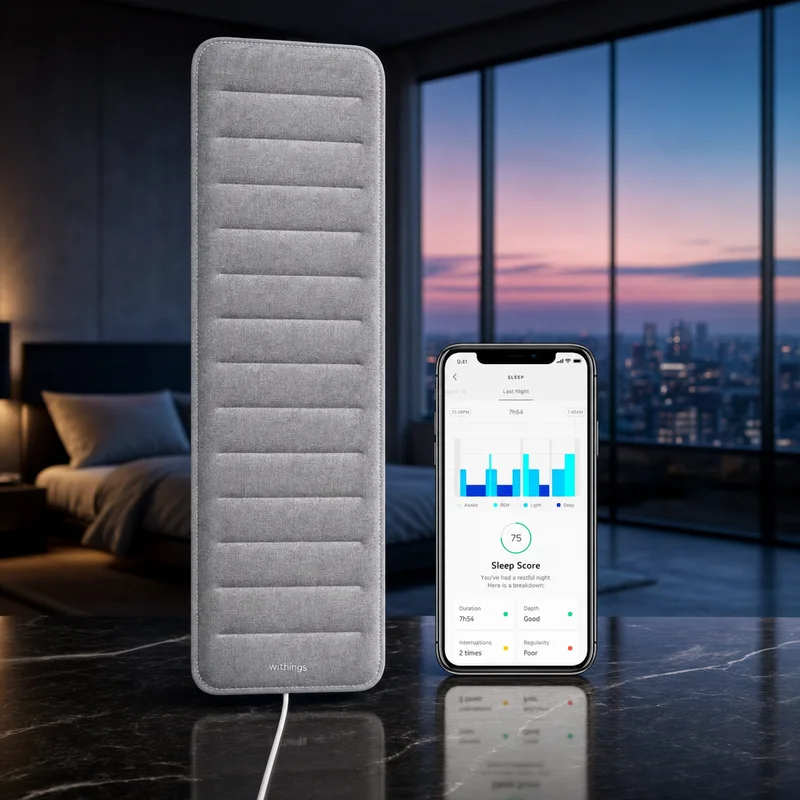
Withings Sleep under-mattress sleep tracking pad — from Amazon listing
Best non-wearable
Withings · under-mattress sleep mat · no wearable

Withings Sleep (under-mattress) Review

Every other pick in our sleep-tracker ranking asks you to wear something to bed. The Withings Sleep pad asks nothing: a thin mat slides under your mattress once, plugs into the wall, and from that day on it tracks your sleep cycles, heart rate, snoring, and breathing disturbances through the mattress itself — using ballistocardiography, the established technique of reading the tiny mechanical vibrations of your heartbeat and breathing. You wear nothing, you charge nothing, you remember nothing. For the meaningful slice of people for whom every wearable eventually lands in the nightstand drawer, that's not a gimmick — it's the difference between having sleep data and not. The honest limits are exactly what you'd guess from the form factor. It tracks one bed: travel, the couch, a hotel — invisible to it. A restless partner on a shared mattress adds noise to the signal. Its coaching layer is lighter than Oura's, and its stage analysis — like every consumer device's, pad or wearable — is an estimate to read as a trend, not a lab report. But at ~$130 with no required subscription, always-on power, and a breathing-disturbance signal that can prompt a real apnea evaluation, it's the clear pick for the wear-nothing sleeper. Here's the full breakdown.

Check on Amazon

Affiliate link — Super Achiever Club earns a small commission at no extra cost to you.

Read the complete Sleep & Recovery guide →
▸ THE SCORE

How we built the SAC Product Score™8.3/10

Accuracy (vs lab PSG)30%8/10

Ballistocardiography through a mattress captures the honest outputs solidly: sleep versus wake, total sleep time, heart rate, and multi-week trends — the layer validation work says consumer devices get right (Chinoy 2021). It scores below the top rings because the through-mattress signal is more exposed to interference (partner movement above all), and its cycle/stage analysis is, as everywhere in this category, an estimate rather than a measurement.

Metrics & insight20%7.7/10

A clear nightly sleep score, heart-rate tracking, and the standout feature: snoring and breathing-disturbance detection that gives wearable-free sleepers a genuinely actionable signal — the kind you take to a physician. The Health Mate app presents it all cleanly and trend-first. The deduction is coaching depth: there's no Readiness-style daily guidance layer, so turning the data into behavior change is more on you than with Oura or WHOOP.

Comfort & wearability20%9.8/10

The best possible score on this axis belongs to the device you cannot feel: nothing on your finger, wrist, or face, no material against your skin at all — which also makes the body-contact material question moot, the cleanest answer there is. Set up once under the mattress and forget it exists. The 0.2 deduction is only that the one-bed limitation is, in a sense, a wearability constraint: comfort is perfect, but it's perfect in exactly one location.

Cost / no-subscription15%8.5/10

~$130 one-time — among the cheapest entries in our ranking — with core sleep tracking requiring no subscription. Cost of ownership is genuinely just the sticker price plus a wall outlet. It scores below RingConn's 9.8 only because RingConn pairs no-fee with a fuller health-metrics suite; as a pure price-for-what-you-get proposition, the pad is one of the honest bargains here.

Battery & ecosystem15%7.5/10

Battery is a solved problem: mains-powered and always on, so uptime in your own bed is effectively 100% — no other pick can say that. The deductions are ecosystem-shaped: everything lives in your bed (zero coverage anywhere else), and while Withings Health Mate integrates well with Apple Health and Google ecosystems, the pad contributes sleep-centric data only, with none of the daytime-activity context wrist and finger wearables add.

▸ SPECS

The product at a glance

Form
Under-mattress pad — zero wearable, imperceptible through the mattress
Method
Ballistocardiography (pneumatic sensor reads heartbeat/breathing vibrations)
Tracks
Sleep cycles, heart rate, snoring, breathing disturbances
Power
Mains-powered, always on — no charging, ever
Subscription
Not required for core sleep tracking
Coverage
Your own bed only — no travel tracking
App
Withings Health Mate (Android + iOS; Apple Health / Google integration)
Price
~$130 one-time
▸ TRUTH CHECK

Marketing claims vs. reality

Verified

Tracks sleep cycles, heart rate, and snoring from under the mattress.

This is the product's core function as stated on the listing, delivered via ballistocardiography — an established sensing technique for exactly these signals. Sleep/wake, duration, heart rate, and snoring detection are the well-supported layer; the 'cycles' analysis carries the same estimate status as staging on every consumer device.

Partial

Sleep cycle analysis (deep, light, REM).

The feature exists and produces a nightly breakdown. We mark it PARTIAL for the category-wide reason: exact stage classification is the weakest output of every consumer sleep device versus lab polysomnography (Chinoy 2021), and a through-mattress motion/cardiac signal doesn't escape that ceiling. Use duration and trends as your anchors; read the cycle chart as context.

Partial

Detects breathing disturbances / can help surface sleep apnea risk.

The breathing-disturbance tracking is real and genuinely valuable as a screening prompt — it's one of the reasons this pad earns its rank. PARTIAL because no consumer device can diagnose sleep apnea: a flag from the pad is a reason to see a physician and ask about a clinical sleep study, never a diagnosis or an all-clear.

Verified

One-time setup — slide it under the mattress and it works automatically.

Accurate in practice: position at chest height under a compatible mattress, plug into mains, pair once with the app, and tracking is automatic from then on — no charging, no nightly ritual. The flip side is disclosed in our cons: automatic tracking exists only in that one bed.

▸ THE DEEP DIVE

What our test actually found

01Compliance is the metric nobody ranks — and the pad wins it outright

The dirty secret of sleep tracking is abandonment: wearables get taken off for charging, comfort, or annoyance, and every skipped night punches a hole in the trend data that is the whole honest point of consumer tracking. The pad's answer is structural. It cannot be forgotten, cannot run out of battery, and demands nothing at bedtime — so in your own bed, capture is effectively 100% from the day of setup. For the buyer who has already abandoned a wristband once, that reliability is worth more than a marginally better sensor being worn three nights a week.

02The breathing-disturbance signal is the sleeper feature

Sleep apnea is one of the most underdiagnosed common conditions — the person with it is, by definition, asleep when it happens. The pad's snoring and breathing-disturbance tracking watches for exactly the patterns worth investigating, night after night, with no effort from you. Used correctly, that's a low-cost early-warning system: persistent flags, heavy snoring, waking unrefreshed — take that record to a physician and ask about a sleep study. The record of dated, repeated disturbances is far more useful in that conversation than 'my partner says I snore.' Just never read the absence of flags as an all-clear, nor their presence as a diagnosis.

03The one-bed limitation is real — decide if it matches your life

The pad tracks a location, not a person. Sleep in a hotel, at a partner's place, on the couch — those nights simply don't exist in your data. For a homebody with a stable routine, coverage gaps are rare, and the trend line stays honest. For a frequent traveler, the missing nights are often the most interesting ones (jet lag, strange beds), and a ring that goes where you go is flatly the better instrument. Shared beds add the second caveat: the sensor reads mechanical vibration, so a restless partner can bleed into your numbers. Trends still resolve over weeks, but single-night precision on a lively mattress deserves skepticism.

04No wearable also means no wearable anxieties

There's a quiet behavioral advantage to a tracker you never see or feel: it's harder to obsess over. No ring to fiddle with, no score glowing on a wrist, no bedtime ritual reminding you you're being graded — just a chart in an app you open when you choose. Given that orthosomnia — anxiety about achieving perfect sleep scores that itself worsens sleep (Baron 2017) — is a documented failure mode of sleep tracking, the pad's out-of-sight nature nudges the healthy usage pattern by default: check weekly, read trends, build one habit, and let single nights go. It's the most naturally 'trends, not report cards' device in our lineup.

▸ THE TRADE-OFFS

Pros & cons, no sugar-coating

Pros
  • Wear absolutely nothing — the only zero-wearable pick in our ranking, ideal for wearable-refusers
  • Always-on mains power: no charging, no bedtime ritual, no missed nights in your own bed
  • Snoring and breathing-disturbance tracking — a genuinely useful prompt for a real apnea evaluation
  • No required subscription, at ~$130 one of the cheapest credible entries here
  • Set-and-forget setup: slide under the mattress once, and tracking is automatic
Cons
  • Only tracks your own bed — travel nights and naps elsewhere vanish from your data
  • A restless partner on a shared mattress can add noise to the signal
  • Lighter coaching layer than Oura/WHOOP, and cycle/stage analysis is an estimate like every consumer device
▸ THE BOTTOM LINE

The wear-nothing pick — buy it if a wearable would end up in the drawer.

The Withings Sleep pad wins its slot by refusing the premise every other pick accepts: that sleep tracking requires wearing something. Slide it under the mattress once and it tracks your sleep, heart rate, snoring, and breathing disturbances indefinitely — no charging, no ritual, no skin contact at all, no required subscription, for ~$130. For the sleeper who has tried a wearable and abandoned it, or knows they would, this is the difference between owning sleep data and owning a gadget drawer. Buy it with its limits in clear view: it tracks one bed only, a restless partner can muddy the signal, and its cycle analysis — like staging on every consumer device — is an estimate whose honest core is duration, consistency, and trend. Its breathing-disturbance flagging is the standout extra: if it keeps raising flags, take the record to a physician and ask about a clinical sleep study — the pad screens, doctors diagnose. Frequent travelers and data maximalists should take the RingConn (#2) or Oura (#1) instead. Everyone else who just wants honest sleep trends while wearing nothing: this is the pick, and there's no real competition for it.

Check Withings · under-mattress sleep mat · no wearable on Amazon
▸ ALTERNATIVES

If this doesn’t fit — try these

▸ RESEARCH

Sources & further reading

  1. Chinoy 2021Chinoy ED, Cuellar JA, Huwa KE, Jameson JT, Watson CH, Bessman SC, Hirsch DA, Cooper AD, Drummond SPA, Markwald RR · 2021 · Sleep · PMID 33378539

    Performance of seven consumer sleep-tracking devices compared with polysomnography

    Consumer sleep devices validated against lab polysomnography: reliable at sleep/wake and total sleep time, weaker at exact staging. The framework for trusting the pad's duration/trend outputs while reading its cycle analysis as an estimate.

  2. Baron 2017Baron KG, Abbott S, Jao N, Manalo N, Mullen R · 2017 · Journal of Clinical Sleep Medicine · PMID 27855740

    Orthosomnia: are some patients taking the quantified self too far?

    Case series coining 'orthosomnia' — score-fixation that worsens sleep. The pad's invisible, no-ritual form factor naturally supports the healthy pattern: weekly trend checks instead of nightly grading.