Updated Jul 21, 2026 · by Felix Hesse · Verified by SAC team
Jul 21, 2026
Verified by SAC team
+10
XP on completion
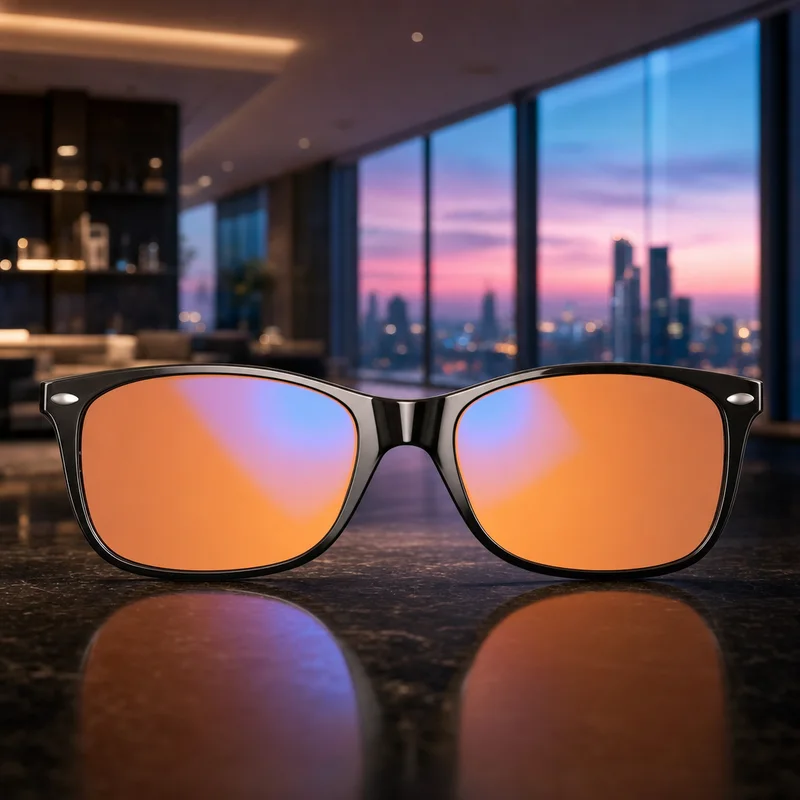
Swanwick Classic Night Swannies with amber lenses, black frame — from Amazon listing
Best value amber
Swanwick (Swannies) · amber/orange evening lens · ~99% blue blocked (400-500 nm)

Swanwick Classic Night Swannies (Amber) Review

Every ranking has a pick that's nobody's maximum and almost everybody's answer, and in our blue-light lineup that's the Classic Night Swannies. Swanwick built a true amber evening lens — ~99% of blue light blocked across 400-500 nm, a genuine sleep tool and nothing like the clear 'computer' glasses that dominate this category — and then put it in the most livable package here: a comfortable acetate frame with everyday styling, at $79. It scores 8.8 on comfort and 8.8 on value, the best combined liveability numbers among the true sleep lenses. The honest ceiling is the amber itself. Melatonin suppression runs into green (~530 nm), and an amber lens passes more of that green tail than the red specialists above it — which is exactly why the Swannies score 8.6 on our 35%-weighted blocking criterion while the reds score 9.6-9.8. Two mitigating facts: the sleep-lens randomized trials were run with amber lenses, so the direct evidence is strongest for this class; and the lens you comfortably wear every night beats the stronger lens you abandon. If the red picks feel like too much — too dark, too odd-looking, too single-purpose — start here. Here's the full breakdown.

Check on Amazon

Affiliate link — Super Achiever Club earns a small commission at no extra cost to you.

Read the complete Sleep & Recovery guide →
▸ THE SCORE

How we built the SAC Product Score™8.6/10

Evening light-blocking35%8.6/10

~99% of blue (400-500 nm) blocked — a genuine evening sleep lens, far beyond any clear or pale-yellow 'computer' glass. The honest deduction: amber passes more of the green tail (up to ~530 nm) than the red specialists, so raw melatonin protection is a notch below the top three.

Lens & optical quality20%8.4/10

Solid mid-tier optics — a real tint with clean enough clarity for evening reading and screens, without the distortion or haze of bargain films. Not the premium polish of the Ra Optics, and it doesn't need to be at this price.

Comfort & fit20%8.8/10

The best comfort score among our true sleep lenses: a well-shaped acetate frame with everyday styling that disappears over a long evening. Slightly chunky, and sizing matters (the listing sells distinct sizes) — but this is the pair built to make nightly wear effortless.

Build & durability15%8.2/10

Solid, well-finished acetate construction that handles nightly use — proper eyewear plastic against your skin for hours, not a brittle shell. A step below premium in hinge feel and finish, in line with the price.

Value10%8.8/10

$79 for a true amber evening lens in a frame this comfortable is the best refinement-per-dollar among the dedicated sleep picks — cheaper than all three red specialists while being the easiest to live with. Only the industrial Uvex beats it on raw protection per dollar.

▸ SPECS

The product at a glance

Lens
Amber/orange evening lens
Blocks
~99% of blue light (400-500 nm); passes more green than red lenses
Intended use
Evening / 2+ h before bed, nightly
Frame
Comfortable acetate, everyday styling; sold in sizes (verify fit)
Price
~$79 — cheapest of the dedicated non-industrial sleep lenses
ASIN
B010B5GUH0 (verified live 2026-07-20)
▸ TRUTH CHECK

Marketing claims vs. reality

Verified

Blocks ~99% of blue light for sleep (400-500 nm).

The listing positions the Night Swannies explicitly as a sleep aid with a deep amber lens, and the ~99% blue-blocking spec across 400-500 nm is consistent with the tint density. A genuine evening lens — the claim holds within its stated blue band.

Partial

A sleep aid — helps you fall asleep faster and sleep deeper.

The amber-lens class has the best direct evidence in the category — randomized trials (Burkhart 2009; Shechter 2018) found amber lenses worn 2-3 h before bed improved sleep versus clear lenses. But the trials tested the class, not this product, effects are modest, and amber's green-tail passthrough means it's not the maximum version of the intervention. Honest positioning overall.

Partial

Anti-eyestrain for computer, gaming and TV.

A deep amber tint does cut glare and harsh screen light in the evening, and users report comfortable viewing. But as an all-day computer lens claim it overreaches — the strong tint makes these evening glasses, not daytime office wear. Buy them for the sleep use case.

▸ THE DEEP DIVE

What our test actually found

01The adherence king of the true sleep lenses

The failure mode of sleep glasses isn't the spectrum — it's the drawer. Deep red lenses work brilliantly and get abandoned because they're odd-looking, single-purpose objects. The Swannies are the engineered compromise: a lens dark enough to be a genuine sleep tool, in a frame comfortable and normal-looking enough that wearing it 2-3 hours every night costs you nothing socially or physically. Across months of nightly use, we'd bet on the amber pair that stays on your face over the red pair that doesn't.

02Amber is what the trials actually tested

It's easy to read our ranking as 'red good, amber compromise' — but the randomized evidence runs the other way around. Burkhart 2009 (3 h nightly, 2 weeks) and Shechter 2018 (2 h nightly, insomnia patients) both used amber blue-blocking lenses and both found meaningful sleep improvements versus controls. Red lenses extend the same logic further down the spectrum, plausibly better, but the amber class is where the direct trial evidence lives. Buying Swannies means buying the tested article.

03The green tail is the honest limitation

Melatonin suppression doesn't stop at blue: the action spectrum runs to roughly 530 nm, into green. The Swannies' ~99% spec covers 400-500 nm, which means some of that green tail gets through — the precise gap the red 'Sleep+'/'Twilight' lenses close. For typical evening environments (warm-dimmed lamps, night-mode screens) the residual green exposure is small; under bright cool-white lighting it matters more. If you can't control your evening environment, that's the argument for stepping up to red.

04Get the size right — fit is doing real work here

Swanwick sells the Classic in distinct sizes (the listing we verified is the Small/Black variant), and unlike a stretchy wrap frame, an acetate frame only delivers its comfort advantage when it actually fits your face. Measure against the listed frame dimensions before ordering. A well-fitted pair also hugs closer to the face, which reduces the stray evening light leaking in around the edges — a small but real protection bonus.

▸ THE TRADE-OFFS

Pros & cons, no sugar-coating

Pros
  • True amber evening lens — ~99% of blue blocked, a genuine sleep tool
  • The most comfortable and presentable dedicated sleep lens in our ranking
  • The lens class the actual sleep RCTs tested (Burkhart 2009, Shechter 2018)
  • Strong value at $79 — cheaper than every red specialist
  • Solid acetate build that stands up to nightly use
Cons
  • Passes more green (~500-530 nm) than red lenses — a notch less melatonin protection than #1-#3
  • Still a strongly tinted evening lens — not for daytime, color work, or night driving
  • Sold in sizes; a mis-sized acetate frame loses the comfort advantage
▸ THE BOTTOM LINE

The all-rounder to actually buy — a real sleep lens built for nightly life.

The Swannies win their slot by understanding what most buyers need: not the theoretical maximum block, but a genuine evening lens they'll still be wearing in three months. The ~99% blue-blocking amber lens is a real sleep tool — the same class the randomized trials used — and the comfortable, presentable acetate frame removes every excuse that kills the habit. At $79, it's the cheapest of the dedicated non-industrial sleep lenses while being the easiest of all of them to live with. The trade is stated plainly on the tin: amber passes more of the green tail than red, so shift workers, diagnosed insomniacs, and the severely light-sensitive should take the red specialists' extra margin instead. Everyone else should weigh this: the intervention only works worn 2-3 hours nightly, forever, and the Swannies are the pair in our ranking most likely to survive that test. Put them on after dinner, dim the overheads, and give it two weeks — that's the protocol the evidence supports, in the package built to sustain it.

Check Swanwick (Swannies) · amber/orange evening lens · ~99% blue blocked (400-500 nm) on Amazon
▸ ALTERNATIVES

If this doesn’t fit — try these

▸ RESEARCH

Sources & further reading

  1. Gooley 2011Gooley JJ, Chamberlain K, Smith KA, et al. · 2011 · J Clin Endocrinol Metab · PMID 21193540

    Exposure to room light before bedtime suppresses melatonin onset and shortens melatonin duration in humans

    Ordinary evening room light suppressed melatonin and shortened its duration versus dim light — the mechanistic reason to protect the whole 2-3 hour pre-bed window. Studies light exposure, not this product.

  2. Burkhart 2009Burkhart K, Phelps JR · 2009 · Chronobiology International · PMID 20030543

    Amber lenses to block blue light and improve sleep: a randomized trial

    Randomized trial: AMBER lenses — the same class as the Swannies — worn ~3 h before bed for 2 weeks improved sleep quality and mood versus control lenses. The most direct trial support for this pick's lens type.

  3. Shechter 2018Shechter A, Kim EW, St-Onge MP, Westwood AJ · 2018 · Journal of Psychiatric Research · PMID 29101797

    Blocking nocturnal blue light for insomnia: A randomized controlled trial

    Randomized crossover RCT in adults with insomnia: amber lenses worn 2 h before bed improved sleep versus clear placebo — again the amber class specifically, reinforcing that the Swannies' lens type is the trial-tested one.

  4. Manufacturer specs 2026Swanwick · 2026

    Product specifications (amber Night lens, ~99% blue blocking, sizing, sleep positioning) from the Amazon listing

    All product facts in this review — the amber Night lens, ~99% blue-blocking spec (400-500 nm), acetate frame and sizing, and sleep-aid positioning — come from the manufacturer's Amazon listing (verified live 2026-07-20). Manufacturer specifications, not independent lab measurements.