Updated Jul 21, 2026 · by Felix Hesse · Verified by SAC team
Jul 21, 2026
Verified by SAC team
+10
XP on completion
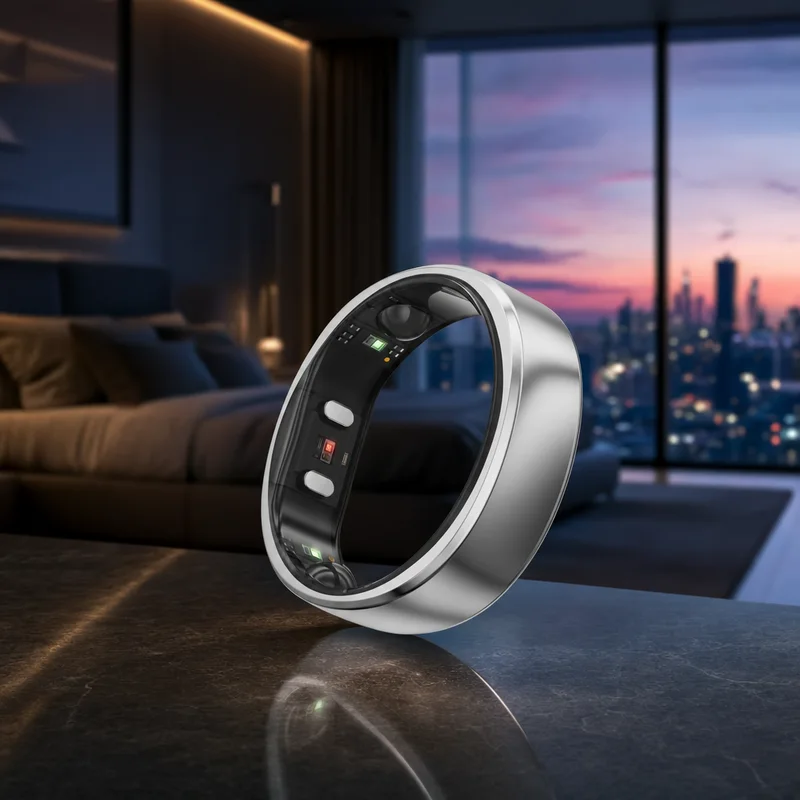
RingConn Gen 2 ultra-light titanium smart ring sleep tracker — from Amazon listing
Best no-subscription
RingConn · titanium smart ring · NO subscription

RingConn Gen 2 Review

The RingConn Gen 2 exists to answer one question: how much of the smart-ring experience can you keep without paying a monthly fee forever? The answer turns out to be most of it. You get an ultra-light, very thin titanium ring that's effortless to sleep in, strong tracking of the numbers consumer wearables honestly get right — sleep versus wake, total sleep time, night-to-night trends — a claimed-first sleep-apnea monitoring signal, and the longest battery in our ranking at up to ~12 days. And the price is the price: ~$299 once, lifetime app access, zero subscription. Over three years, that's well over $200 saved versus the Oura Ring 4. What you give up is the software layer that makes Oura #1: RingConn's app serves clean data with a thinner coaching layer, and its ecosystem is smaller. The universal caveat applies too — exact light/deep/REM staging is an estimate on every consumer device, this one included, and an apnea SIGNAL is a prompt to see a doctor, never a diagnosis. But judged on what a sleep tracker is honestly for — comfortable nightly wear, trustworthy duration and trend data, no missed nights — this is the best pure value in the category, and the pick we'd hand to anyone allergic to subscriptions. Here's the full breakdown.

Check on Amazon

Affiliate link — Super Achiever Club earns a small commission at no extra cost to you.

Read the complete Sleep & Recovery guide →
▸ THE SCORE

How we built the SAC Product Score™8.7/10

Accuracy (vs lab PSG)30%8.5/10

Strong where it counts: sleep/wake detection and total sleep time — the outputs the validation literature says consumer trackers genuinely get right (Chinoy 2021) — track reliably, and the multi-day trend line is trustworthy. Stage estimation is good-not-perfect, a notch below Oura's refinement, and like every consumer device it remains an inference from movement, heart rate, and temperature rather than a measurement of brain waves. We score the honest strengths, not the pie chart.

Metrics & insight20%8/10

Clean, complete data — sleep, heart rate, HRV, stress, SpO2-adjacent signals — plus the headline sleep-apnea monitoring feature, all with no paywall. What keeps it below Oura is the coaching layer: RingConn shows you the data more than it tells you what to do with it, and turning numbers into next actions is the hardest part of the job. For a self-directed user that's fine; for someone who wants to be coached, it's the gap the Oura fee buys.

Comfort & wearability20%8.8/10

Among the lightest and thinnest rings in the category — a few grams of titanium with a squarish low-profile cross-section that's easy to forget you're wearing. Titanium is a skin-honest material for eight hours of nightly contact: corrosion-resistant and well tolerated by most wearers. No screen, no buzzing, nothing on the wrist. Sizing accuracy matters (use the kit), and as with any ring, heavy lifting will scuff it.

Cost / no-subscription15%9.8/10

The best score on this axis in our entire ranking, and it's not close: ~$299 once, lifetime app access, zero recurring fee — versus roughly $565 over three years for Oura (device + membership) and a perpetual membership for WHOOP. The 'no subscription' promise is the product's identity, printed on the listing itself. This is what honest cost of ownership looks like in a category that loves burying fees.

Battery & ecosystem15%8.8/10

Up to ~12 days per charge is the longest battery in our lineup — in practice you charge it once a week with huge margin and essentially never lose a night of data. The deduction is ecosystem: the app is solid but the third-party integration surface and community are smaller than Oura's or the big-brand wrist wearables', and long-term software cadence from a younger company is the honest open question.

▸ SPECS

The product at a glance

Form
Titanium smart ring — ultra-light, very thin, no screen
Battery
Up to ~12 days per charge — longest in our ranking
Subscription
NONE — lifetime app access included in purchase
Apnea feature
Sleep-apnea monitoring signal (a prompt, not a diagnosis)
Tracks
Sleep, heart rate, HRV, stress, women's-health metrics
Compatibility
Android and iOS
Sizing
Ring-sized — use the sizing kit before ordering
Price
~$299, no recurring fee
▸ TRUTH CHECK

Marketing claims vs. reality

Verified

No app subscription — full features with lifetime access.

Stated prominently on the listing ('No APP Subscription') and central to the product's positioning. There is no paywalled tier: the tracking and analysis features ship with the ring. This is the claim that defines the product's place in our ranking, and it holds.

Partial

World's first smart ring with sleep apnea monitoring.

The monitoring feature is real and listed as the headline capability. We mark the claim PARTIAL on two counts: 'world's first' is a marketing superlative we can't independently adjudicate, and — more importantly — apnea MONITORING is a screening signal, not a diagnosis. A flag from the ring warrants a physician and a clinical sleep study; it doesn't replace them.

Verified

12-day battery life.

The listing states 12-day battery life; that's a manufacturer's up-to figure, with real-world use typically landing near it depending on settings. Even discounted, it's the longest in our eight-pick lineup and comfortably clears the practical bar: weekly charging with margin, no overnight data gaps.

Partial

Accurate sleep tracking with detailed stage analysis.

Sleep/wake detection and total sleep time — the outputs that matter most — track strongly, in line with what validation work shows consumer trackers do well (Chinoy 2021). Exact stage analysis, here as on every consumer device including Oura, is an estimate inferred from peripheral signals rather than measured brain activity. Trust the duration and trends; read stages as approximate.

▸ THE DEEP DIVE

What our test actually found

01The subscription math is the whole argument — and it's decisive

Run the three-year numbers: RingConn Gen 2 at ~$299 flat, versus Oura Ring 4 at ~$349 plus ~$5.99/month — roughly $565 total. That's a ~$265 gap for devices whose core honest outputs (sleep/wake, duration, trends) are much closer than the price difference implies. What the Oura premium genuinely buys is software: more refined staging, the Readiness coaching layer, a bigger ecosystem. If you won't use daily coaching, you're paying ~$72/year for polish. That's why our value math puts RingConn at 9.8 on cost — the best in the entire ranking — and why it sits one slot behind Oura overall instead of five.

02The apnea signal is a genuinely useful screen — used correctly

Sleep apnea is massively underdiagnosed, and the people who have it usually don't know. A ring that watches overnight breathing patterns and raises a flag is a real public-health-adjacent feature, not a gimmick — and RingConn ships it with no subscription. The correct use: if the ring flags repeated disturbances, or you snore heavily, wake gasping, or drag through days despite 'enough' hours, book a physician visit and ask about a clinical sleep study. The wrong use: treating the ring's output as either a diagnosis or an all-clear. It is a smoke detector, not a fire marshal — valuable precisely because it prompts the real evaluation.

03Twelve days of battery quietly improves your data quality

Battery life sounds like a convenience spec, but in sleep tracking it's an accuracy spec. Trend lines — the honest core value of any consumer tracker — depend on consecutive nights captured, and every night the device spends on a charger is a hole in your data. At ~12 days per charge, RingConn's charging cadence is 'sometime this week, whenever,' which in practice means near-perfect nightly coverage. Compare a smartwatch that needs a charge most days and often spends the night on the nightstand: the ring wins on data completeness before any sensor comparison even starts.

04What you give up: coaching depth and ecosystem maturity

Honesty about the trade: RingConn's app presents data cleanly but coaches thinly. There's no equivalent of Oura's Readiness turning your night into a specific daily recommendation, the integration surface with third-party apps is smaller, and RingConn is a younger company than Oura or Garmin — long-term software support is a reasonable open question, though the no-subscription model means you're not renting features that could be repriced. For a self-directed user who wants trustworthy numbers and a trend line, none of this matters much. For someone who wants to be told what to do each morning, it's the real gap — and the reason Oura keeps the #1 slot.

▸ THE TRADE-OFFS

Pros & cons, no sugar-coating

Pros
  • NO subscription, ever — lifetime app access for ~$299, saving well over $200 versus Oura across three years
  • Longest battery in our ranking at up to ~12 days — near-zero missed nights in practice
  • Ultra-light, very thin titanium ring — effortless, skin-friendly nightly wear
  • Sleep-apnea monitoring signal included free — a genuinely useful prompt for real evaluation
  • Strong on the numbers that matter: sleep/wake, total sleep time, and trends
Cons
  • App coaching and polish are a step behind Oura's — data-forward, guidance-thin
  • Smaller ecosystem and fewer third-party integrations than the big-brand rivals
  • Exact sleep staging is an estimate, like every consumer device — and the apnea signal is a screen, not a diagnosis
▸ THE BOTTOM LINE

The smartest money in sleep tracking — buy it if a subscription is a dealbreaker.

The RingConn Gen 2 is the pick for the buyer who wants smart-ring sleep tracking priced like a product instead of a rental. For ~$299 once, you get the form factor that wins on nightly compliance — an ultra-light titanium ring — the longest battery in our lineup at ~12 days, strong tracking of the numbers consumer wearables honestly get right, and a sleep-apnea signal that can prompt a real medical evaluation. No monthly bill, no paywalled features, no fee creep. The honest trades are software depth and ecosystem: Oura's app coaches better and integrates wider, which is what its ~$5.99/month actually buys, and RingConn's staging — like every consumer device's — is an estimate to read as context, not gospel. Use it the way the evidence supports: wear it nightly, trust total sleep time and your weekly trend, build one habit (fixed wake time first), and treat any apnea flag as a reason to see a doctor. If you want the category's best app and accept the fee, get the Oura (#1). For everyone else — and especially for anyone who bristles at subscriptions — this is the buy, and it's not a compromise.

Check RingConn · titanium smart ring · NO subscription on Amazon
▸ ALTERNATIVES

If this doesn’t fit — try these

▸ RESEARCH

Sources & further reading

  1. Chinoy 2021Chinoy ED, Cuellar JA, Huwa KE, Jameson JT, Watson CH, Bessman SC, Hirsch DA, Cooper AD, Drummond SPA, Markwald RR · 2021 · Sleep · PMID 33378539

    Performance of seven consumer sleep-tracking devices compared with polysomnography

    Seven consumer sleep trackers validated against lab polysomnography: strong sleep/wake and total-sleep-time performance, weaker exact staging. The basis for trusting RingConn's duration and trend outputs while reading its stage chart as an estimate.

  2. Baron 2017Baron KG, Abbott S, Jao N, Manalo N, Mullen R · 2017 · Journal of Clinical Sleep Medicine · PMID 27855740

    Orthosomnia: are some patients taking the quantified self too far?

    Case series coining 'orthosomnia' — perfectionistic fixation on ideal tracker data that worsens sleep. Why our usage guidance for RingConn is weekly trend reads and one habit, never nightly score-grading.