Updated Jul 21, 2026 · by Felix Hesse · Verified by SAC team
Jul 21, 2026
Verified by SAC team
+10
XP on completion
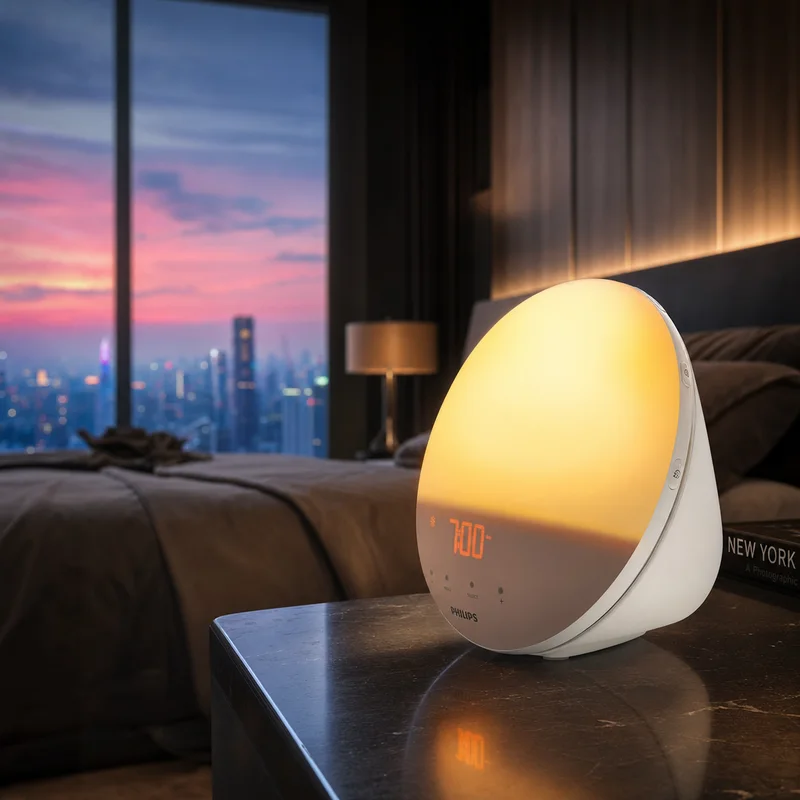
Philips SmartSleep Wake-Up Light HF3520, colored sunrise and sunset simulation — from Amazon listing
Best premium / clinical light
Philips · clinical sunrise to ~300 lux, no app, no subscription

Philips SmartSleep Wake-Up Light HF3520 Review

If you strip the sunrise-alarm category down to its core function — wake me with genuinely good light, no strings attached — the Philips SmartSleep HF3520 is the answer. Its sunrise is the clinical benchmark everything else on our list is measured against: a validated ramp to roughly 300 lux at the pillow, building over about 30 minutes through a natural red→amber→white progression, with 20 intensity settings to tune the peak. And the ownership story is as clean as the light: no app, no account, no subscription — every function runs from physical buttons and will keep running identically, offline, for as long as the unit lasts. The honest limits are what keep it at #2 rather than #1. It's not a full sleep system — you get five natural sounds, FM radio, sunset simulation and tap-snooze, but no real noise-color sound machine and no guided wind-down ecosystem like the Hatch Restore 3. And it lacks the loud backup-beeper failsafe of its sibling HF3650, so the heaviest sleepers should spend up. For everyone else who wants the purest light in the category with zero ongoing costs, this is the pick — and at ~$120 it's cheaper than the Hatch. Here's the full breakdown.

Check on Amazon

Affiliate link — Super Achiever Club earns a small commission at no extra cost to you.

Read the complete Sleep & Recovery guide →
▸ THE SCORE

How we built the SAC Product Score™8.6/10

Light quality30%9.6/10

The best light on the list and the reference point for our whole ranking: a sunrise validated to roughly 300 lux at ~45 cm, ramping over about 30 minutes through a natural red→amber→white progression, with 20 intensity levels to tune the peak and use it as a reading lamp. This is the light the dawn-simulation research space points at, and no rival here matches its credentials.

Wake reliability20%8.2/10

The sunrise completes with your chosen natural sound or FM radio, which reliably finishes the wake for average sleepers. The deduction is specific: there's no loud, escalating backup-beeper failsafe like the HF3650's, so the heaviest sleepers — the people light alone can't budge — should step up to that model rather than trust this one.

Features20%8/10

Colored sunset simulation for wind-down, five natural wake sounds, FM radio with presets, tap-snooze and a bedside reading-lamp mode — the essentials, done properly, with nothing gated behind an account. What it doesn't have: a genuine noise-color sound machine (Dreamegg carries true white/pink/brown noise) or a guided routine ecosystem (Hatch). Focused rather than sparse.

Controls & usability20%8.8/10

Fully button-operated with a tap-to-snooze top surface you can hit half-asleep — the daily interactions are exactly right, and there is no app dependency at any point in the product's life. Slight deductions for Philips' somewhat dated menu-and-icon control scheme, which takes a first evening to learn compared with Hatch's slicker three-button flow.

Value10%7.6/10

Around $120 for the category's benchmark light with zero ongoing costs is honest value — cheaper than the Hatch ($170) and the HF3650 ($180), with no membership ever. It's still a premium price next to the sub-$50 JALL and Dreamegg units, which is the only thing keeping this score from going higher; you're paying for light credentials, not features-per-dollar.

▸ SPECS

The product at a glance

Light
Sunrise/sunset simulation, ~1-300 lux, 20 intensities
Ramp
~30 min, red→amber→bright white
Sound
5 natural wake sounds + FM radio
Snooze
Tap-to-snooze top surface
App / sub
None — fully button-operated, no account, no subscription
Price
~$120
▸ TRUTH CHECK

Marketing claims vs. reality

Partial

Sunrise simulation clinically proven to wake you more naturally.

The dawn-simulation category has genuine controlled-trial support — Gabel 2013 (improved morning cognition, mood and cortisol at a 250-lux dawn) and Giménez 2010 (significantly reduced sleep inertia) — and Philips' light is the best-specified in the class. But those are category-level trials at similar (not identical) parameters, not outcome trials of this exact SKU, and Giménez found no melatonin-onset shift. Directionally well-supported; we mark it PARTIAL rather than treating marketing shorthand as product-specific proof.

Verified

Light intensity up to 300 lux with colored sunrise simulation.

Matches the published Philips specification for the HF3520 — ~1-300 lux across 20 settings at approximately 45 cm, with the red→amber→white colored sunrise and a sunset equivalent. This is the checkable hard number our whole listicle leans on, and it holds as stated.

Verified

Works completely without an app or subscription.

Every function — alarms, light, sounds, FM, snooze — is set and operated from on-device physical controls. There is no companion app, no account requirement, and no paid content tier anywhere in the product. Verified against the live listing and consistent with the product's long-standing design.

Verified

Tap-snooze and FM radio built in.

The listing confirms the tap-to-snooze top surface and integrated FM radio alongside the five natural wake sounds — long-standing, well-documented features of the HF3520/60.

▸ THE DEEP DIVE

What our test actually found

01This is the light every other pick gets measured against

Our ranking weights light quality at 30% because it's the category's core function, and the HF3520 is the unit that defines the top of that axis: a validated ~300-lux peak at the pillow, a ~30-minute ramp, and a genuinely natural red→amber→white color progression rather than a white LED fading up. When our listicle says a cheaper clock's light 'isn't in the Philips clinical tier,' this is the tier. If you want the best defensible light per dollar on our list, this is where the money goes.

02No app, no account, no subscription — and that's worth real points

The HF3520 will do everything it does today in ten years, offline, with no login and nothing renewing — because there's simply no software ecosystem attached. Our scoring deliberately rewards that: several modern clocks need an app to change settings or paywall their best content behind a membership, which is a strange dependency for an alarm clock. For privacy-minded and simplicity-minded buyers, this and the Lumie are the cleanest ownership stories in the category, and the Philips has the better light of the two.

03The one gap: no beeper failsafe for the heaviest sleepers

The HF3520's wake sequence ends in a rising natural sound or FM radio — enough for most people, but not a purpose-built failsafe. Philips' own answer to the heavy-sleeper problem is the HF3650, which pairs the same clinical sunrise with a loud escalating backup beeper that guarantees the wake when light doesn't do it. That's not a flaw in the HF3520 so much as a segmentation line: know which sleeper you are before choosing between them, because the $60 difference buys insurance, not better light.

04What the dawn-simulation trials actually show — and don't

The honest evidence frame: Gabel 2013 found a dawn ramping to 250 lux improved morning cognitive performance, mood and wake-time cortisol in sleep-restricted adults, and Giménez 2010 found artificial dawn significantly reduced self-reported sleep inertia in a field setting. Both support waking to a gradual light like this one. Neither shows a shift in melatonin onset — the benefit is in how you wake, not in re-timing your circadian clock — and neither is a trial of this exact SKU. Expect gentler, less groggy mornings, not a rewired body clock.

▸ THE TRADE-OFFS

Pros & cons, no sugar-coating

Pros
  • The clinical-light benchmark: validated sunrise to ~300 lux with a natural red→amber→white ramp
  • Zero app, zero account, zero subscription — fully button-operated for life
  • Colored sunrise AND sunset simulation, 5 natural sounds, FM radio, tap-snooze
  • 20 light intensities double as a tunable bedside reading lamp
  • About $60 cheaper than its HF3650 sibling and $50 under the Hatch
Cons
  • No loud escalating backup-beeper failsafe — heavy sleepers should buy the HF3650 instead
  • No true noise-color sound machine or guided wind-down ecosystem
  • Philips' menu-driven controls feel dated next to Hatch's polish and take an evening to learn
▸ THE BOTTOM LINE

The pure-light pick — buy it for the benchmark sunrise and the cleanest ownership story on the list.

The HF3520 is what you buy when you want the sunrise itself, done to the category's highest verifiable standard, with nothing attached: a validated ~300-lux clinical ramp, sunset simulation, five sounds, FM and tap-snooze, all on physical buttons with no app and no subscription ever. At ~$120 it undercuts both the Hatch and its own HF3650 sibling while beating both on light-per-dollar. That combination — benchmark light, zero strings — is exactly what our 8.6 reflects. Be honest with yourself on two questions before buying. If you sleep through alarms, the HF3650 (#3) exists precisely for you: same light, plus the loud backup-beeper failsafe this unit lacks. And if what you actually want is a full evening-to-morning system — sound machine, guided wind-downs, smart reading light — the Hatch Restore 3 (#1) is the more complete device, membership caveat and all. For everyone whose brief is 'the best light, no strings, reasonable money,' this is the one to buy.

Check Philips · clinical sunrise to ~300 lux, no app, no subscription on Amazon
▸ ALTERNATIVES

If this doesn’t fit — try these

▸ RESEARCH

Sources & further reading

  1. Gabel 2013Gabel V, Maire M, Reichert CF, et al. · 2013 · Chronobiol Int · PMID 23841684

    Effects of artificial dawn and morning blue light on daytime cognitive performance, well-being, cortisol and melatonin levels

    Lab study, 17 sleep-restricted participants: a dawn simulation rising gradually to 250 lux improved cognitive performance, mood and well-being and raised wake-time cortisol versus dim and blue light. Core evidence for waking to a gradual ramp — the HF3520's validated peak (~300 lux) sits above the tested dawn.

  2. Giménez 2010Giménez MC, Hessels M, van de Werken M, et al. · 2010 · Chronobiol Int · PMID 20653451

    Effects of artificial dawn on subjective ratings of sleep inertia and dim light melatonin onset

    Field study with a wake-up light: artificial dawn significantly reduced self-reported sleep inertia (easier, more alert waking; strongest at 250 lux) — but did NOT shift dim-light melatonin onset. The benefit is on how you wake, not on re-timing the body clock. We apply that honest frame to this product's claims.

  3. Philips specs / Amazon listing 2026Philips · 2026 · usa.philips.com / Amazon.com

    Philips SmartSleep Wake-up Light HF3520/60 — published specifications and Amazon product listing

    Product facts on this page — the ~1-300 lux light range across 20 intensities at ~45 cm, ~30-minute colored sunrise/sunset simulation, 5 natural sounds, FM radio, tap-snooze, and fully button-based operation with no app or subscription — verified against the manufacturer specification and the live Amazon listing (ASIN B0093162RM, checked 2026-07-20).