
Nutricost Electrolyte Complex Powder Review
 #7 of 10 · Cheapest per serving✓ Label verified · Supplement Facts read Oct 21, 2026
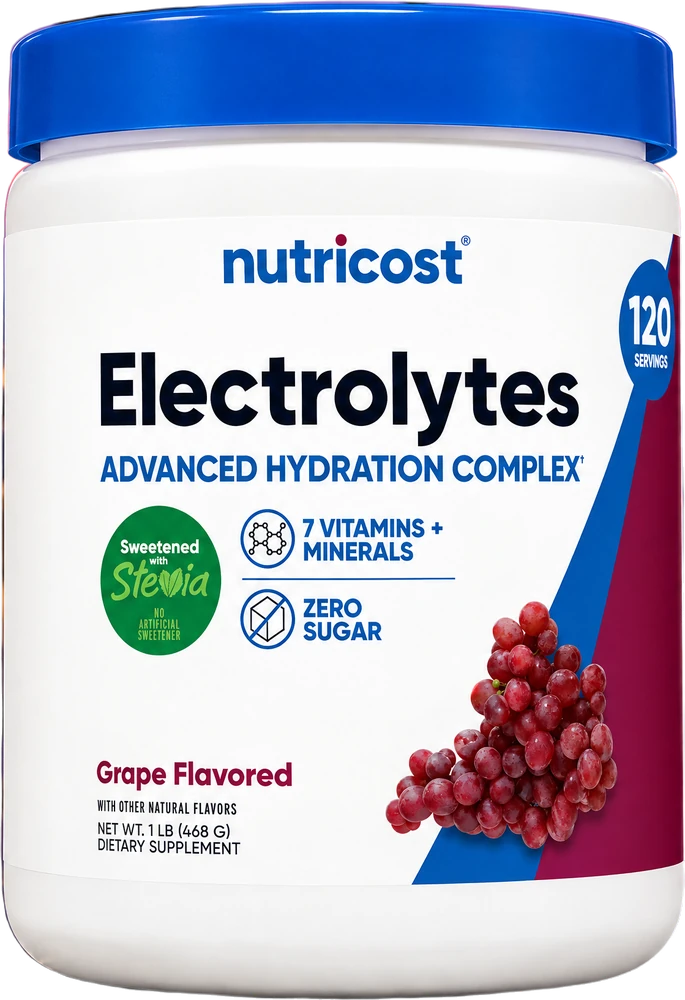
Studio shot rebuilt from the retailer photo, cut out. Label text checked against the real pack.
Consider it. A cheap, zero-sugar daily mix with 260 mg of potassium and a few vitamins, at about 23 cents a scoop. The sodium is only 90 mg, so it is the wrong tool for heavy sweat or keto salt, and the Third Party Tested claim names no lab.
$27.95 · 120 servings (Amazon US, Oct 21, 2026)$0.23 per scoop
Why It Scores 7.1 — And The Label Line Behind Each Number
Sodium & electrolyte dose
30% of scoreThe weak axis. The panel prints 90 mg of sodium per scoop, 4% of the Daily Value, less than a tenth of LMNT's 1000 mg and far below Redmond's 810 mg. It is above Ultima's 55 mg, but the rest of the electrolyte load is similar in size, so we score it in the same band as Ultima. Potassium is the larger line at 260 mg (6% DV). The points here come from the potassium, not from the sodium that decides heavy-sweat and keto use.
- Sodium
- 90 mg per scoop (as sodium citrate and sodium chloride), 4% DV
- Potassium
- 260 mg per scoop (as potassium citrate and potassium chloride), 6% DV
Clean formula
25% of scoreThe front says Zero Sugar and Sweetened with Stevia, No Artificial Sweetener. The only sweeteners on the ingredient list are Reb M (from stevia extract) and stevia, with grape powder for color and natural flavors. Two flow agents, calcium silicate and dicalcium phosphate, sit in the list. The panel has no Sugars line to confirm a printed 0 g, which is why it scores below LMNT and Ultima (9.5 each) and level with Key Nutrients (9.0).
- Sugar
- Zero Sugar on the front; the panel has no Sugars or Calories line
- Sweetener
- Reb M (from stevia extract) and stevia; front: Sweetened with Stevia, No Artificial Sweetener
- Other ingredients
- L-malic acid, citric acid, natural flavors, Reb M (from stevia extract), calcium silicate, grape (fruit) powder (for color), stevia, dicalcium phosphate
Full mineral spectrum
20% of scorePotassium, magnesium and calcium are all on the panel: 260 mg, 40 mg and 30 mg, with vitamin C, B6 and B12 alongside. Potassium is higher than LMNT's 200 mg, but magnesium is lower than LMNT's 60 mg, and the 30 mg of calcium is a small line. It scores just under LMNT (8.0) and well under Ultima (9.0), which carries 100 mg of magnesium and more minerals. The panel declares no chloride or phosphorus line, although the formula uses chloride salts.
- Magnesium
- 40 mg per scoop (as magnesium citrate and di-magnesium malate), 10% DV
- Calcium
- 30 mg per scoop (as calcium citrate), 2% DV
- Vitamins
- Vitamin C 90 mg (100% DV), vitamin B6 1.6 mg (94% DV), vitamin B12 6 mcg as methylcobalamin (250% DV)
Value per serving
15% of score$27.95 for 120 servings on October 21, 2026: about $0.23 a scoop, the lowest on this list, and a fraction of what the stick-pack mixes cost. It earns the top end of the scale on cost per serving. Per 100 mg of sodium the picture is different: about 26 cents here against about 15 cents for LMNT at the $45 price on this list, so the low price buys a small dose.
- Price
- $27.95 for 120 servings = $0.23 per serving (Amazon US, October 21, 2026)
- Cost per 100 mg of sodium
- About 26 cents per 100 mg of sodium
Taste & mixability
10% of scoreWe have not tasted it, so this score comes from the label. L-malic acid, citric acid, natural flavors and two stevia lines point to a sweet-tart grape drink, and with only 90 mg of sodium there is no salty edge to get past. One scoop in a 16 oz bottle or a tall glass is the printed use, shaken or stirred until dissolved. We scored it level with Key Nutrients (7.5): a reliable stevia-sweetened daily drink, with stevia's divisive sweetness.
- Suggested use
- 1 scoop daily in a 16 oz water bottle or a tall glass of water, shaken or stirred until dissolved; healthy individuals 18 and older (back label)
- More Specs
- Serving
- 1 scoop (4 g) · 120 servings · net wt. 1 lb (468 g) · Grape flavor
- Testing
- Third Party Tested printed on the back label; no lab named; no certificate of analysis found; no Nutricost product in the NSF Certified for Sport or NSF/ANSI 173 listings (checked October 21, 2026)
- Certifications
- None verified. Printed: Third Party Tested, GMO-Free, Gluten-Free (back label, daggered); gallery tile also shows Vegetarian, GMP Compliant Facility. No NSF, USP or Informed mark.
- Manufacturer
- Nutricost, Vineyard, UT; made and quality tested in the USA with globally sourced ingredients
Label verified. Every figure read from the Supplement Facts photo, Oct 21, 2026.
Marketing Claims Vs. Reality
Advanced Hydration Complex with 7 vitamins + minerals.
The panel has seven lines: vitamin C, vitamin B6, vitamin B12, calcium, magnesium, sodium and potassium. The count on the front is a count of those lines. Only three of them, sodium, potassium and magnesium, are the electrolytes this list scores.
Zero Sugar, sweetened with stevia, no artificial sweetener.
The front prints both claims, and the other-ingredients list shows Reb M (from stevia extract) and stevia as the only sweeteners. The panel has no Sugars or Calories line, so there is no printed 0 g to read; the claim rests on the front and the ingredient list.
Third Party Tested; each batch tested by independent laboratories.
Printed on the back label and on the Nutricost product page. No lab is named, no certificate is linked, and we found no Nutricost product in the NSF Certified for Sport brand list or the NSF/ANSI 173 listings (searched October 21, 2026).
GMO-Free and Gluten-Free.
Both are printed on the back label with a dagger, which points to the FDA disclaimer, and neither carries a certifier mark. The ingredient list has no obvious gluten source, so the claim is plausible, but it is the maker's word.
Aids rapid hydration (Amazon listing bullet).
It adds potassium, magnesium and a little sodium to your water, which is a fair daily top-up. For fluid retention after heavy sweat, the controlled rehydration trial (Shirreffs 1996) found the sodium in the drink is what decides how much fluid you keep, and 90 mg a scoop is a small amount. Accurate for everyday use, a stretch for hard-training rehydration.
What Our Test Actually Found
A potassium-led mix, not a salt-led one
The biggest mineral line on the panel is potassium, 260 mg, with sodium at 90 mg. That is the reverse of LMNT, which prints 1000 mg of sodium against 200 mg of potassium. The category is decided on sodium, so this product sits in the daily-mineral group with Ultima (55 mg of sodium, 250 mg of potassium, 100 mg of magnesium) and not in the salt-replacement group. Know which job you are hiring it for.
Three vitamins come along for the ride
The panel adds vitamin C (90 mg, 100% DV), vitamin B6 (1.6 mg, 94% DV) and vitamin B12 as methylcobalamin (6 mcg, 250% DV). They are real, readable doses, and they are why the front says 7 Vitamins + Minerals. They are not electrolytes, so they add little to the score on this list, but they are a small extra if you would otherwise take them separately.
Cheapest per serving, not cheapest per milligram of salt
At $27.95 for 120 scoops the serving costs about 23 cents. That is the lowest on the list, and the main reason to buy it. But each scoop carries only 90 mg of sodium, so the cost per 100 mg of sodium is about 26 cents, against about 15 cents for LMNT at the $45 price on this list. The low price is for a small dose, which is fine if a small dose is what you want.
Testing: printed, not proven
Third Party Tested appears on the back label and the product page says every batch goes to independent laboratories, but neither names a lab and we found no certificate of analysis. We searched NSF Certified for Sport and NSF/ANSI 173 on October 21, 2026 and found no Nutricost product. Absence from a list is not proof of failed testing; it means there is nothing for us to check. If it matters to you, ask Nutricost for the certificate for your lot.
Clean on sugar, with two flow agents on the list
Stevia is the only sweetener, twice: Reb M and plain stevia. Color comes from grape powder, and the flavor is listed as natural flavors. Calcium silicate and dicalcium phosphate are there to keep the powder flowing. None of that is a red flag, and it is a short, plain list. The one gap is that the panel prints no Sugars line, so zero sugar is the front-of-pack claim backed by the ingredient list.
Full analysis: all pros & cons (9), buy if / skip if
- About $0.23 a serving, the lowest cost per serving on this list
- 260 mg potassium and 40 mg magnesium per scoop, plus 30 mg calcium
- Zero sugar on the front, sweetened only with stevia, no artificial sweetener
- Vitamin C, B6 and B12 (as methylcobalamin) on a readable, fully dosed panel
- 120 servings in one tub
- Only 90 mg sodium per scoop, wrong for heavy sweat or keto salt needs
- Third Party Tested names no lab and has no NSF listing
- Thinner mineral spread than Ultima: 40 mg magnesium against its 100 mg
- Stevia sweetness divides palates; the panel prints no Sugars line
- You want the lowest cost per serving: about $0.23 a scoop for 120 servings
- You want a sugar-free daily mix with 260 mg of potassium and a little magnesium
- You already eat enough salt and mainly want potassium and vitamins in your water
- You like the idea of adding vitamin C, B6 and B12 to the same drink
- You are a heavy sweater or on keto and need real sodium: 90 mg is far too low
- You want the strongest magnesium dose: Ultima gives 100 mg to this product's 40 mg
- You want a named lab or an NSF seal behind the testing claim; this tub has neither
Per scoop you get 260 mg potassium, 40 mg magnesium, 30 mg calcium and 90 mg sodium, plus vitamin C, B6 and B12, for about $0.23. It is the lowest cost per serving on the list and the label is short and readable. The score stops at 7.1 because sodium, the axis that decides this category, is low, because the mineral spread is thinner than Ultima's, and because the testing claim names no lab. Consider it as a daily top-up; skip it if you sweat heavily or eat low-carb and need real sodium.
Nutricost Electrolyte Complex Powder is the budget end of this list. One 4 g scoop gives you 260 mg of potassium, 40 mg of magnesium, 30 mg of calcium, 90 mg of sodium and three vitamins (C, B6 and B12), sweetened only with stevia. The Amazon offer we checked on October 21, 2026 was $27.95 for 120 servings, about 23 cents a scoop, the lowest cost per serving of any product here. The front of the pack says Zero Sugar, and nothing on the ingredient list is a sugar. The honest catch is the headline electrolyte. At 90 mg, the sodium is less than a tenth of LMNT's and sits close to Ultima's, which makes this a potassium-led daily mix and not a replacement for the salt a heavy sweater or a keto dieter loses. The back label prints Third Party Tested but names no lab, and we found no Nutricost product in the NSF Certified for Sport or NSF/ANSI 173 listings. Buy it for cheap, sugar-free daily minerals. If sodium is what you are short on, look to the salt-forward picks higher on the list.
The cheap daily mix: buy it for potassium and vitamins, not for salt.

Nutricost Electrolyte Complex Powder does what its panel says: 260 mg of potassium, 40 mg of magnesium, 30 mg of calcium and 90 mg of sodium in a 4 g scoop, with vitamin C, B6 and B12, sweetened with stevia. At about 23 cents a serving it is the cheapest scoop on this list by a wide margin, and the label is easy to read. What holds the score at 7.1 is the sodium and the paper trail. At 90 mg it sits close to Ultima's 55 mg, far under LMNT's 1000 mg and Redmond's 810 mg, so it cannot do the heavy-sweat or keto job the rehydration evidence is about. The mineral spread is thinner than Ultima's, and Third Party Tested names no lab. Consider it if you eat enough salt and want a cheap, sugar-free daily mix; if sodium is what you are short on, spend more on LMNT or Redmond Re-Lyte.
If This Doesn’t Fit — Try These
LMNT Zero Sugar Electrolytes
The opposite priority: 1000 mg sodium per stick with 200 mg potassium and 60 mg magnesium, also zero sugar.
Redmond Re-Lyte Hydration
810 mg sodium with 400 mg potassium, calcium and magnesium at zero sugar.
Ultima Replenisher Daily Electrolyte
The closest in spirit: low sodium (55 mg) and sugar-free, but 100 mg of magnesium and a wider mineral spread.
Quick Answers
How much sodium is in Nutricost Electrolyte Complex Powder?
The Supplement Facts panel lists 90 mg of sodium per scoop (as sodium citrate and sodium chloride), printed as 4% of the Daily Value. That is less than a tenth of the 1000 mg in an LMNT stick and well below the 810 mg in a Redmond Re-Lyte stick. It is close to Ultima's 55 mg. The panel's biggest mineral line is potassium at 260 mg, so this is a potassium-led mix rather than a salt-led one.
Is it good for keto or heavy sweating?
Not on its own. The zero-sugar claim fits keto, but the reason keto dieters and heavy sweaters buy electrolyte powders is the sodium, and 90 mg a scoop barely touches that. In the rehydration research the sodium in the drink is what decides how much of the fluid you keep (Shirreffs 1996). If sodium is what you are short on, LMNT or Redmond Re-Lyte are the better tools. This one suits a daily top-up when you already eat enough salt.
What do I get besides electrolytes?
Three vitamins ride along on the panel: vitamin C 90 mg (100% DV), vitamin B6 1.6 mg (94% DV) and vitamin B12 6 mcg as methylcobalamin (250% DV). The front calls it 7 Vitamins + Minerals, which is a count of the seven panel lines: those three plus calcium, magnesium, sodium and potassium.
Is Nutricost Electrolyte Complex third-party tested?
The back label prints Third Party Tested, and the Nutricost product page says every batch is tested by independent laboratories. Neither names the lab, and we found no certificate of analysis. We searched the NSF Certified for Sport brand list and the NSF/ANSI 173 listings on October 21, 2026 and found no Nutricost product in either. So the claim is printed but we could not verify it at any certifier.
Does the zero-sugar claim hold up?
The front says Zero Sugar and Sweetened with Stevia, No Artificial Sweetener. The other-ingredients list has Reb M (from stevia extract) and stevia as the only sweeteners, plus L-malic acid and citric acid for tartness, natural flavors, grape powder for color, and calcium silicate and dicalcium phosphate as flow agents. The panel itself has no Sugars or Calories line, so the claim rests on the ingredient list and the front of the pack.
Are all flavors the same as the Grape panel?
We read the Grape panel only. Nutricost sells this line in several flavors and in 60 and 120 servings, and a flavor can carry a slightly different other-ingredients list. Check the panel on the flavor you buy before relying on the numbers here.
Sources & Further Reading
3 peer-reviewed sources, each linked to PubMed
- [1] Sawka 2007 PMID 17277604 — American College of Sports Medicine position stand. Exercise and fluid replacement. The ACSM's authoritative position stand on hydration: the goal is to begin exercise euhydrated with normal plasma electrolyte levels, to limit fluid deficits, and — because sweat contains substantial sodium — to include sodium in fluids during prolonged exercise and recovery to offset losses and stimulate thirst and fluid retention. The foundational evidence that electrolyte (especially sodium) replacement, not water alone, matters when sweat losses are large.
- [2] Shirreffs 1996 PMID 8897383 — Post-exercise rehydration in man: effects of volume consumed and drink sodium content. In a controlled rehydration trial, both the volume consumed and the drink's sodium content interacted to determine fluid recovery: a drink volume greater than sweat loss must be ingested to restore balance, but unless the beverage's sodium content is sufficiently high, the extra fluid is simply lost as urine. Direct experimental evidence for why sodium — not just water — is the limiting electrolyte for effective rehydration.
- [3] Hew-Butler 2015 PMID 26227507 — Statement of the 3rd International Exercise-Associated Hyponatremia Consensus Development Conference, Carlsbad, California, 2015. The expert consensus on exercise-associated hyponatremia, which identifies overdrinking of hypotonic fluid (water) relative to sodium losses as the primary cause of dangerously low blood sodium during endurance events. The honest counterweight on this page: more is not better — electrolyte (sodium) balance, not maximal fluid intake, is what protects endurance athletes, and most casual exercisers don't need aggressive supplementation at all.
Affiliate disclosure: every Amazon link uses our Associates tag (superachieverclub-20). We earn a small commission at no cost to you; it funds independent reviews. We never accept payment to change a ranking.