Updated Jul 21, 2026 · by Felix Hesse · Verified by SAC team
Jul 21, 2026
Verified by SAC team
+10
XP on completion
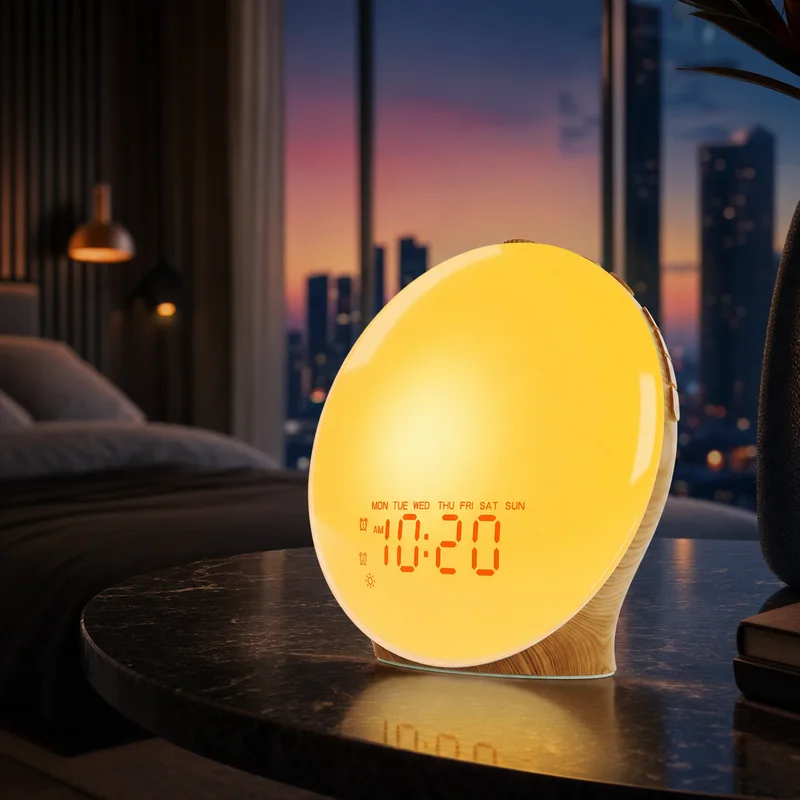
JALL Wake Up Light sunrise alarm clock, wood grain finish — from Amazon listing
Best budget
JALL · 10-100% sunrise ramp, dual alarms, FM radio, wood-grain finish

JALL Wake Up Light (wood grain) Review

Every category needs an honest entry point, and in sunrise alarm clocks this is it. The JALL Wake Up Light covers the real basics of light-waking for about $35: a genuine gradual dawn that ramps from 10% to 100% brightness before your alarm, two alarms with all-day, weekday and weekend modes, seven natural sounds, FM radio, and a tidy wood-grain case that looks better on a nightstand than the price suggests — all from on-device buttons with no app and no subscription anywhere. Our ranking philosophy is explicit that affordability earns a badge, not the podium, and the honest limits here are exactly why: the light output and color quality are basic — nowhere near the Philips clinical ~300-lux tier — and there's no escalating beeper failsafe, so it's not the answer for the heaviest sleepers. But as a first sunrise clock, it does the one thing that matters: it lets you find out, for the price of a dinner, whether waking to light instead of a buzzer changes your mornings. For a lot of people it does — and some of them will later upgrade to a Philips knowing exactly why. Here's the full breakdown.

Check on Amazon

Affiliate link — Super Achiever Club earns a small commission at no extra cost to you.

Read the complete Sleep & Recovery guide →
▸ THE SCORE

How we built the SAC Product Score™7.6/10

Light quality30%7.2/10

A genuine gradual sunrise — brightness ramping 10% to 100% ahead of the alarm — which is the mechanism that makes the category work, present and real at $35. The score is honest about the rest: output and color quality are basic, no lux figure is published, and the dawn doesn't attempt the Philips red→amber→white clinical progression. In a dark room it does the job; it doesn't pretend to more.

Wake reliability20%7.4/10

The ramp finishes with one of seven natural sounds or FM at your set volume, which wakes average sleepers dependably. No escalating beeper failsafe exists at this price point, so the honest rule applies: occasional snoozers are fine here, chronic oversleepers need the HF3650. Set the sound volume firmly and the light becomes the gentle lead-in it should be.

Features20%7.2/10

Dual alarms with all-day/weekday/weekend repeat modes, seven natural sounds, FM radio, adjustable brightness as a bedside lamp — the honest basics, each one functional. Nothing more: no sunset wind-down program, no noise colors, no Bluetooth, no smart features. At $35 that focus is a feature in itself, but the score reflects the short list.

Controls & usability20%7.8/10

Fully button-operated with no app existing at all — the durable architecture — and the wood-grain case is genuinely tidy on a nightstand. The controls are budget-tier: functional buttons and menus that take a session to learn, without the tap-snooze refinement or polish of the premium picks. Set it once and it stays out of your way.

Value10%9.4/10

The best value score on our list: about $35 for a real dawn ramp, two scheduled alarms, sounds and FM with zero ongoing costs. It's the cheapest credible way into the entire category — cheap because it's basic, not because it's broken, which is precisely the distinction our budget badge exists to mark.

▸ SPECS

The product at a glance

Light
Sunrise ramp 10% → 100% before alarm; adjustable brightness lamp
Alarms
Dual alarms (all-day / weekday / weekend modes)
Sound
7 natural sounds + FM radio
Finish
Wood-grain case
App / sub
None — button-operated, no subscription
Price
~$35
▸ TRUTH CHECK

Marketing claims vs. reality

Verified

Simulates sunrise with gradually brightening light before the alarm.

The core 10-100% gradual ramp is real and configurable — a genuine dawn simulation, not a lamp on a timer. We note honestly that no lux specification is published and the color progression is basic compared with the clinical-tier Philips ramp.

Verified

Dual alarms with weekday/weekend scheduling.

The listing confirms two alarms, each settable to all-day, weekday-only or weekend-only repeat — the practical scheduling feature that covers a weekday/weekend split or a two-sleeper household at the lowest price on our list.

Verified

Seven natural sounds plus FM radio.

Seven on-device natural wake sounds and an FM tuner are confirmed on the listing — a modest but functional library, all stored locally with no app or streaming dependency.

Partial

Helps heavy sleepers wake up.

Light-plus-sound at firm volume wakes average and moderately deep sleepers, but this unit has no escalating beeper failsafe — the engineering that defines a true heavy-sleeper clock (Philips HF3650). We mark the category-typical marketing PARTIAL: helpful for most, no guarantee for the heaviest sleepers.

▸ THE DEEP DIVE

What our test actually found

01The $35 test: it keeps the mechanism and drops the refinement

The intellectually honest way to judge a budget pick is to ask what the category's core mechanism costs — and the JALL shows the answer is about $35. The gradual pre-alarm ramp in a dark room is the whole trick the dawn-simulation trials describe, and this unit performs it genuinely. Everything above that price in the category buys refinement: validated lux figures, natural color progressions, failsafes, sound libraries, ecosystems. Refinement is real value — our top picks earn their prices — but it's important that entry to the category itself isn't gated behind $120. It isn't. This is the proof.

02Where the money went: what 'basic light' means in practice

Expect a functional dawn, not a beautiful one. The JALL's ramp brightens on schedule and fills a dark bedroom well enough to wake most sleepers, but the peak is modest, no lux number is published, and the color of the light through the ramp is simple warm-to-bright rather than the Philips' tuned red→amber→white progression that mimics a real horizon. If you test it and love waking to light but wish the dawn were richer and brighter — that's not the product failing, that's the upgrade path announcing itself. The HF3520 exists for exactly that moment.

03No app is a durability feature at the budget end

Cheap electronics with companion apps have a predictable lifecycle: the hardware outlives the software, the app stops getting updates, and a working device becomes e-waste. The JALL sidesteps the entire failure mode by having no app at all — both alarms, all sounds, the ramp and the radio are programmed from buttons and will work identically for the unit's whole life. Our ranking rewards no-app operation across the board, but at $35 it's arguably worth the most: this is the price tier where software abandonment is otherwise routine.

04Who should skip straight past the budget pick

Three buyers shouldn't start here, and we'd rather route them now. Chronic oversleepers: no light-led budget clock replaces a loud escalating failsafe — buy the Philips HF3650 or keep your phone alarm as backup. Light purists: if the quality of the dawn is the purchase, the HF3520's validated ~300-lux clinical ramp is the benchmark and the JALL will disappoint you on purpose. And sound-machine users: the Dreamegg's true white/pink/brown noise engine is only ~$15 more. Everyone else — the curious, the budget-bound, the buzzer-weary — this is your on-ramp.

▸ THE TRADE-OFFS

Pros & cons, no sugar-coating

Pros
  • Genuine 10-100% gradual sunrise ramp at the category's lowest price
  • Dual alarms with all-day, weekday and weekend modes
  • Seven natural sounds plus FM radio, all on-device
  • No app, no account, no subscription — nothing to break or expire
  • Tidy wood-grain finish that outclasses its price on the nightstand
Cons
  • Light output and color quality are basic — nowhere near the Philips clinical tier
  • No escalating beeper failsafe — not the answer for the heaviest sleepers
  • Short feature list: no sunset program, noise colors, Bluetooth or tap-snooze
▸ THE BOTTOM LINE

The right first sunrise clock — buy it to test light-waking for $35, upgrade later if the light hooks you.

The JALL Wake Up Light (wood grain) is our budget pick because it's cheap the right way: it keeps the category's core mechanism — a real gradual dawn ramp ending in sound — and sheds only refinement, not function. Dual scheduled alarms, seven sounds, FM, a case that doesn't embarrass the nightstand, and not a single app, account or subscription anywhere in the product. At about $35, it's the cheapest credible answer to the question 'would waking to light actually help me?' — and that's a question worth $35 for anyone who dreads their buzzer. Our ranking's honesty rule bears repeating: affordability earns this badge, not the #1 slot. The light is basic, there's no failsafe, and the feature list is short — so light purists should buy the Philips HF3520, chronic oversleepers the HF3650, and sound-machine buyers the Dreamegg. But if you're new to the category and unwilling to gamble premium money on an unfamiliar wake-up style, this is exactly where to start. Worst case, you're out a dinner; best case, you never hear a buzzer again.

Check JALL · 10-100% sunrise ramp, dual alarms, FM radio, wood-grain finish on Amazon
▸ ALTERNATIVES

If this doesn’t fit — try these

▸ RESEARCH

Sources & further reading

  1. Gabel 2013Gabel V, Maire M, Reichert CF, et al. · 2013 · Chronobiol Int · PMID 23841684

    Effects of artificial dawn and morning blue light on daytime cognitive performance, well-being, cortisol and melatonin levels

    Lab study, 17 sleep-restricted participants: a dawn simulation gradually rising to 250 lux improved cognitive performance, mood and well-being and raised wake-time cortisol versus dim and blue light. The mechanism a budget ramp still performs — gradual pre-alarm light in a dark room.

  2. Giménez 2010Giménez MC, Hessels M, van de Werken M, et al. · 2010 · Chronobiol Int · PMID 20653451

    Effects of artificial dawn on subjective ratings of sleep inertia and dim light melatonin onset

    Field study with a wake-up light: artificial dawn significantly reduced self-reported sleep inertia — but did NOT shift dim-light melatonin onset, and light alone doesn't guarantee arousal for every sleeper. Why we route chronic oversleepers past every light-led clock, budget or premium.

  3. Amazon listing 2026JALL · 2026 · Amazon.com

    JALL Wake Up Light Sunrise Alarm Clock, Wood Grain (Amazon product listing)

    Product facts on this page — the 10-100% gradual sunrise ramp, dual alarms with all-day/weekday/weekend modes, seven natural sounds, FM radio, wood-grain case and button-only no-app/no-subscription operation at ~$35 — verified against the live Amazon listing (ASIN B0BPXBD7NM, checked 2026-07-20).