Updated Jul 21, 2026 · by Felix Hesse · Verified by SAC team
Jul 21, 2026
Verified by SAC team
+10
XP on completion
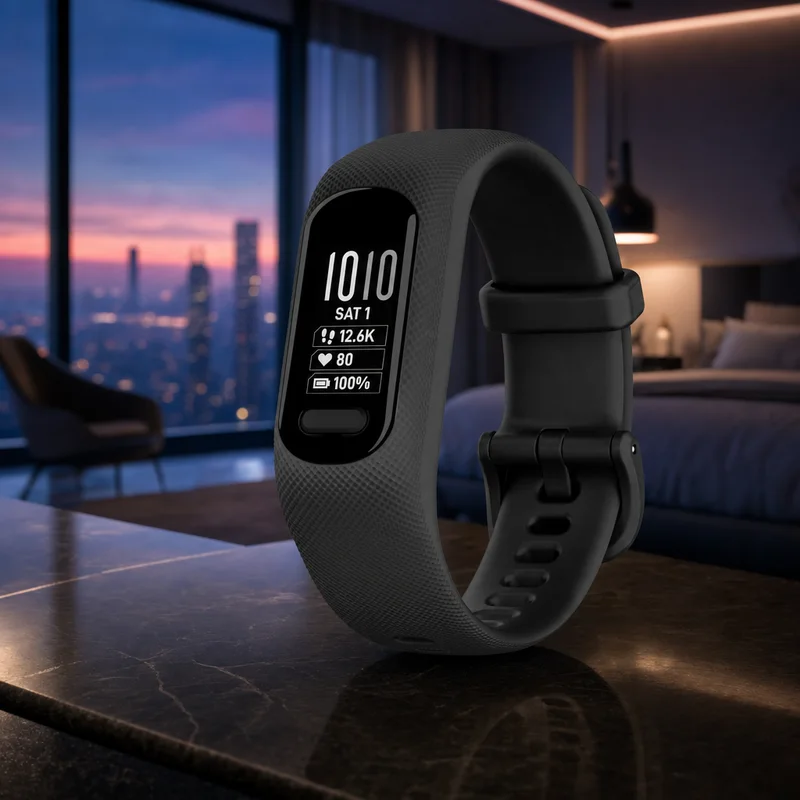
Garmin vivosmart 5 slim fitness and sleep band — from Amazon listing
Best battery / value watch
Garmin · slim fitness band · no subscription

Garmin vívosmart 5 Review

The Garmin vívosmart 5 is the pick for a buyer the ring-first picks quietly underserve: someone who wants ONE affordable device that earns its keep all day — steps, workouts, stress — and then tracks sleep all night, without a subscription anywhere in the equation. The band is slim and light enough to sleep in, runs up to ~7 days between charges, and feeds everything into Garmin Connect, which remains one of the few genuinely free full-featured health apps in the industry. Body Battery is the quiet star: a simple 0-100 recovery gauge that makes the connection between last night's sleep and today's energy visible enough to actually change behavior. The honest frame for its #6 rank: as a pure sleep instrument, a wrist band gives ground to the rings — slightly less comfortable to sleep in, staging that's good-not-great, and a less sleep-focused app than Oura's. And the universal caveats apply: its stage breakdown is an estimate like every consumer device's, and Body Battery is a modeled trend gauge, not a measurement. But judged as what it actually is — a ~$150, subscription-free, day-and-night wearable with real battery life — it's the best value on the wrist in our lineup, and for the right buyer that's exactly the assignment. Here's the full breakdown.

Check on Amazon

Affiliate link — Super Achiever Club earns a small commission at no extra cost to you.

Read the complete Sleep & Recovery guide →
▸ THE SCORE

How we built the SAC Product Score™7.8/10

Accuracy (vs lab PSG)30%7.8/10

Solid on the honest layer — sleep/wake detection, total sleep time, and consistent trends, the outputs validation work says consumer devices get right (Chinoy 2021). Garmin's staging is good-not-great within the category: serviceable as context, a step behind Oura's refinement, and like every consumer device it infers stages from movement and heart signals rather than measuring brain activity. Trust the duration and the trend line; hold the stage chart loosely.

Metrics & insight20%7.8/10

A strong practical package: sleep stages and score, HRV status, stress tracking, and Body Battery — the simplest genuinely useful recovery gauge in our lineup, translating sleep into a visible daily energy number. All of it free, none of it paywalled. The deduction is coaching: Garmin Connect presents data well but directs behavior less than Oura's Readiness does, and its interface is fitness-first, sleep-second.

Comfort & wearability20%7.5/10

About as good as wristwear gets for sleep: slim, light, with a soft silicone strap — far more bedding-friendly than a full smartwatch. It still concedes to the rings: a strap is present on the wrist in a way a ring isn't, silicone worn 24/7 needs hygiene discipline to keep skin happy (rinse, dry, don't overtighten), and some sleepers never adapt to nightwear on the wrist at all. Good; not ring-good.

Cost / no-subscription15%8/10

~$150 once, and Garmin Connect's full feature set — including every sleep and recovery metric — is free forever. Three-year cost of ownership: ~$150, versus ~$565 for Oura and more for WHOOP. It trails RingConn's 9.8 only because RingConn pairs no-fee with class-leading battery and an apnea signal; as wrist devices go, this is the honest-money pick.

Battery & ecosystem15%8/10

Up to ~7 days per charge — a real advantage over daily-charge smartwatches, because a watch on the charger overnight tracks nothing; with weekly top-ups timed to a shower, nights essentially never gap. The Garmin Connect ecosystem is mature, broadly integrated, and works with both Android and iOS. Deduction: the display and sensors are modest, and rings still double the battery figure.

▸ SPECS

The product at a glance

Form
Slim, lightweight fitness band with silicone strap
Battery
Up to ~7 days per charge
Subscription
NONE — Garmin Connect is fully free
Sleep features
Sleep stages, sleep score, HRV status
Recovery
Body Battery energy gauge (0-100, trend-friendly)
Daytime
Steps, workouts, stress, smart notifications
Compatibility
Android and iOS
Price
~$150, no recurring fee
▸ TRUTH CHECK

Marketing claims vs. reality

Verified

Long-lasting battery life.

The listing leads with long battery life, and the ~7-day figure holds as an up-to number in normal use — a genuine sleep-tracking advantage over daily-charge smartwatches, since charging can happen in a weekly daytime window instead of overnight. Rings still double it, which our ranking prices in.

Partial

Tracks sleep with stages plus health metrics like stress and Body Battery.

The feature set is as listed and Body Battery is genuinely useful as a trend gauge. PARTIAL for the category-wide honesty: stage classification is an estimate on every consumer device versus lab polysomnography (Chinoy 2021), Garmin's included, and Body Battery is a modeled composite — read both as trends and context, not measurements.

Verified

Simple design, easy to wear all day and night.

Fair as stated: the slim profile and low weight make it one of the most sleep-tolerable wrist devices, and its simplicity is the point — it does double duty without smartwatch bulk. The honest asterisk from our comfort criterion: 'easy for a wrist band' still trails a ring for pure sleep comfort, and 24/7 silicone wear demands basic strap hygiene.

▸ THE DEEP DIVE

What our test actually found

01The free-forever app is a bigger deal than the hardware

Wearable pricing has drifted toward the razor-and-blades model: cheap-ish hardware, monthly fee for the insights. Garmin is the largest holdout — Garmin Connect's complete feature set, sleep stages and Body Battery included, costs nothing and always has. That changes the three-year math completely: ~$150 total for the vívosmart 5, versus ~$565 for Oura and an open-ended membership for WHOOP. For the budget buyer, that's the whole argument. For everyone else it's still the trust signal that Garmin's business doesn't depend on paywalling your own sleep data later — a structural honesty our cost criterion is built to reward.

02Body Battery makes the sleep-energy link visible — which is what changes behavior

A raw sleep log tells you what happened; Body Battery tells you what it cost. Watching your morning number sit low after a string of short nights, then climb after a week of consistent bedtimes, closes the feedback loop that actually drives habit change — and habit change, not data collection, is the only mechanism by which any tracker improves sleep. Use it at trend altitude: a low Tuesday means little (HRV-based composites are noisy day to day), but a two-week drift means something. That's the same discipline we preach across this ranking, and Garmin's simple gauge makes it unusually easy to practice.

03Double duty is a real strategy, not a compromise — for the right buyer

The ring-first logic of our top picks assumes a dedicated sleep instrument is worth its own slot on your body. The vívosmart 5's counter-argument: a device you wear all day for steps, workouts, and notifications is a device that's already on your wrist at bedtime — compliance by momentum. Add that daytime activity and stress data gives its sleep analysis context a night-only tracker lacks (Body Battery is precisely this synthesis), and the one-device strategy holds up for anyone who wants good-enough sleep data attached to a genuinely useful daytime tracker. The buyer it fails is the sleep maximalist — who should be at picks #1-#2 anyway.

04Where the wrist concedes to the finger

Honesty about the form factor: for pure sleep tracking, the band loses to the rings on three fronts. Comfort — slim as it is, a strap on the wrist is more present in bed than a few grams of titanium on a finger, and some sleepers never adapt. Skin practicalities — silicone worn 24/7 requires actual hygiene (rinse, dry, don't overtighten) to avoid the irritation that ends many wearable relationships. And focus — Garmin Connect is a fitness app that also does sleep, not a sleep app; its staging polish and sleep coaching trail Oura's. None of this sinks the pick; all of it explains why the double-duty band ranks #6 in a sleep-first ranking while winning its own value-on-the-wrist category.

▸ THE TRADE-OFFS

Pros & cons, no sugar-coating

Pros
  • Everything free, forever — full sleep and recovery features in Garmin Connect with zero subscription
  • True double duty: all-day fitness, stress, and notifications plus overnight sleep tracking
  • Body Battery turns sleep into a visible daily energy number — the simplest useful recovery gauge here
  • Up to ~7 days of battery — weekly daytime charging, no overnight data gaps
  • Slim, light, and affordable (~$150) — the best value on the wrist in our lineup
Cons
  • A wrist strap is less sleep-friendly than a ring, and 24/7 silicone wear demands strap hygiene
  • Staging is good-not-great and — like every consumer device — an estimate, not a measurement
  • Garmin Connect is fitness-first: less sleep-focused polish and coaching than Oura's app
▸ THE BOTTOM LINE

Best value on the wrist — buy it for no-fee double duty; go ring if sleep is the whole mission.

The Garmin vívosmart 5 earns its place as the sensible-money wrist pick: ~$150 once, everything free in Garmin Connect forever, up to ~7 days of battery, and a genuinely useful day-plus-night package where Body Battery converts your sleep into a daily energy trend you'll actually respond to. For the buyer who wants one affordable device covering workouts by day and sleep by night — with zero subscription anywhere — nothing else in our lineup does this job as honestly. Its limits are the form factor's, and we've stated them plainly: a strap on the wrist trails a ring for sleep comfort, its staging is a good-not-great estimate (as all consumer staging is), and its app coaches less than Oura's. So the decision tree is clean. Sleep is the whole mission: get a ring — Oura (#1) for the best app, RingConn (#2) for no-fee value. Won't wear anything to bed: the Withings pad (#4). Want one budget device for everything with honest free software: this is your pick. Whichever way, the usage rule is identical — wear it nightly, read Body Battery and sleep data as weekly trends, build one habit, and never let a morning number grade you (Baron 2017).

Check Garmin · slim fitness band · no subscription on Amazon
▸ ALTERNATIVES

If this doesn’t fit — try these

▸ RESEARCH

Sources & further reading

  1. Chinoy 2021Chinoy ED, Cuellar JA, Huwa KE, Jameson JT, Watson CH, Bessman SC, Hirsch DA, Cooper AD, Drummond SPA, Markwald RR · 2021 · Sleep · PMID 33378539

    Performance of seven consumer sleep-tracking devices compared with polysomnography

    Consumer sleep trackers validated against lab polysomnography: reliable sleep/wake and total-sleep-time outputs, weaker exact staging. Why we anchor the vívosmart 5's value on duration and trends and hold its stage chart loosely.

  2. Baron 2017Baron KG, Abbott S, Jao N, Manalo N, Mullen R · 2017 · Journal of Clinical Sleep Medicine · PMID 27855740

    Orthosomnia: are some patients taking the quantified self too far?

    Case series coining 'orthosomnia' — perfectionistic score-chasing that worsens sleep. Applies to sleep scores and Body Battery alike: read both as multi-day trends, never as daily grades.