Updated Jul 21, 2026 · by Felix Hesse · Verified by SAC team
Jul 21, 2026
Verified by SAC team
+10
XP on completion
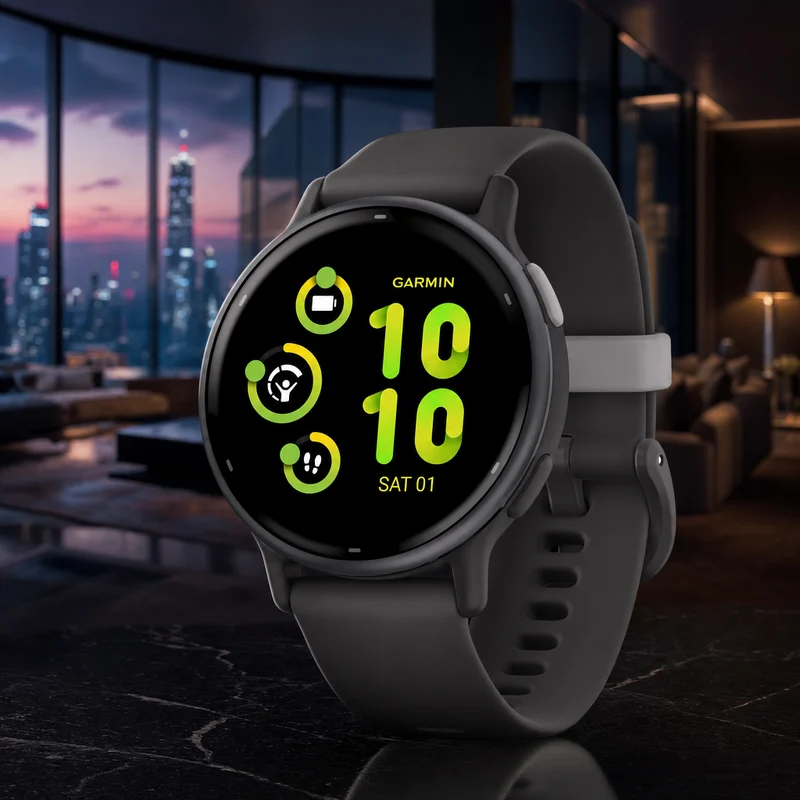
Garmin Vívoactive 5 GPS smartwatch with AMOLED display and silicone band — from Amazon listing
Best battery / serious tracking
Garmin · AMOLED GPS smartwatch · up to 11-day battery · Garmin Connect

Garmin Vívoactive 5 Review

The Garmin Vívoactive 5 is the tracker for people who understand that the best fitness tracker is the one that's actually on your wrist. Its headline spec — up to 11 days of battery — is not a convenience feature for weight loss, it's the adherence feature: no nightly charging ritual, no dead-watch evenings, no gaps in your step streak or sleep data. Around that it wraps Garmin-grade step and heart-rate accuracy (benchmark-adjacent, from one of the category's three accuracy-reference brands), a bright AMOLED display behind Corning Gorilla Glass 3, 5 ATM water resistance, and Garmin Connect — the deepest activity app in this ranking, with Body Battery, sleep, 30+ sports, and clean exports to Apple Health, Google Fit, and Strava on either phone platform. Why is it #2 rather than #1? Two honest reasons. At ~$300 it's the priciest pick in the lineup, so it takes the lowest value score of our top three — you're paying a premium for the battery-plus-data combination. And for the specific job of building a daily movement habit, Apple's Activity rings edge Garmin Connect on sheer stickiness (Connect is deeper but busier, with a learning curve). The universal caveat applies here too: its calorie-burn estimate is rough like every wrist device — no tracker beat 20% error in the Stanford test — so read the burn as a trend and run your deficit off intake. For long battery plus serious data on any phone, this is the best device on the list.

Check on Amazon

Affiliate link — Super Achiever Club earns a small commission at no extra cost to you.

Read the complete Weight Loss guide →
▸ THE SCORE

How we built the SAC Product Score™8.9/10

Step & heart-rate accuracy30%9.2/10

Garmin is one of the category's three accuracy-reference brands: reliable step counting and strong optical heart rate at rest and steady effort, with sports-grade GPS on top. It sits just behind the Apple Watch, which was the single best device in the Stanford seven-wearable test. Same universal caveats: wrist HR wanders during arm-heavy intervals (Gillinov 2017), and the derived calorie number stays rough on every wrist device.

App & ecosystem / habit-building25%9/10

Garmin Connect is the deepest app in the ranking — Body Battery, sleep, stress, 30+ sports, long-horizon trends — and it exports to Apple Health, Google Fit, and Strava from either phone platform, so activity sits beside your calorie tracking anywhere. It loses a hair to Apple's rings and Fitbit's nudges on pure habit stickiness: Connect informs brilliantly but coaxes a little less, and its density takes a week to learn.

Battery & wearability25%9.2/10

The standout axis. Up to 11 days of battery means the watch is effectively always on your wrist — day, night, and through travel — which is the whole adherence game. It's light and comfortable with a standard silicone band (a proven, skin-safe wearable material), 5 ATM water-rated so it stays on for swims and showers, and the AMOLED display sits behind Gorilla Glass 3. Only the 14-day Amazfit GTR 4 outlasts it here.

Value15%7.4/10

The honest cost of the package: at ~$300 it's the most expensive pick in the lineup, scoring lowest on value among our top picks. You're paying for the battery-accuracy-data trifecta, and it's worth it if those are your priorities — but the Venu Sq 2 delivers most of the same strengths for ~$200, which is exactly why price stays a tie-breaker in our methodology rather than a crown-maker.

▸ SPECS

The product at a glance

Type
GPS smartwatch, AMOLED display, aluminum bezel, Corning Gorilla Glass 3
Battery
Up to 11 days (smartwatch mode) — roughly weekly charging
Accuracy
Garmin-grade optical HR + reliable steps; sports GPS (calorie estimate rough like all wrist devices)
App / data
Garmin Connect: Body Battery, sleep, stress, 30+ sports modes
Exports to
Apple Health, Google Fit, Strava — iPhone and Android
Water rating
5 ATM — swim- and shower-proof
Band material
Silicone band — standard, skin-safe wearable material
Price
~$300 — the priciest pick in the lineup
▸ TRUTH CHECK

Marketing claims vs. reality

Verified

Up to 11 days of battery life.

Stated on the live Amazon listing and consistent with Garmin's published spec for smartwatch mode. Real-world use with heavy GPS shortens it, but even conservative use lands in the many-days class — the honest, decisive adherence advantage over daily-charge smartwatches.

Verified

Health and fitness tracking: heart rate, sleep, Body Battery, 30+ sports.

All present as listed. Steps and heart rate are the trustworthy core (Garmin is an accuracy-reference brand); Body Battery and sleep scores are honest derived estimates, best read as trends. The breadth of tracking is genuinely the deepest in our lineup.

Partial

Tracks calories burned.

It shows a calorie estimate like every tracker — and like every wrist device, that estimate is rough. No wearable in the Stanford seven-device test beat 20% error on energy expenditure (Shcherbina 2017). Use Garmin's burn figure for trends and streaks, never as an exact number to eat back. We mark this partial on every pick in the category.

Verified

AMOLED display, 5 ATM water resistance, Gorilla Glass 3.

Stated on the live listing — a bright, durable, swim-proof build that supports the keep-it-on-always adherence case. Manufacturer specs, verified as claimed on the listing; not independent lab testing.

▸ THE DEEP DIVE

What our test actually found

01Battery is the feature that actually changes outcomes

Everything a tracker does for weight loss — visible steps, unbroken streaks, sleep and resting-HR trends — depends on it being worn continuously. The Vívoactive 5's up-to-11-day battery converts charging from a daily ritual (the classic drop-off point) into a weekly afterthought, and 5 ATM water resistance means it stays on through swims and showers. In our ranking that earns it the best battery-and-wearability score of the premium picks, and it's the single strongest reason to choose it over the Apple Watch: an 80%-as-sticky habit loop that's on your wrist 100% of the time beats a perfect one that's on the charger.

02Garmin Connect: deepest data, mild learning curve

Connect is the most complete activity picture in the category: steps, sleep stages, stress, Body Battery, dozens of sports profiles, and long-term trend views that make a slow, honest weight-loss journey visible week over week. It exports to Apple Health, Google Fit, and Strava, so your calorie app gets the data on any phone. The honest cost is density — first-week users face more screens and metrics than Fitbit or Apple show, and the habit nudges are politer and easier to ignore. Data-driven personalities thrive on it; if you want to be coaxed rather than informed, Fitbit's app suits you better.

03Accuracy is benchmark-adjacent — and the calorie caveat still applies

Garmin's steps and optical heart rate are among the most reliable on a wrist, which is what makes its trends trustworthy. But no brand escapes the physics: wrist optical HR degrades during arm-heavy, high-intensity work (Gillinov 2017 — a chest strap remains the reference for hard training, and Garmin watches pair with one), and the derived calorie-burn number was off by more than 20% on every device in the Stanford test. Practically: trust the steps, trust the resting-HR trend, use active minutes as your daily target, and treat the burn figure as a comparison against your own baseline — never as calories you've 'earned back.'

04The price is the trade — and there's a cheaper Garmin if it stings

At ~$300 the Vívoactive 5 asks the most money in the lineup, and our value score reflects that honestly rather than hiding it. What the premium buys is the combination — top-tier battery AND benchmark-adjacent accuracy AND the deepest app — which no cheaper device fully matches. But if the budget is the blocker, the Garmin Venu Sq 2 (#5, ~$200) keeps the 11-day battery, Garmin accuracy, and Garmin Connect with a squarer look and a slightly trimmed feature set. Per our methodology, quality leads and price is a tie-breaker — this is precisely the pick where you decide what the last $100 is worth to you.

▸ THE TRADE-OFFS

Pros & cons, no sugar-coating

Pros
  • Up to 11-day battery — the best adherence profile of the premium picks; it's simply always on your wrist
  • Garmin-grade step and heart-rate accuracy plus serious, trustworthy sports and GPS tracking
  • Garmin Connect is the deepest activity app here: Body Battery, sleep, stress, 30+ sports
  • Works fully on iPhone AND Android; exports to Apple Health, Google Fit, and Strava
  • Bright AMOLED display, Gorilla Glass 3, and 5 ATM water resistance — built to stay on
Cons
  • ~$300 — the priciest pick in the lineup, and our value score says so
  • Garmin Connect's depth has a learning curve; its habit nudges are less sticky than Apple's rings or Fitbit's coaching
  • Calorie-burn estimate is rough like every wrist device — a trend, never a number to eat back
▸ THE BOTTOM LINE

Buy it for battery + data — the tracker that's never off your wrist, at the lineup's highest price.

The Vívoactive 5 is the rational pick for anyone who has ever abandoned a daily-charge smartwatch — which is most people who've abandoned a tracker at all. Its up-to-11-day battery makes continuous wear the default rather than a discipline, and continuous wear is what actually produces the unbroken streaks, complete sleep data, and honest resting-HR trends that support a weight-loss phase. Around that it delivers benchmark-adjacent Garmin accuracy, the deepest app in the category, and full dual-platform support with exports to Apple Health, Google Fit, and Strava. It finishes #2 for two honest reasons: it costs the most here (~$300), and Apple's Activity rings remain the stickier pure habit loop for iPhone users willing to charge daily. If the price stings, the Venu Sq 2 (#5) keeps the core formula for ~$200; if maximum habit stickiness on iPhone matters more than battery, the Apple Watch SE (#1) is the call. And whichever you choose: the burn number is a trend on every wrist device — run your deficit off measured intake, and let this watch do what it does best, which is keep your activity visible every single day.

Check Garmin · AMOLED GPS smartwatch · up to 11-day battery · Garmin Connect on Amazon
▸ ALTERNATIVES

If this doesn’t fit — try these

▸ RESEARCH

Sources & further reading

  1. Shcherbina 2017Shcherbina A, Mattsson CM, Waggott D, Salisbury H, Christle JW, Hastie T, Wheeler MT, Ashley EA · 2017 · Journal of Personalized Medicine · PMID 28538708

    Accuracy in Wrist-Worn, Sensor-Based Measurements of Heart Rate and Energy Expenditure in a Diverse Cohort

    Seven consumer wrist wearables vs gold-standard references: six kept median heart-rate error under 5% during cycling, but not one estimated energy expenditure to better than 20%. Why we score step/HR accuracy and refuse to score calorie-burn accuracy on any tracker, Garmin included.

  2. Gillinov 2017Gillinov S, Etiwy M, Wang R, Blackburn G, Phelan D, Gillinov AM, Houghtaling P, Javadikasgari H, Desai MY · 2017 · Medicine & Science in Sports & Exercise · PMID 28709155

    Variable Accuracy of Wearable Heart Rate Monitors during Aerobic Exercise

    Wrist optical HR accuracy varies by activity and degrades during arm-driven exercise; a chest strap remains the reference for hard training. Why we call Garmin's wrist HR trustworthy for trends and steady effort, not for interval-by-interval precision.

  3. Amazon listing (manufacturer specs)Garmin · 2026

    Garmin Vívoactive 5, Health and Fitness GPS Smartwatch, AMOLED Display, Up to 11 Days of Battery, 5 ATM, Corning Gorilla Glass 3

    Source for the product specs cited in this review (battery, display, water rating, materials, price). Manufacturer specifications verified live on the listing — not peer-reviewed research, and never framed as such.