Updated Jul 21, 2026 · by Felix Hesse · Verified by SAC team
Jul 21, 2026
Verified by SAC team
+10
XP on completion
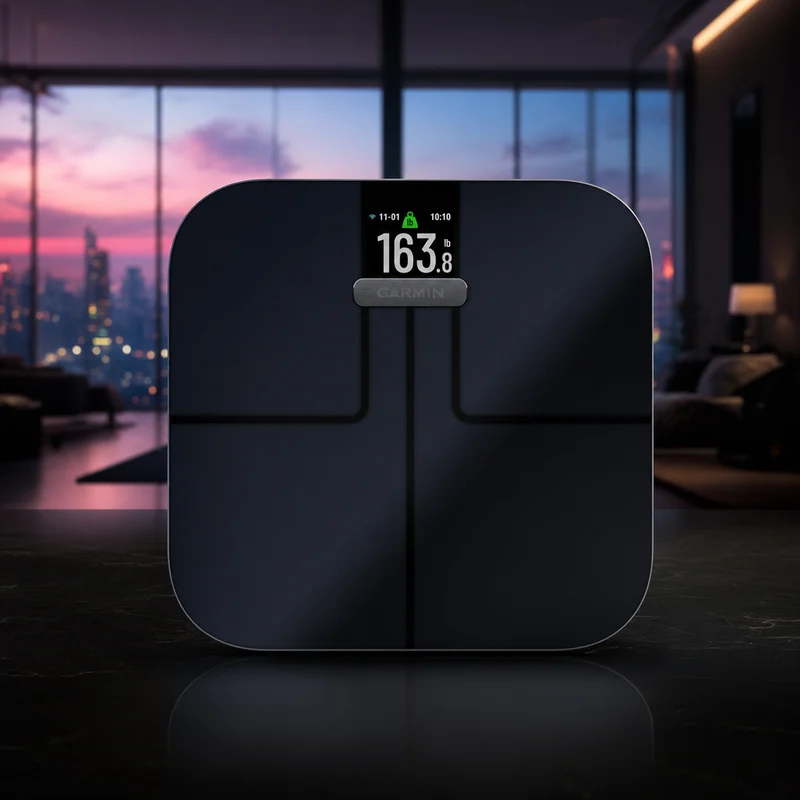
Garmin Index S2 Wi-Fi smart scale, black square platform with color display — from Amazon listing
Best premium
Garmin · Wi-Fi, premium build, on-device weight-trend graph, syncs to Garmin Connect, up to 16 users

Garmin Index S2 Wi-Fi Smart Scale Review

If you wear a Garmin and live in Garmin Connect, the Index S2 is the obvious premium choice. The weight reading is Garmin-precise and beautifully consistent, it auto-syncs over Wi-Fi with no phone needed, and it draws a weight-trend graph right on the device — then drops your weight alongside your training load and wellness data for the tightest feedback loop of any scale here. Add up to 16 user profiles, a high-resolution color display, and roughly 9 months of battery, and it's a polished, buy-once-and-forget device. It sits at #2 rather than #1 for one honest reason: value. It's the most expensive scale on our list by a wide margin, and its biggest advantage — the Garmin Connect integration — is only fully realized if you're already in that ecosystem. Its body-composition metrics are the usual BIA estimates (weight, body fat, skeletal muscle, bone, water), best read as a trend, not an absolute. For accuracy plus Garmin ecosystem fit, it's superb; for everyone else, the Withings Body Smart delivers most of the same for less. Here's the full breakdown.

Check on Amazon

Affiliate link — Super Achiever Club earns a small commission at no extra cost to you.

Read the complete Weight Loss guide →
▸ THE SCORE

How we built the SAC Product Score™8.9/10

Weight accuracy & consistency35%9.5/10

Garmin-grade precision and a premium build give a rock-solid, repeatable weight reading — the foundation of a trend you can actually read. It sits a hair below the Withings only because Withings is the category's dedicated accuracy-benchmark brand; in practice both give you a weigh-in consistent enough to trust the moving average.

App & trend tracking / sync25%9.3/10

Wi-Fi auto-sync to Garmin Connect with no phone needed, plus a weight-trend graph drawn on the device itself — you see the direction the moment you step off. For Garmin owners the loop is unbeatable: weight lands beside training and wellness data. Slightly behind Withings' Health Mate only because the standalone-app polish is strongest inside the Garmin world.

Body-comp metrics & sensors25%8.8/10

Weight, weight trend, body fat %, skeletal muscle mass, bone mass, and body water via BIA on a high-resolution color display. A sensible, well-implemented set rather than an inflated list — and framed honestly, that's the right call, since every one of those metrics is a trend indicator from the same moderately-accurate BIA estimate.

Value15%7.2/10

The lowest value score on the podium, and deliberately so: at roughly $130-175 it's the priciest scale on the list, and its biggest advantage is realized only inside the Garmin ecosystem. For a Garmin owner it replaces a premium scale and ties into gear they already own, so the price is defensible; for anyone else, the Withings does most of the same for less.

▸ SPECS

The product at a glance

Connectivity
Wi-Fi (auto-sync to Garmin Connect)
App
Garmin Connect; on-device weight-trend graph
Metrics
Weight, weight trend, body fat %, skeletal muscle, bone mass, body water (BIA)
Display
High-resolution color display
Users
Up to 16 user profiles with individual goal tracking
Battery
Up to 9 months; 4 AAA batteries (included)
Body-fat method
Bioelectrical impedance (BIA) — read as a trend, not an absolute
Price
~$130-175 — the priciest pick; premium build
▸ TRUTH CHECK

Marketing claims vs. reality

Verified

Wi-Fi sync to Garmin Connect with an on-device weight-trend graph.

The listing confirms Wi-Fi connectivity that syncs to your Garmin Connect account for trend graphs and more, and Garmin documents the on-device weight-trend view. The auto-capture uploads without the phone present — the adherence advantage over Bluetooth-only scales.

Verified

Up to 16 user profiles and up to 9 months of battery life.

The Amazon listing states up to 16 user profiles with unique goal tracking and battery life of up to 9 months on 4 AAA batteries (included). Both are accurate and among the scale's genuine convenience strengths.

Partial

Accurate measurements for body fat %, skeletal muscle mass and more.

The metrics are real and the weight reading is Garmin-precise, but the body-composition figures come from bioelectrical impedance, which is reliable-but-rough (Jackson 1988, Siedler 2022) and shifts with hydration and time of day. Accurate as a feature; best read as a trend, not an absolute. Marked partial on that honesty.

Partial

Premium, most-accurate build in its class.

Garmin's precision and build quality are excellent and back the high weight-accuracy score. We mark it partial only because Withings is the category's dedicated accuracy-benchmark brand and matches it for less — 'premium' is true, 'most accurate' is a close tie rather than a clear win.

▸ THE DEEP DIVE

What our test actually found

01The Garmin ecosystem is the whole case for buying it

The Index S2's defining advantage isn't a spec — it's integration. If you already wear a Garmin and track workouts in Garmin Connect, your weight lands in the same place as your training load, sleep, and wellness data, giving you the tightest feedback loop of any scale on this list. That single-app view of input, output, and body-weight trend is worth real money to a Garmin athlete. Off-ecosystem, that advantage largely evaporates, which is exactly why our value score is measured.

02The on-device trend graph is a genuinely useful touch

Most scales make you open an app to see whether the trend is moving; the Index S2 draws a weight-trend graph on the device itself, so you get the moving-average signal the instant you step off. Because day-to-day weight is noise and only the multi-week trend is real, seeing that line on the scale nudges you toward reading direction instead of over-reacting to a single reading — a small design decision that reinforces the right habit.

03Priced at the top — and honest about why it's #2

At roughly $130-175 the Index S2 is the most expensive pick on our list, and we ranked value at 15% precisely so price stays a subordinate tie-breaker rather than crowning a cheap scale. That's what keeps this at #2 instead of #1: its accuracy and app are excellent, but the Withings Body Smart delivers comparable accuracy and Wi-Fi auto-sync for less, and beats it on standalone-app polish. Pay the premium for the Garmin loop, not as a general upgrade.

04Body fat is a BIA trend here too — the weight is what to trust

Garmin precision applies to the weight reading, not the body-fat physics. Its body-composition metrics are BIA estimates with the usual limits — reliable but only moderately accurate (Jackson 1988), widely variable between devices (Siedler 2022), and sensitive to hydration and time of day. Weigh under consistent conditions and treat body fat, muscle, and water as direction over weeks. The trustworthy signal for weight loss is the weight trend, and on that the Index S2 excels.

▸ THE TRADE-OFFS

Pros & cons, no sugar-coating

Pros
  • Garmin-grade precision and a premium build — a rock-solid, repeatable weight reading
  • Wi-Fi auto-sync to Garmin Connect plus an on-device weight-trend graph you see while standing on it
  • The tightest feedback loop for Garmin watch owners — weight beside training and wellness data
  • Supports up to 16 user profiles; ~9-month battery on included AAA cells
Cons
  • The priciest pick by a wide margin, so it scores lower on value
  • Its app advantage is biggest inside the Garmin ecosystem; less compelling if you don't use Garmin
  • Body fat and body-comp are rough BIA estimates — read as a trend, not an absolute
▸ THE BOTTOM LINE

The premium, ecosystem-tightest pick — buy it if you wear a Garmin, otherwise get the Withings.

For a Garmin owner, the Index S2 is the easy premium call. The weight reading is Garmin-precise and consistent, it auto-syncs over Wi-Fi, it draws a trend graph on the device, and — the real edge — it drops your weight into Garmin Connect beside your training load for the tightest feedback loop of any scale here. Up to 16 profiles and ~9-month battery make it a polished, buy-once device. It lands at #2 purely on value: it's the most expensive scale on the list, and its biggest advantage lives inside the Garmin world. If you don't use Garmin, the Withings Body Smart (#1) gives you comparable accuracy and Wi-Fi auto-sync for less, with a better standalone app. And as with every scale here, read the body-fat % as a trend under consistent conditions, not as ground truth. Pay the premium for the Garmin loop; if you're not in that ecosystem, spend less elsewhere.

Check Garmin · Wi-Fi, premium build, on-device weight-trend graph, syncs to Garmin Connect, up to 16 users on Amazon
▸ ALTERNATIVES

If this doesn’t fit — try these

▸ RESEARCH

Sources & further reading

  1. Jackson 1988Jackson AS, Pollock ML, Graves JE, Mahar MT · 1988 · Journal of Applied Physiology · PMID 3372410

    Reliability and validity of bioelectrical impedance in determining body composition

    BIA was highly reliable but only moderately valid for body-fat %: standard error ~4.6-6.4 percentage points, far coarser than skinfold calipers. Why a smart scale's body-fat number is consistent but rough in absolute terms and should be read as a trend. (Evidence about the BIA method, not a product spec.)

  2. Siedler 2022Siedler MR, Rodriguez C, Stratton MT, Harty PS, Keith DS, Green JJ, Boykin JR, White SJ, Williams AD, DeHaven B, Tinsley GM · 2022 · British Journal of Nutrition · PMID 36404739

    Assessing the reliability and cross-sectional and longitudinal validity of fifteen bioelectrical impedance analysis devices

    Across 15 BIA devices vs a 4-compartment reference, body-fat constant error ranged ~−3.5% to +11.7%, yet select devices tracked CHANGE over time acceptably. Supports reading a scale's body-fat % as a trend under consistent conditions, not as an absolute. (Evidence about BIA accuracy, not a manufacturer claim.)