Updated Jul 21, 2026 · by Felix Hesse · Verified by SAC team
Jul 21, 2026
Verified by SAC team
+10
XP on completion
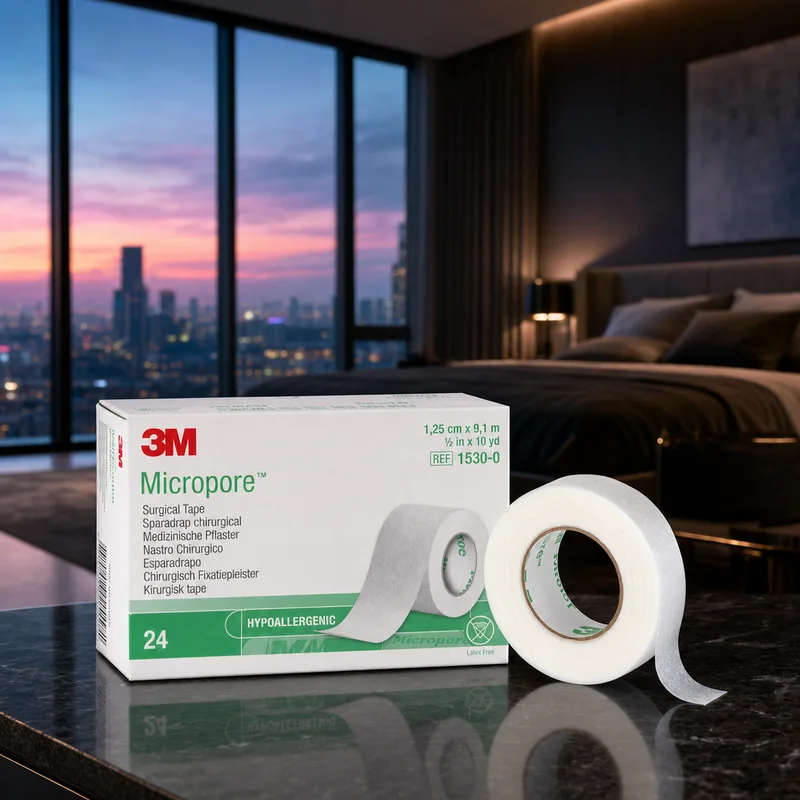
3M Micropore Paper Tape, white, 1/2 inch, single roll — from Amazon listing
Best DIY (doctor-recommended)
3M Micropore · hypoallergenic surgical paper tape · 1/2 in x 10 yds, 1 roll

3M Micropore Paper Tape (1/2 in) Review

3M Micropore is the mouth tape that existed before mouth tape was a product category. This is the plain white surgical paper tape found in every hospital and first-aid drawer: hypoallergenic, latex-free, very porous, engineered to adhere gently but firmly to skin and peel away without punishment. When clinicians suggest a patient try taping, this material class is usually what they mean — and gentle porous tape of exactly this kind is what the small clinical literature used. The half-inch roll reviewed here is our preferred width for the job, because a narrow tape makes the golden rule — a small strip, never a wide seal — almost self-enforcing. The honest limits are the DIY deal in full: hold is modest and depends on your application technique, there's no shaping or vent or elastic geometry, and a plain white strip on your face has zero aesthetic charm. None of that changes the math. At a few dollars for a 10-yard roll — months of nightly strips — it's the second-cheapest credible entry into taping behind the Nexcare 2-roll, with the same top-tier gentle adhesive class. And the category's safety rules stand over everything: habitual mouth-breathers with clear noses only; never with untreated sleep apnea, congestion, alcohol, or sedatives. Here's the full breakdown.

Check on Amazon

Affiliate link — Super Achiever Club earns a small commission at no extra cost to you.

Read the complete Sleep & Recovery guide →
▸ THE SCORE

How we built the SAC Product Score™8.5/10

Adhesive safety & skin-friendliness30%8.8/10

Hypoallergenic, latex-free, and gentle per the listing — and behind those three words sits decades of hospital use on fragile skin, the longest gentleness track record of anything in our lineup. It scores a notch below the Nexcare consumer roll only because the industrial-plain listing states less (no dermatologist-tested language) — the material class is the same. Patch-test regardless; perioral skin is delicate.

Secure all-night hold25%7.6/10

Adheres gently but firmly, in 3M's own words — which is an honest description of moderate hold. A well-pressed strip on clean, dry lips lasts the night for most people; lip balm, oils, stubble, or a restless sleeper will loosen it, and some mornings it will simply be off. That's the built-in safety margin of gentle tape, and also the reason no DIY roll can match a purpose-made adhesive on this axis.

Comfort & easy removal20%8.8/10

So light you forget it's there, and the peel is genuinely gentle — this tape's whole reason for existing in wound care is repeated low-trauma removal. Tears cleanly by hand to whatever length you want. Instant painless removal doubles as a safety property in this category, and Micropore passes without effort. Minor ding: plain flat tape can wrinkle at the lip line if applied sloppily.

Breathability / safety design15%8.8/10

'Micropore' is the design: a very porous paper that breathes and doesn't trap moisture against skin overnight. And the half-inch width is a genuine safety-relevant feature — it physically nudges you toward the small central strip that keeps the corners of the mouth free, closer in practice to partial coverage than to a seal. The score stops short of the shaped picks because the guardrail is still ultimately your discipline, not a built-in airflow gap.

Value10%9.6/10

A few dollars for a 10-yard roll — months of nightly half-inch strips at pennies each. It scores a hair below the Nexcare 2-roll purely on bulk economics (one roll versus two for a similar per-yard price), but both sit in a value tier no branded mouth tape approaches. Value is our tie-breaker criterion; among the DIY options it nearly ties.

▸ SPECS

The product at a glance

Type
Hypoallergenic surgical paper tape (the hospital classic)
Width
1/2 in — narrow, ideal for a small strip; 10 yds per roll
Adhesive
Adheres gently but firmly; latex-free
Breathability
Very porous, gentle and breathable per listing
Use for taping
Apply a small piece (vertical or short horizontal) — never a full seal
Price
~$5 for 1 roll → pennies per night for months
Safety scope
Only for habitual mouth-breathers with clear nasal passages — never with untreated OSA, congestion, alcohol, or sedatives
▸ TRUTH CHECK

Marketing claims vs. reality

Verified

Hypoallergenic and latex-free.

Stated on the listing, and backed by the deepest real-world record in our lineup: Micropore's decades of clinical use on healing and fragile skin are precisely why clinicians reach for this material when suggesting a taping trial. The most important spec for something worn on perioral skin nightly.

Verified

Adheres gently but firmly.

An unusually honest manufacturer phrase, and accurate: firm enough to last a night on clean dry lips when pressed well, gentle enough to peel off in a fraction of a second without stripping skin. The corollary — hold defeated by balm, oil, or stubble — is the accepted cost of gentleness, and we score hold at 7.6 accordingly.

Verified

Gentle and breathable, suitable for sensitive applications.

The porous paper construction is the product's namesake feature; it breathes and avoids trapping moisture under the strip overnight. For very reactive or eczema-prone skin, the silicone Nexcare Sensitive Skin roll (#7) is gentler still — but for typical skin, Micropore's gentleness is exactly as advertised.

Partial

Works as a mouth tape for sleep.

3M makes no such claim — the sleep application is the clinician-suggested DIY practice, so we fact-check the practice. For nose-clear habitual mouth-breathers, small studies (Lee 2022, PMID 36141367; Huang 2015, PMID 25450408) report reduced snoring indices — but they're tiny and preliminary, and the 2025 systematic review (PMID 40397877) found the evidence does not support taping as an OSA treatment. A modest, unproven habit aid; never a therapy.

▸ THE DEEP DIVE

What our test actually found

01The narrow width is a safety feature disguised as a spec

Most safety advice in this category is behavioural: apply a small strip, never seal the whole mouth. The half-inch Micropore turns that advice into physics — the tape simply isn't wide enough to build a meaningful seal without stacking strips deliberately. A single vertical or short horizontal piece leaves the corners of the mouth free, lets you part your lips at the edges, and peels off instantly. Among all the DIY options, this roll is the one whose default use is closest to the safer partial-coverage philosophy our #1 pick is built on.

02You're buying the studied practice, not a brand's interpretation of it

When the small clinical literature taped mouths, it used gentle porous hypoallergenic tape — the material class Micropore defines. When clinicians suggest a cautious taping trial, this is the drawer they point to. That provenance matters in a category where marketing runs far ahead of evidence: with Micropore you're replicating the actual studied practice at pennies a night, with no proprietary adhesive or design between you and the intervention. If the experiment earns its keep, shaped products add comfort and hold — but nothing they add changes the underlying mechanism.

03Modest hold is a feature-shaped limitation

The same gentleness that protects your skin caps this tape's grip. On clean dry lips a well-pressed strip usually survives the night; add lip balm, facial oil, stubble, or heavy tossing and you'll wake with it on the pillow. Two honest framings: as a product limitation, it's why purpose-made tapes out-hold it and why bearded sleepers should go straight to the extra-strong MyoTape (#6); as a safety property, a tape that surrenders easily is exactly what you want in the worst case. For a first-time taper, we'd take the forgiving version every time.

04The exclusions are the most important paragraph on this page

No mouth tape — including a humble half-inch paper strip — is safe for everyone. Do not tape with untreated or suspected obstructive sleep apnea (loud snoring, gasping, witnessed pauses, daytime exhaustion — get a sleep assessment first). Do not tape over a congested or blocked nose; the 2025 systematic review's asphyxiation warning is aimed exactly at that scenario, and the fix for a blocked nose is treating the nose. Do not tape after alcohol or sedatives. Micropore's easy removal narrows the worst case; it does not repeal the contraindications.

▸ THE TRADE-OFFS

Pros & cons, no sugar-coating

Pros
  • The exact plain hypoallergenic surgical tape clinicians suggest trying first — the studied material class
  • Narrow 1/2-inch width makes the small-strip safety rule nearly self-enforcing
  • Very porous and breathable; latex-free and gentle on fragile skin
  • Pennies per night — one roll lasts months of nightly strips
  • Tears by hand to any length; peels off instantly and painlessly
Cons
  • Modest, technique-dependent hold — defeated by lip balm, oils, stubble, or restless sleep
  • No shaping, vent, or elastic geometry — it's literally plain medical tape (which is the point)
  • Single roll versus the Nexcare pick's two — slightly weaker bulk economics
  • Like all mouth tape: contraindicated with untreated OSA, nasal congestion, alcohol, or sedatives
▸ THE BOTTOM LINE

The classic starter — buy it to run the honest experiment at pennies a night.

3M Micropore is the least-marketed product in our lineup and one of the easiest to recommend. It's the actual material the taping practice was built on: hypoallergenic, latex-free, very porous paper tape that adheres gently but firmly and peels away without punishment, in a half-inch width that quietly enforces the small-strip rule. At a few dollars for months of strips, it's the lowest-stakes way for a safe candidate to learn whether nasal-breathing taping does anything for them at all. Run it as an experiment, not a treatment: forearm patch-test, a 20-30 minute awake trial, then a single small vertical strip at night for a week or two. The realistic win is less dry mouth and perhaps a quieter mild snore — the evidence base is tiny, and the 2025 systematic review is blunt that taping is not an apnea treatment. If it earns its keep and you want more hold or built-in geometry, upgrade to the VIO2 (#1) or MyoTape (#2); if your skin is very reactive, the silicone Nexcare Sensitive (#7) is gentler still. And the hard rules never move: clear nose, no untreated or suspected apnea, no alcohol or sedatives — the doctor comes before the tape.

Check 3M Micropore · hypoallergenic surgical paper tape · 1/2 in x 10 yds, 1 roll on Amazon
▸ ALTERNATIVES

If this doesn’t fit — try these

▸ RESEARCH

Sources & further reading

  1. Lee 2022Lee YC, Lu CT, Cheng WN, Li HY · 2022 · Healthcare (Basel) · PMID 36141367

    The Impact of Mouth-Taping in Mouth-Breathers with Mild Obstructive Sleep Apnea: A Preliminary Study

    n=20 nose-clear mouth-breathers with MILD OSA, taped with hypoallergenic tape: snoring and apnea indices decreased. The class of gentle tape used is exactly what Micropore is — and the study is far too small to make taping a therapy.

  2. Huang 2015Huang TW, Young TH · 2015 · Otolaryngology–Head and Neck Surgery · PMID 25450408

    Novel porous oral patches for patients with mild obstructive sleep apnea and mouth breathing: a pilot study

    30-person uncontrolled pilot of a porous oral patch — the breathable-porous philosophy Micropore embodies. Some improvement in snoring; the authors state safety and efficacy cannot be established from the study.

  3. Rhee 2025 (systematic review)Rhee J, Iansavitchene A, Mannala S, Graham ME, Rotenberg B · 2025 · PLOS One · PMID 40397877

    Breaking social media fads and uncovering the safety and efficacy of mouth taping in patients with mouth breathing, sleep disordered breathing, or obstructive sleep apnea: A systematic review

    The field's reality check: low-quality evidence, no support for taping as an OSA treatment, and an explicit asphyxiation-risk warning with nasal obstruction. The reason our recommendation is gated on being a safe candidate.