Updated Jul 21, 2026 · by Felix Hesse · Verified by SAC team
Jul 21, 2026
Verified by SAC team
+10
XP on completion
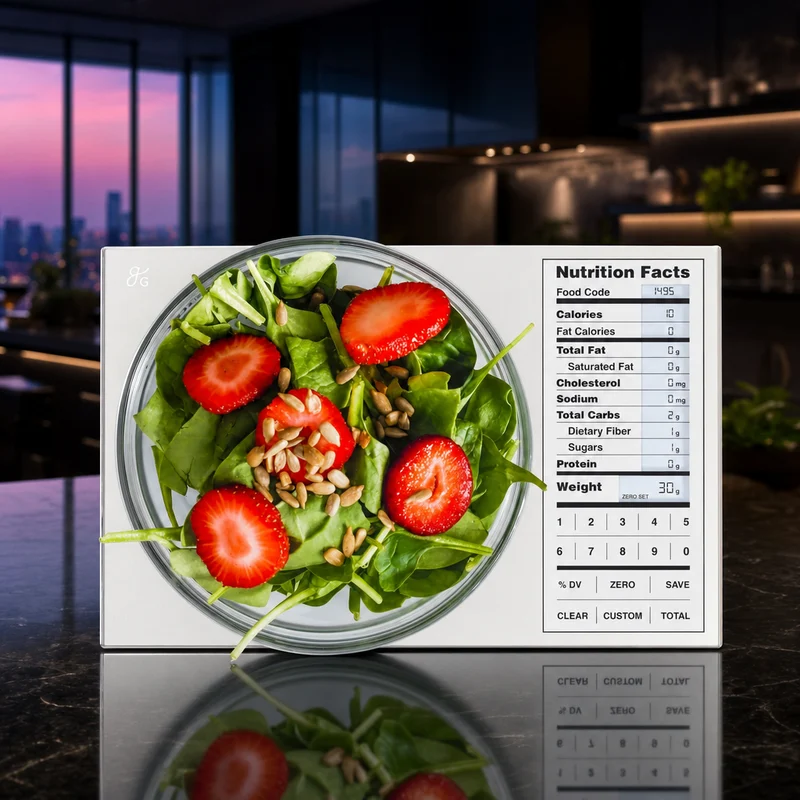
Greater Goods Nourish nutrition food scale with glass platform and nutrition-label display, silver — from Amazon listing
Best for macros on-device
Greater Goods · tempered-glass platform · 1 g / 0.1 oz · 11 lb · ~2,000 built-in food codes

Greater Goods Nourish Food Scale Review

The Greater Goods Nourish answers a specific, common frustration: you bought a food scale to track calories, and now every meal requires the scale AND your phone AND an app AND the willpower to log. The Nourish collapses that stack into one device. It's a 1 g / 0.1 oz kitchen scale with a database of roughly 2,000 foods stored onboard — weigh the chicken breast, enter its code, and the backlit display shows calories, protein, carbs, fats, and sodium for that exact weight. Tare out a bowl and it totals nutrition across every ingredient you add, turning a whole recipe into one honest number. Per the listing, all of it runs offline: no app, no account, no syncing, no data leaving your kitchen. Our 8.4 is enthusiastic about the concept and honest about the rest. The nutrition computer earns the lineup's near-top features score (9.4) because it's genuinely differentiated and exactly aligned with weight-loss portion control. But the hardware beneath it is a competent, ordinary scale: 1 g resolution with no fine mode, a food-grade tempered-glass platform that's hygienic but sits mid-tier on our material principle, and code lookup that's slower than a good app with a finite database behind it. The Nourish is the right buy for a clearly defined person — the app-averse, whole-food home cook — and merely a decent one for everyone else. Here's the full breakdown.

Check on Amazon

Affiliate link — Super Achiever Club earns a small commission at no extra cost to you.

Read the complete Weight Loss guide →
▸ THE SCORE

How we built the SAC Product Score™8.4/10

Accuracy & resolution35%8.2/10

Accurate 1 g / 0.1 oz readings up to 11 lb — fully sufficient for honest calorie tracking, and the nutrition math is only as good as the weighing under it, which is sound. But there's no 0.1 g fine mode for small calorie-dense foods, so on our heaviest-weighted axis it sits below the precision leaders (Etekcity 9.6, Ozeri 8.8).

Features (tare, units, extras)25%9.4/10

The best features score in the lineup, on one big idea executed well: an onboard, offline database of ~2,000 foods that displays calories, protein, carbs, fats, and sodium for the exact measured weight, plus recipe totaling across tared ingredients, four units (g/oz/lb/ml), tare, and a bright backlit display. No other pick shows you nutrition without a phone.

Build & material25%8/10

A food-grade tempered-glass platform: non-porous, odor- and stain-resistant, and genuinely easy to wipe clean — the middle tier of our material principle, above plastic but below a stainless platform, with glass's honest fragility risk under hard knocks. Overall construction is tidy mid-pack; nothing flimsy, nothing exceptional.

Value (price)15%8/10

Around $30 buys a competent 1 g scale plus the nutrition computer — fair pricing for the only on-device tracking in the lineup, and cheap versus a bad month of untracked eating. But strictly as weighing hardware it's outpriced by the Etekcity and Ozeri, so the value case depends entirely on whether you'll actually use the database.

▸ SPECS

The product at a glance

Resolution
1 g / 0.1 oz
Capacity
11 lb / 5 kg
Platform material
Food-grade tempered glass (non-porous, wipe-clean)
Nutrition database
~2,000 foods onboard, offline — calories, protein, carbs, fats, sodium per measured weight
Recipe totaling
Tare out containers and total nutrition across added ingredients
Privacy
No app, no account, no internet or syncing (per listing)
Units
g, oz, lb, ml + tare
Display
Bright backlit LCD showing weight + nutrition readout
Price
~$30 — scale plus nutrition computer
▸ TRUTH CHECK

Marketing claims vs. reality

Verified

Built-in nutrition data for 2,000 foods — no apps, accounts, or internet required.

Stated directly on the live listing ('Track calories and macros instantly with built-in data for 2,000 foods. No apps, accounts, or internet required'). The database is onboard and offline; the practical caveats — code lookup takes a moment, and 2,000 items can't cover every branded product — are inherent to the design, not contradictions of the claim.

Verified

Displays calories, protein, carbs, fats, and sodium for the measured weight.

Per the listing, the scale shows calories, protein, carbohydrates, fats, and sodium for 2,000 common foods — meats, fruits, vegetables, grains, and packaged ingredients — scaled to the weight on the platform. This is the product's core function and the basis of its features score.

Verified

Totals nutrition across ingredients using the tare function.

The listing describes zeroing out bowls or containers with tare and automatically totaling nutrition as ingredients are added — the recipe/meal-prep flow. A genuinely useful implementation detail that turns the database from a novelty into a daily workflow.

Verified

A food scale meaningfully helps weight loss.

The category's research-backed claim: people underestimated larger meals by ~38% in Wansink & Chandon 2006 (PMID 16954358) and misjudged solid foods roughly ten times more than liquids in Lasschuijt 2019 (PMID 31255647). The Nourish adds the calorie arithmetic on top, but the honest gram weight is still what does the work.

▸ THE DEEP DIVE

What our test actually found

01The killer feature is friction removal, not information

Any phone app can tell you the calories in 142 g of chicken breast. What the Nourish removes is the stack of small frictions between weighing and knowing: unlock phone, open app, search food, enter weight, repeat per ingredient. On the Nourish the number appears on the same display as the weight, seconds after the code. For consistent trackers that saving is trivial; for the large group of people whose tracking dies of app fatigue by week two, it can be decisive. This is a behavioral product wearing a hardware product's clothes — and for the right buyer, that's exactly the value.

022,000 foods is enough for whole-food cooking, not for the snack aisle

The database's ~2,000 entries cover the staples that dominate home-cooked weight-loss eating — meats, fish, produce, grains, dairy, common packaged basics. If that describes your kitchen, coverage will rarely fail you. What it cannot do is track the long tail of branded products: no barcode scanner, no user-added entries at app scale, and a printed code chart instead of a search box. Buyers who live on packaged and restaurant food will hit the database's edges quickly and should pair a plain scale with an app instead. Know your eating pattern before buying the feature.

03Underneath the trick is a deliberately ordinary scale — priced fairly for what it adds

Strip the nutrition computer away and the Nourish is a tidy, mid-pack device: accurate to 1 g, four units, tare, backlight, on a hygienic tempered-glass platform that our material principle slots between stainless and plastic. Nothing is wrong with any of that, and nothing stands out either — no 0.1 g mode, no premium build. At ~$30 you're paying roughly a $10-15 premium over equivalent bare hardware for the database and its workflow. That's a fair price for a unique, daily-use feature — and a poor one for a feature you'd never use, which is why our verdict is 'consider' rather than a blanket 'buy'.

▸ THE TRADE-OFFS

Pros & cons, no sugar-coating

Pros
  • Only pick in the lineup that shows calories and macros on the device — no phone, app, or account
  • Offline, private by design: nothing syncs, nothing is uploaded (per listing)
  • Recipe totaling via tare turns multi-ingredient meals into one honest nutrition number
  • Hygienic food-grade tempered-glass platform with a bright backlit display
  • Purpose-built for portion control — the most weight-loss-focused product here
Cons
  • Food-code lookup is slower than a good app, and the ~2,000-item database has hard edges
  • Ordinary hardware underneath: 1 g only, no fine mode, glass rather than stainless
  • The premium over bare hardware is wasted if you already track happily in an app
▸ THE BOTTOM LINE

Consider it — a genuinely clever tracker for the app-averse; redundant hardware for everyone else.

The Nourish is the most sharply targeted product in our lineup. For the home cook who keeps abandoning tracking apps, its on-device database is not a gimmick — it's the removal of exactly the friction that kills the habit: weigh, code, read calories and macros, done, with recipe totals via tare and nothing ever leaving the device. That flow, running offline on ~2,000 whole-food staples, earns the best features score here (9.4) and our genuine recommendation for that buyer. The reason the overall verdict is 'consider' rather than 'buy' is everyone else. If you already log comfortably in Cronometer or MacroFactor, the database duplicates your app with worse coverage, and what remains is an ordinary 1 g glass-platform scale at a premium the Etekcity (#1) beats on every hardware axis for less money. So the decision is unusually clean: if 'shows the calories on the scale, no phone' made you sit up, buy the Nourish and use it every meal. If it didn't, buy the Etekcity, keep your app, and pocket the difference. Both paths end at the same place — an honest gram weight making your deficit real.

Check Greater Goods · tempered-glass platform · 1 g / 0.1 oz · 11 lb · ~2,000 built-in food codes on Amazon
▸ ALTERNATIVES

If this doesn’t fit — try these

▸ RESEARCH

Sources & further reading

  1. Wansink 2006Wansink B, Chandon P · 2006 · Annals of Internal Medicine · PMID 16954358

    Meal size, not body size, explains errors in estimating the calorie content of meals

    People substantially underestimated the calorie content of larger meals — by about 38% in study 1 — while judging small meals almost perfectly. The case for weighing at all; the Nourish's database converts the honest weight to calories, but the weight is what defeats the estimation error.

  2. Lasschuijt 2019Lasschuijt MP, Camps G, Koopman Y, Smeets PAM · 2019 · Physiology & Behavior · PMID 31255647

    Unaware of the amount consumed: systematic error in estimating food- and drink intake

    Estimation error was roughly ten times greater for solid foods than liquids — precisely the whole-food staples the Nourish's database covers best. Weighing plus on-device nutrition targets the foods the eye misjudges most.