

4 Real Berberine Benefits — and the ‘Nature's Ozempic’ Myth
The 4 benefits, ranked by evidence
- Blood sugar — the flagship: −0.63% HbA1c across 37 RCTs, on the scale of a metformin add-on.
- Cholesterol & lipids — lowers LDL and triglycerides through a statin-distinct mechanism (pooled ~−15 mg/dL LDL).
- PCOS — improves insulin sensitivity and cycle regularity, matching metformin in a head-to-head — a metabolic tool, not a fertility drug.
- Longevity — promising by mechanism (it activates AMPK, like metformin), but inferred from biomarkers, not proven by lifespan trials.
And the one it does not do, despite the TikTok hype: meaningful weight loss— ‘Nature's Ozempic’ is a myth (pooled body weight barely moves). Each benefit below has its own chart and sources.
The four numbers that anchor the honest picture:
Is berberine right for you?
Berberine, scored by goal
How strongly berberine moves each goal on our SAC Efficacy Score™. Tap a goal to see the full ranking.
The berberine we actually recommend
Our best-tested pick — clean, standardised berberine HCl at the clinical dose — plus the full ranking by form, quality and cost.
See all ranked berberine picks →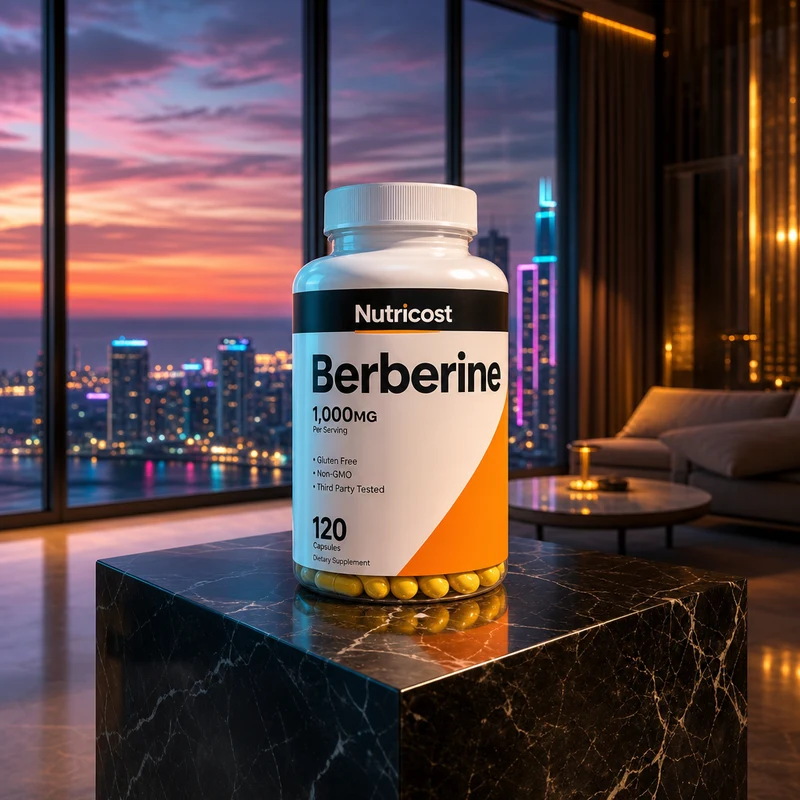
These picks are chosen by our independent editorial ranking; we may earn a commission if you buy through them — it never changes the scores.
Blood sugar — the flagship benefit
This is berberine's strongest, most-replicated effect. A meta-analysis of 37 RCTs (3,048 people) found it lowered HbA1c by about 0.63%, fasting glucose by roughly 15 mg/dL, and after-meal glucose by about 21 mg/dL — all statistically significant, and largest in people who start with higher glucose[1]. It works by activating AMPK, the cellular fuel-sensor, pulling glucose out of the blood the way metformin does. Reassuringly, the pooled data show it did not raise the risk of hypoglycemia on its own[1].
Blood sugar: real, metformin-class reductions
pooled reductions vs control across 37 RCTs (3,048 people) · HbA1c also fell 0.63% — a genuine effect, largest in people who start with higher glucose, on the scale of a metformin add-on rather than a miracle
Cholesterol & lipids
Berberine also improves the lipid panel, through a mechanism distinct from statins — it up-regulates the LDL receptor. The landmark Nature Medicine trial showed −25% LDL, −35% triglycerides and −29% total cholesterol over three months[5]. The honest caveat: that was a small early study (32 patients), and pooled meta-analyses land more modestly — an LDL drop closer to 15 mg/dL[6]. Real effect, just not always the headline magnitude.
Cholesterol: big drops in the landmark trial
reduction over 3 months in the Nature Medicine trial that first mapped berberine's cholesterol mechanism · honest caveat: these are from a small early study — pooled meta-analyses land more modestly (LDL roughly −15 mg/dL)
Berberine vs metformin — the honest comparison
The “natural metformin” nickname is earned by mechanism (both activate AMPK) and by one trial: in a head-to-head study, berberine's glucose-lowering was similar to metformin over three months[2]. But “similar in one ~30-patient trial” is not “interchangeable.” Metformin is FDA-approved, costs about $4/month, and has decades of cardiovascular-outcome and mortality datathat berberine simply doesn't have. Berberine is the rational choice when you don't have prescription access or are at the pre-diabetes stage — not a reason to drop a prescribed metformin dose. Never swap without your doctor.
PCOS — a metabolic tool, not a fertility drug
For the insulin-resistance side of PCOS, berberine has real support: it improved insulin sensitivity, BMI and waist-to-hip ratio comparably to metformin over three months, with a more favourable lipid profile[11]. The honest limit: a meta-analysis found berberine did notimprove live-birth rates versus placebo or metformin[12]. So it's a lever for the metabolic and cycle-regularity side of PCOS — not a fertility treatment — and it must be stopped once pregnancy is confirmed, because it's contraindicated in pregnancy.
The weight-loss truth — ‘Nature's Ozempic’ is a myth
This is the claim that put berberine on TikTok, and it's the one the evidence doesn't support. A dose-response meta-analysis found berberine did not significantly reduce body weight (−0.11 kg, p=0.79) — only small changes in waist circumference and BMI[7] — and a second meta-analysis agreed body weight was unchanged[8]. For scale: semaglutide (Ozempic / Wegovy) produces roughly 12–15% body-weight lossthrough an appetite-suppressing GLP-1 mechanism berberine doesn't share — an order of magnitude more. Berberine can improve the metabolic environment, which may nudge body composition over months, but calling it “Nature's Ozempic” is marketing, not science.
Weight: barely moves — 'Nature's Ozempic' is a myth
pooled change vs control · body weight did NOT change significantly; only waist and BMI shift a little. This is nothing like a GLP-1 drug — semaglutide produces ~12–15% body-weight loss through a different (appetite) mechanism
Longevity — promising by mechanism
AMPK is one of the conserved aging pathways, and activating it pharmacologically extends lifespan in worms, flies and mice — which is why the longevity community treats berberine as a metformin-class lever. But be clear about the evidence tier: there are no human lifespan trials(there won't be for decades). The case rests on berberine reproducibly improving the biomarkers that predict longevity — glucose, insulin, triglycerides, LDL, visceral fat. Promising and mechanistically coherent, but inferred, not proven.
Who benefits most
Berberine rewards a specific profile: pre-diabetics and insulin-resistant adults, people with metabolic syndrome(high waist, triglycerides, fasting glucose), women managing the metabolic side of PCOS, and those with elevated LDL who don't yet need a statin. It does far less for metabolically healthy people — it corrects dysfunction rather than optimising a normal system. See the honest side-effect & safety picture before you start — the drug interactions matter — and the full data report for every number and source.
How long until it works
Berberine's metabolic effects build over weeks, in a staggered order. After-meal glucose spikes blunt first (2–4 weeks); fasting glucose drops by 4–8 weeks; lipids and a confirmed HbA1c change take about 12 weeks (HbA1c lags because it reflects a 3-month blood-sugar average)[1,5]. Start low and ramp to limit the GI side effects. Worried about the risks first? See the honest safety picture →
How long until it works
typical time to a measurable effect — the metabolic benefits build over weeks, in a staggered order
Benefit myths vs. facts
| The myth | What the evidence shows | Source |
|---|---|---|
| Berberine is 'Nature's Ozempic' | False. Pooled trials show body weight barely moves — one dose-response meta found −0.11 kg, not statistically significant, and a second meta agreed. Semaglutide produces ~12–15% body-weight loss through a completely different (appetite/GLP-1) mechanism. Berberine's real action is on blood sugar and lipids, not fat mass. | [7,8] |
| Berberine can replace metformin | Overstated. In one small head-to-head trial its glucose-lowering was similar to metformin — but that was roughly 15 vs 16 patients over 3 months, and metformin has decades of cardiovascular-outcome and mortality data that berberine entirely lacks. Never swap a prescribed metformin dose for berberine without your doctor. | [2] |
| The pricey dihydroberberine / phytosome forms work better | Not proven. They genuinely raise blood levels 5–10× in small pharmacokinetic studies — but no trial shows they beat cheap berberine HCl on any real outcome (glucose, lipids, weight), and a DHB pilot showed no glucose change at all. The entire efficacy evidence base is on plain HCl. | [14,15] |
| Berberine drops your LDL 25% | In one small landmark trial, yes (−25% LDL, −35% triglycerides). But that was 32 patients; pooled meta-analyses land more modestly, around −15 mg/dL LDL. A real lipid effect — just don't expect the headline number. | [5,6] |
| Berberine lowers blood pressure | Unproven. One meta-analysis found a modest systolic drop (~5 mmHg) but no diastolic effect, and a 2025 meta found no blood-pressure effect at all. It is not an established antihypertensive — treat any BP benefit as a bonus, not a reason to take it. | [9,10] |
Frequently asked questions
What is berberine best for?
Blood sugar and lipids. Across 37 RCTs (3,048 people) berberine lowered HbA1c by about 0.63% and fasting glucose meaningfully, and it improves cholesterol and triglycerides. It activates AMPK — the same pathway as metformin — which is why it's called the 'natural metformin.' It is NOT a weight-loss drug: pooled trials show body weight barely changes.
Is berberine 'Nature's Ozempic'?
No — that's the biggest myth about it. Meta-analyses show berberine does not significantly reduce body weight (about −0.11 kg, not significant), with only small waist and BMI changes. Semaglutide produces ~12–15% body-weight loss through an appetite-suppressing mechanism berberine doesn't share. Berberine improves the metabolic environment, which may help body composition slowly — but it is not a GLP-1 substitute.
Can berberine replace metformin?
Not on your own. In one small head-to-head trial its glucose-lowering was similar to metformin over 3 months — but that was about 30 patients, and metformin is FDA-approved, costs ~$4/month, and has decades of cardiovascular-outcome data berberine lacks. Never swap a prescribed metformin dose for berberine without your doctor.
Does berberine help PCOS?
It helps the metabolic side of PCOS. Berberine improved insulin sensitivity, BMI and waist-to-hip ratio comparably to metformin in a 3-month trial, with a better lipid profile. But a meta-analysis found it did NOT improve live-birth rates versus placebo or metformin, so it's a metabolic tool, not a fertility treatment — and it must be stopped once pregnancy is confirmed.
How much berberine should I take?
500 mg two to three times a day with meals (1,000–1,500 mg/day total) — the dose the trials used. Ramp up from once daily over two weeks to limit loose stools, and never take more than 500 mg in one sitting. Plain berberine HCl is the evidence-backed form; dihydroberberine or phytosome forms are better absorbed but not proven to work better.
Sources
- Xie W, Su F, Wang G, et al. Glucose-lowering effect of berberine on type 2 diabetes: a systematic review and meta-analysis. Front Pharmacol. 2022;13:1015045. PMID 36467075
- Yin J, Xing H, Ye J. Efficacy of berberine in patients with type 2 diabetes mellitus. Metabolism. 2008;57(5):712–717. PMID 18442638
- Zhang Y, Li X, Zou D, et al. Treatment of type 2 diabetes and dyslipidemia with the natural plant alkaloid berberine. J Clin Endocrinol Metab. 2008;93(7):2559–2565. PMID 18397984
- Liang Y, Xu X, Yin M, et al. Effects of berberine on blood glucose in patients with type 2 diabetes mellitus: a systematic literature review and meta-analysis. Endocr J. 2019;66(1):51–63. PMID 30393248
- Kong W, Wei J, Abidi P, et al. Berberine is a novel cholesterol-lowering drug working through a unique mechanism distinct from statins. Nat Med. 2004;10(12):1344–1351. PMID 15531889
- Lan J, Zhao Y, Dong F, et al. Meta-analysis of the effect and safety of berberine in the treatment of type 2 diabetes mellitus, hyperlipemia and hypertension. J Ethnopharmacol. 2015;161:69–81. PMID 25498346
- Xiong P, Niu L, Talaei S, et al. The effect of berberine supplementation on obesity indices: a dose-response meta-analysis and systematic review of randomized controlled trials. Complement Ther Clin Pract. 2020;39:101113. PMID 32379652
- Amini MR, Sheikhhossein F, Naghshi S, et al. Effects of berberine and barberry on anthropometric measures: a systematic review and meta-analysis of randomized controlled trials. Complement Ther Med. 2020;49:102337. PMID 32147051
- Zamani M, Zarei M, Nikbaf-Shandiz M, et al. The effects of berberine supplementation on cardiovascular risk factors in adults: a systematic review and dose-response meta-analysis. Front Nutr. 2022;9:1013055. PMID 36313096
- Liu D, et al. Efficacy and safety of berberine on the components of metabolic syndrome: a systematic review and meta-analysis. Front Pharmacol. 2025. PMID 40740996
- Wei W, Zhao H, Wang A, et al. A clinical study on the short-term effect of berberine in comparison to metformin on the metabolic characteristics of women with polycystic ovary syndrome. Eur J Endocrinol. 2012;166(1):99–105. PMID 22019891
- Xie L, Zhang D, Ma H, et al. The effect of berberine on reproduction and metabolism in women with polycystic ovary syndrome: a systematic review and meta-analysis of randomized control trials. Evid Based Complement Alternat Med. 2019;2019:7918631. PMID 31915452
- Liu CS, Zheng YR, Zhang YF, Long XY. Research progress on berberine with a special focus on its oral bioavailability. Fitoterapia. 2016;109:274–282. PMID 26851175
- Moon JM, Ratliff KM, Hagele AM, et al. Absorption kinetics of berberine and dihydroberberine and their impact on glycemia: a randomized, controlled, crossover pilot trial. Nutrients. 2021;14(1):124. PMID 35010998
- Petrangolini G, Ronchi M, Frattini E, et al. Development of an innovative berberine food-grade formulation with an ameliorated absorption: in vitro evidence and human pharmacokinetics. Evid Based Complement Alternat Med. 2021;2021:7563889. PMID 34904017
- Wu X, Li Q, Xin H, Yu A, Zhong M. Effects of berberine on the blood concentration of cyclosporin A in renal transplanted recipients: clinical and pharmacokinetic study. Eur J Clin Pharmacol. 2005;61(8):567–572. PMID 16133554
- Chan E. Displacement of bilirubin from albumin by berberine. Biol Neonate. 1993;63(4):201–208. PMID 8513024
- Pérez-Rubio KG, González-Ortiz M, Martínez-Abundis E, et al. Effect of berberine administration on metabolic syndrome, insulin sensitivity, and insulin secretion. Metab Syndr Relat Disord. 2013;11(5):366–369. PMID 23808999